Check patentability & draft patents in minutes with Patsnap Eureka AI!

Halogen-free flame-retardant thermoplastic elastomer material for wire and cable and preparation method thereof

A thermoplastic elastomer, wire and cable technology, applied in the field of wire and cable materials, can solve the problems of poor weather resistance, complex processing of rubber materials, poor aging resistance, etc., to achieve good processing performance and anti-aging performance, good system mechanics Performance, the effect of improving high temperature resistance

Active Publication Date: 2019-03-08
ANHUI ZHONGDING RUBBER PLASTIC PROD CO LTD
View PDF5 Cites 0 Cited by
  • Summary
  • Abstract
  • Description
  • Claims
  • Application Information

AI Technical Summary

Problems solved by technology

In addition, the processing of rubber materials is complicated, and the leftover materials cannot be recycled, which will easily cause secondary pollution
Among them, the advantage of PVC resin is that it has a cost advantage. However, the cable processed by this material is easy to crack at low temperature, easy to stick at high temperature, has poor aging resistance and is not environmentally friendly; the cable product processed by cross-linked polyethylene material has endowment In order to achieve good mechanical properties, environmental stress cracking resistance, chemical resistance and electrical properties, the existing problems are poor weathering resistance and insufficient processing performance; therefore, in addition to considering the performance advantages of the material, it is also necessary to Actively develop environment-friendly materials and produce environment-friendly wires and cables
[0003] In recent years, thermoplastic elastomers have made great progress. Various types of thermoplastic elastomers have been introduced on the market, but there are still various problems in thermoplastic elastomer materials used in wire and cable. The application of polyphenylene ether provides a good Flame retardant and electrical insulation properties, but the disadvantages of polyphenylene ether, such as high viscosity, poor processability, and insufficient yellowing resistance, limit its application in the wire and cable industry
The patent publication number is CN102414274A. The Chinese patent application discloses the preparation of a kind of wire and cable material based on thermoplastic elastomer and adding polyphenylene ether and flame retardant. However, the flame retardant material has great limitations; the patent publication number is CN102414274A Chinese patent application publishes the method for preparing halogen-free flame retardant wire and cable materials, although polyphenylene ether is also added to improve the flame retardant effect, but due to the addition of crosslinked ethyl alcohol Propylene rubber is difficult to disperse in the whole system, and its high temperature resistance and mechanical properties are also difficult to meet the requirements

Method used

the structure of the environmentally friendly knitted fabric provided by the present invention; figure 2 Flow chart of the yarn wrapping machine for environmentally friendly knitted fabrics and storage devices; image 3 Is the parameter map of the yarn covering machine
View more

Image

Smart Image Click on the blue labels to locate them in the text.
Viewing Examples
Smart Image
  • Halogen-free flame-retardant thermoplastic elastomer material for wire and cable and preparation method thereof

Examples

Experimental program
Comparison scheme
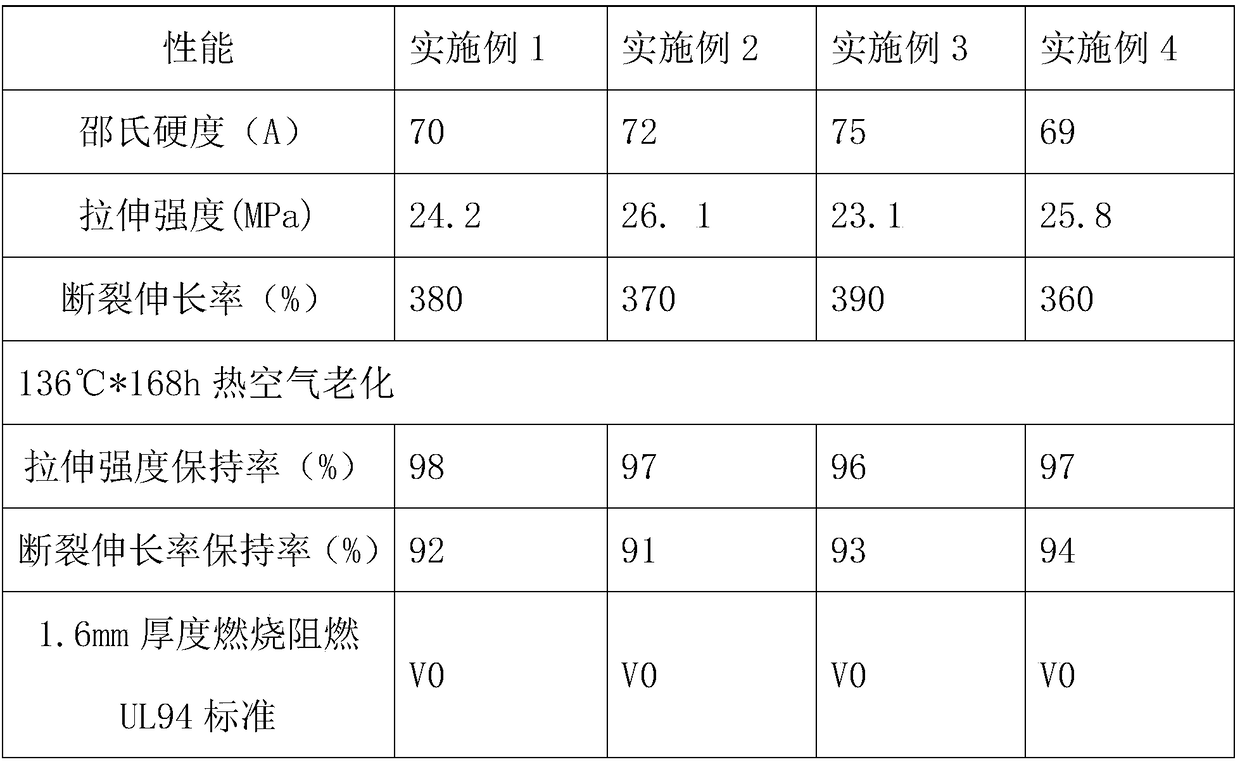
Effect test

Embodiment 1

[0023] A halogen-free flame-retardant thermoplastic elastomer material for wire and cable, the raw materials of which include by weight: 20 parts of SEBS, 15 parts of thermoplastic vulcanized elastomer, 2 parts of CS801 resin, 35 parts of halogen-free flame retardant, polyphenylene ether 15 parts, 3 parts of hydrogenated thermoplastic styrene-butadiene rubber-maleic anhydride grafts, 2 parts of calcium carbonate powder, 15 parts of saturated linear alkanes, 0.1 part of antioxidant 168;

[0024] Wherein, the halogen-free flame retardant is composed of 55% organic phosphate and 45% melamine polyphosphate by weight percentage; and the preparation process of the organic phosphate comprises: adding graphite powder into acetic acid and stirring evenly, Stir and react at 120°C for 12 hours, dry and grind to obtain acidified intercalated graphite for later use; add phosphorus oxychloride and pentaerythritol to anhydrous acetonitrile and stir evenly, then raise the temperature to 50°C und...

Embodiment 2

[0028] A halogen-free flame-retardant thermoplastic elastomer material for wire and cable, the raw materials of which include by weight: 40 parts of SEBS, 5 parts of thermoplastic vulcanized elastomer, 5 parts of M-80 resin, 15 parts of halogen-free flame retardant, poly 30 parts of (2,6-dimethyl-1,4-phenylene) ether, 1 part of hydrogenated thermoplastic styrene-butadiene rubber-methyl methacrylate graft, 15 parts of talcum powder, 8 parts of naphthenic oil, anti- Oxygen 1010 0.5 parts;

[0029] Wherein, the halogen-free flame retardant is composed of 65% organic phosphate and 35% melamine polyphosphate by weight percentage, and the preparation process of the organic phosphate includes: adding graphite powder into acetic acid and stirring evenly, Stir and react at 140°C for 10 hours, dry and grind to obtain acidified intercalated graphite for later use; add phosphorus oxychloride and pentaerythritol to anhydrous acetonitrile and stir evenly, and raise the temperature to 60°C u...

Embodiment 3

[0033] A halogen-free flame-retardant thermoplastic elastomer material used for electric wires and cables, its raw materials include by weight: 30 parts of SEBS, 10 parts of thermoplastic vulcanized elastomer, 3 parts of Endex160 resin, 25 parts of halogen-free flame retardant, poly(2 , 22 parts of 6-dimethyl-1,4-phenylene) ether, 2 parts of compatibilizer, 9 parts of wollastonite powder, 11 parts of saturated linear alkane, 0.3 part of antioxidant 168;

[0034] Wherein, the halogen-free flame retardant is composed of 60% organic phosphate and 40% melamine polyphosphate by weight percentage, and the preparation process of the organic phosphate includes: adding graphite powder into acetic acid and stirring evenly, Stir and react at 130°C for 11 hours, dry and grind to obtain acidified intercalated graphite for later use; add phosphorus oxychloride and pentaerythritol to anhydrous acetonitrile and stir evenly, then raise the temperature to 55°C under nitrogen protection, and stir...

the structure of the environmentally friendly knitted fabric provided by the present invention; figure 2 Flow chart of the yarn wrapping machine for environmentally friendly knitted fabrics and storage devices; image 3 Is the parameter map of the yarn covering machine
Login to View More

PUM

PropertyMeasurementUnit
retention rateaaaaaaaaaa
Login to View More

Abstract

The invention discloses a halogen-free flame-retardant thermoplastic elastomer material for wires and cables. The material comprises, by weight, 20-40 parts of SEBS, 5-15 parts of thermoplastic vulcanized elastomer, 2-5 parts of aromatic monomer resin, 15-35 parts of a halogen-free flame retardant, 15-30 parts of polyphenyl ether, 1-3 parts of a compatilizer, 2-15 parts of an inorganic filler, 8-15 parts of filling oil and 0.1-0.5 part of an antioxidant, wherein the halogen-free flame retardant is composed of, by weight, 55-65% of organic phosphate and 35-45% of melamine polyphosphate. The thermoplastic elastomer material is resistant to high temperature, good in mechanical performance, high in processability, good in flame-retardant performance, halogen-free, low in toxicity and environment-friendly.

Description

technical field [0001] The invention relates to the technical field of wire and cable materials, in particular to a halogen-free flame-retardant thermoplastic elastomer material used for wires and cables and a preparation method thereof. Background technique [0002] As the problem of environmental pollution becomes more and more prominent, people are gradually paying attention to environmental protection, and the wire and cable industry is no exception, and it is bound to face the requirements for environmental protection. The environmental protection of the wire and cable industry is mainly the environmental protection of cable materials. At present, a large number of polymer chemical materials such as rubber, polyvinyl chloride, and polyethylene are used in the production of wire and cable, and a large amount of toxic and harmful gases are produced during the production process. In addition, the processing of rubber materials is complicated, and the leftovers cannot be re...

Claims

the structure of the environmentally friendly knitted fabric provided by the present invention; figure 2 Flow chart of the yarn wrapping machine for environmentally friendly knitted fabrics and storage devices; image 3 Is the parameter map of the yarn covering machine
Login to View More

Application Information

Patent Timeline
no application Login to View More
Patent Type & Authority Patents(China)
IPC IPC(8): C08L53/02C08L23/12C08L23/06C08L23/16C08L23/08C08K13/06C08K9/04C08K3/04C08K3/26C08K3/34C08K5/3492C08K5/521
CPCC08L53/025C08L2201/02C08L2201/22C08L2203/202C08L2205/035C08L23/12C08L23/16C08L71/12C08K13/06C08K9/04C08K2003/265C08K3/04C08K5/34928C08K5/521C08L23/06C08L23/0815C08K3/34
Inventor 夏玉洁曹春林任福海吴章柱陈恩军许峰宋乔方毅明
Owner ANHUI ZHONGDING RUBBER PLASTIC PROD CO LTD
Features
  • R&D
  • Intellectual Property
  • Life Sciences
  • Materials
  • Tech Scout
Why Patsnap Eureka
  • Unparalleled Data Quality
  • Higher Quality Content
  • 60% Fewer Hallucinations
Social media
Patsnap Eureka Blog
Learn More