
Catalyst for producing aromatics from synthesis gas and method of use thereof
A synthesis gas and catalyst technology, applied in molecular sieve catalysts, chemical instruments and methods, physical/chemical process catalysts, etc., can solve problems such as low yield of aromatic hydrocarbons, and achieve the effects of improving the yield of aromatic hydrocarbons, improving efficiency, and simplifying the preparation process.
- Summary
- Abstract
- Description
- Claims
- Application Information
AI Technical Summary
Problems solved by technology
Method used
Image

Examples
Embodiment 1
[0035] After weighing 539 grams of ferric nitrate, 182.5 grams of manganese nitrate (50%), 11.7 grams of lanthanum nitrate and 500 grams of water, mix them uniformly, precipitate with 500 grams of concentrated ammonia water (25%), and after aging for 12 hours at room temperature, wash , centrifuged, dried at 120°C for 8 hours, and calcined at 550°C for 6 hours to obtain Fe-Mn oxide solid. Weigh 72.1 g Fe-Mn oxide solid, impregnate 42 g containing 0.53 g K 2 CO 3 Aqueous solution, dried at 120°C for 6 hours, calcined at 500°C for 4 hours to obtain Fe composite component F-1.
[0036] Weigh 60 grams of ZSM-5 molecular sieves (the molar ratio of silicon oxide to aluminum oxide is 400), impregnate with 116 grams of aqueous solution containing 36.7 grams of zinc nitrate and 16.2 grams of phosphoric acid (85%), and after aging for 4 hours at room temperature MZ1 was obtained by drying at 120°C for 8 hours and calcining at 600°C for 6 hours.
[0037] Weigh 40 grams of F-1, 40 gram...
Embodiment 2-7
[0040] F2-F9 were prepared by the same method as in Example 1, and their compositions are listed in Table 1.
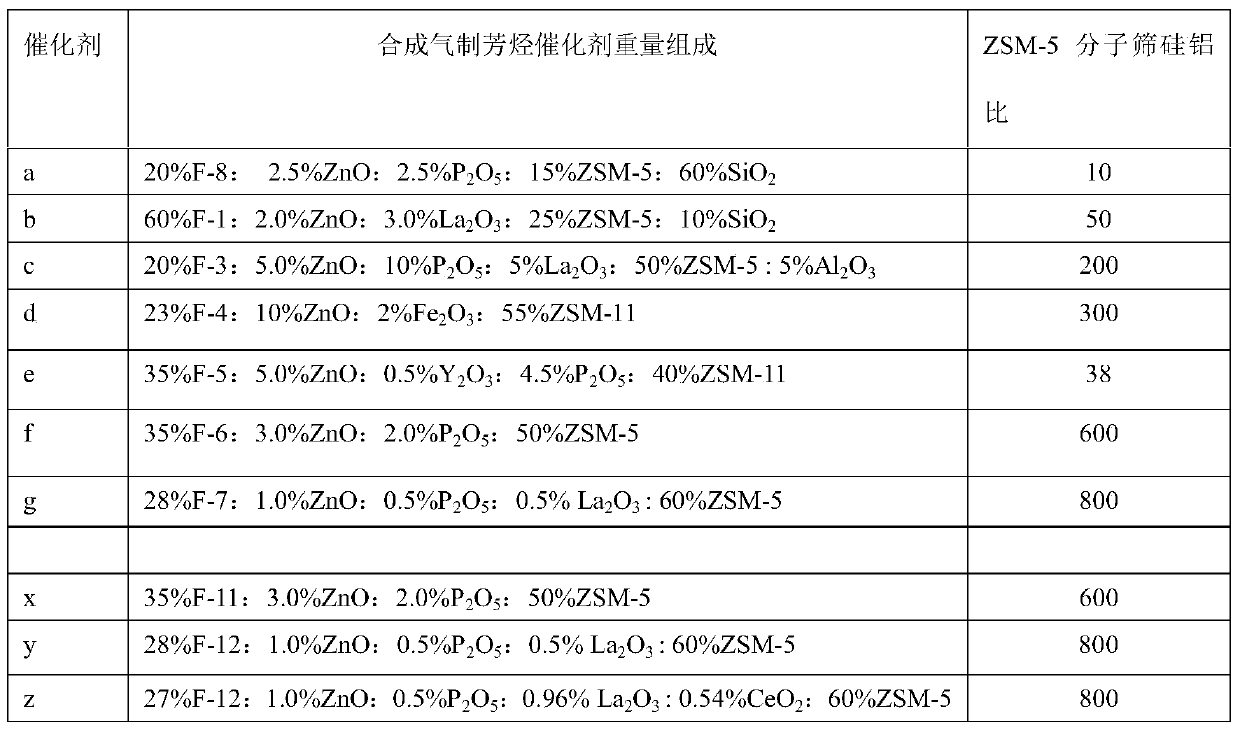
[0041] Catalysts b to i were prepared by the same method as in Embodiment 1, and the evaluation method was the same as in Embodiment 1.
[0042] Catalyst components and evaluation results are listed in Table 2 and Table 3, respectively.
Embodiment 8-11
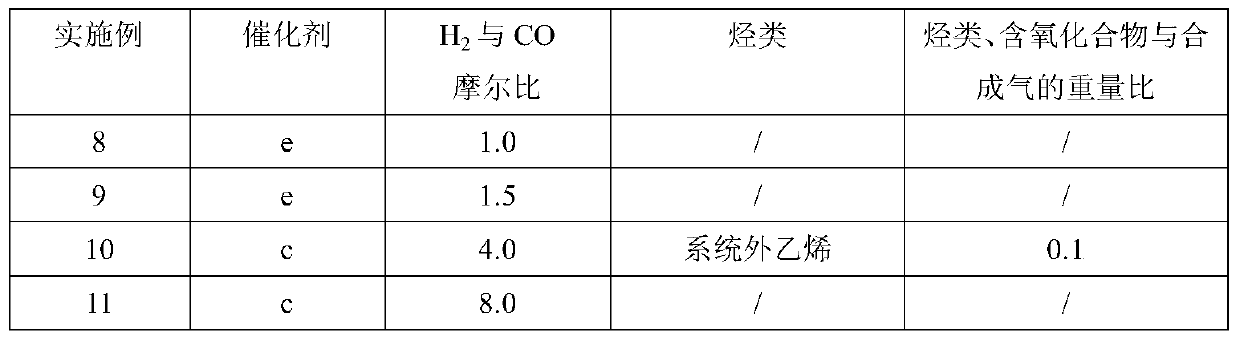
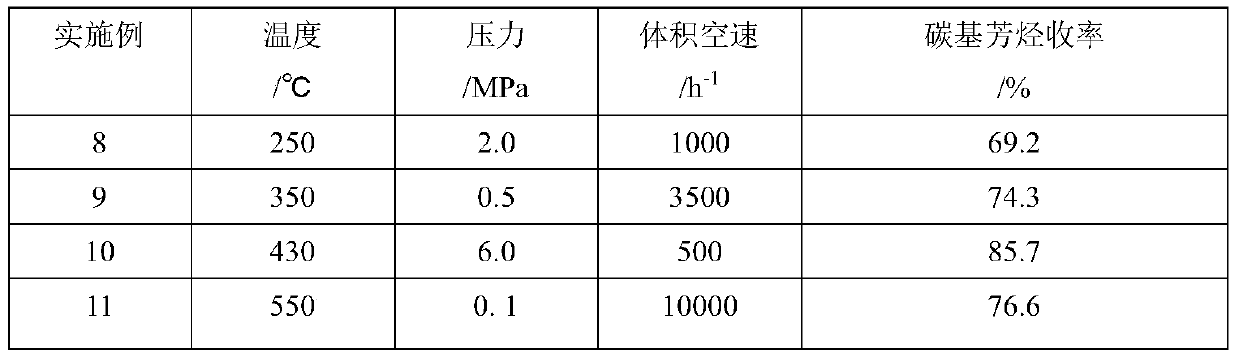
[0050] Using catalyst e, the evaluation conditions and evaluation results are shown in Table 4.
[0051] Table 1
[0052] Fe composite oxide
Weight composition (wt%)
F-1
74.7Fe: 20Mn: 0.3K: 5.0La
F-2
50Fe: 25Mn: 5Na: 10La
F-3
39.9Fe: 50Mn: 10Mg: 0.1La
F-4
58.5Fe: 35Mn: 4.0K: 2.5.0Ce
[0053] F-5
55.3Fe: 35.2Mn: 5.2Ca: 4.3Zn
F-6
50.4Fe: 38.7Mn: 6.0K: 2.0Ce: 2.9Si
F-7
65Fe: 25Mn: 4.8K: 2.0La: 2.2Ce: 1.0Ga
F11
50.4Fe: 38.7Mn: 6.0K: 2.9Si (weight ratio)
F12
65Fe: 25Mn: 4.8K: 1.0Ga (weight ratio)
[0054] Table 2
[0055]
[0056] table 3
[0057] Example
catalyst
Aromatics yield / %
1
a
69.7
2
b
72.3
3
c
71.0
4
d
70.2
5
e
79.2
6
f
59.7
7
g
56.8
8
h
63.2
9
i
57.6
comparative example
1
x
54.2
2
y
...
PUM
 Login to View More
 Abstract
Description
Claims
Application Information
 Login to View More