Check patentability & draft patents in minutes with Patsnap Eureka AI!

A Transversely Asymmetric Reflectionless Periodic Waveguide Microcavity Bandpass Filter

A technology of band-pass filter and periodic wave, applied in the direction of optical waveguide light guide, instrument, light guide, etc., can solve the problems of increasing system complexity and chip area, reducing production cost, unfavorable scale integration application, etc., and achieves compact size and structure Simple, size-reducing effect

Inactive Publication Date: 2019-02-19
NINGBO INST OF TECH ZHEJIANG UNIV ZHEJIANG
View PDF3 Cites 0 Cited by
  • Summary
  • Abstract
  • Description
  • Claims
  • Application Information

AI Technical Summary

Problems solved by technology

Although the reflected light can be effectively eliminated by devices such as circulators or isolators, this will inevitably increase the complexity of the system and the chip area, which is not conducive to large-scale integration applications and lower production costs.

Method used

the structure of the environmentally friendly knitted fabric provided by the present invention; figure 2 Flow chart of the yarn wrapping machine for environmentally friendly knitted fabrics and storage devices; image 3 Is the parameter map of the yarn covering machine
View more

Image

Smart Image Click on the blue labels to locate them in the text.
Viewing Examples
Smart Image
  • A Transversely Asymmetric Reflectionless Periodic Waveguide Microcavity Bandpass Filter
  • A Transversely Asymmetric Reflectionless Periodic Waveguide Microcavity Bandpass Filter
  • A Transversely Asymmetric Reflectionless Periodic Waveguide Microcavity Bandpass Filter

Examples

Experimental program
Comparison scheme
Effect test

Embodiment 1

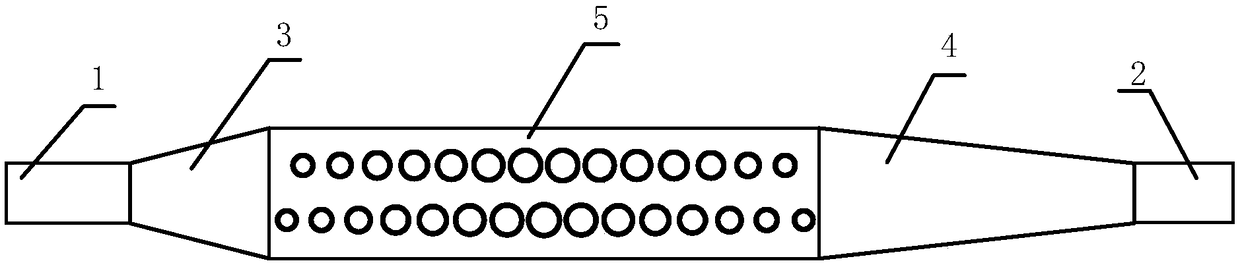
[0035] Below to figure 1 A specific implementation structure shown is illustrated by taking a silicon-on-insulator (Silicon on Silica) substrate widely used in silicon photonics technology as an example, and the thickness of silicon on the top layer of the substrate is 220nm.

[0036] The resonant frequency is calculated by the plane wave expansion method and the fabrication parameters of the device are determined. like figure 1 As shown, the periodic unit adopts an asymmetric double circular hole structure, that is, the horizontal positions of the upper and lower rows of small holes are staggered by half a period, so that the periodic waveguide unit is laterally asymmetric. At the same time, in order to design the resonant frequency of the microcavity at the edge of the second energy band, a small hole with a larger radius is used in the center of the microcavity, and the radius of the circular hole is gradually reduced to both sides of the microcavity. The resonance mode ...

Embodiment 2

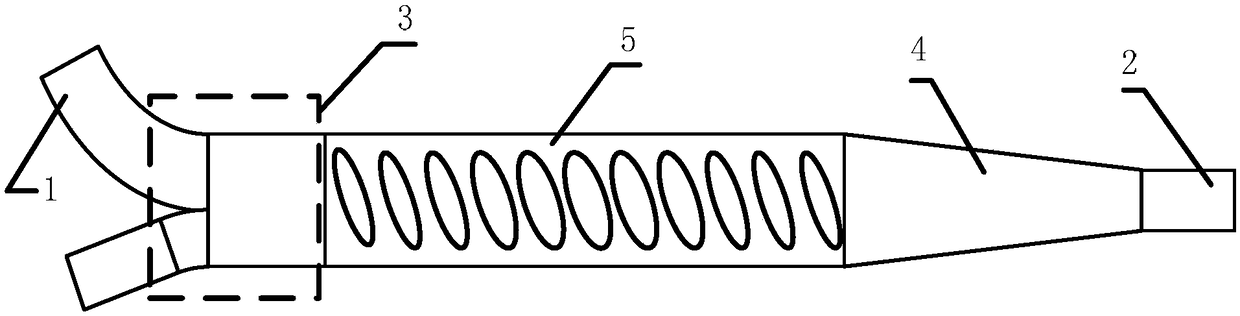
[0043] like figure 2 Shown is another embodiment in which the periodic unit adopts a single row of inclined ellipses and the high-order mode attenuator adopts asymmetrical Y bifurcations. The major axis of the ellipse forms a certain negative angle with the vertical direction to form a transverse asymmetric structure. After determining the periodic unit corresponding to the resonant frequency during design, optimize the waveguide width so that the propagation constant of the high-order mode of the reflected wave is the same as that of the other waveguide except the input port waveguide of the asymmetric Y bifurcation, so that the reflected wave can be coupled to the waveguide And completely lossy, achieving no reflection at input port 1.

Embodiment 3

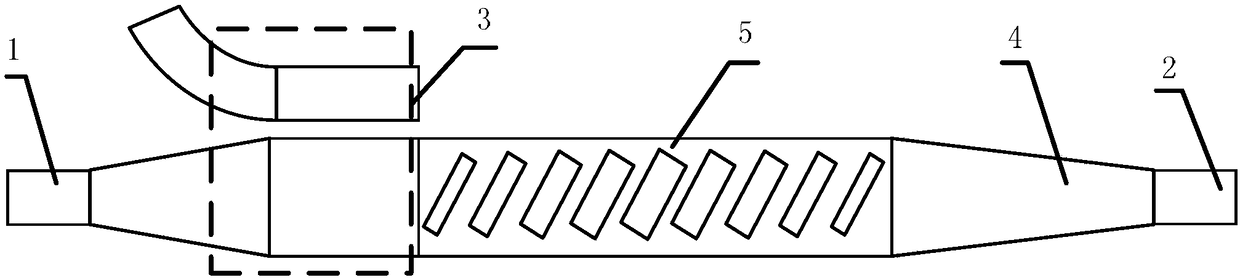
[0045] like image 3 Shown is an embodiment in which the periodic unit is a single row of oblique rectangular holes, and the high-order mode attenuator uses a directional coupler. In this embodiment, the long side of the rectangle forms a positive angle with the vertical direction to form a laterally asymmetric structure, and the propagation constant of the reflected high-order mode is similar to that of the waveguide on the other side of the directional coupler, so the reflected wave is coupled to the waveguide on the other side and lost, realizing Similar to Embodiment 1 and Embodiment 2, the effect of eliminating the reflection of input port 1 is achieved.

the structure of the environmentally friendly knitted fabric provided by the present invention; figure 2 Flow chart of the yarn wrapping machine for environmentally friendly knitted fabrics and storage devices; image 3 Is the parameter map of the yarn covering machine
Login to View More

PUM

No PUM Login to View More

Abstract

The invention discloses a transversely asymmetrical non-reflective periodic waveguide micro-cavity bandpass filter, comprising the following elements connected in succession: an input waveguide, a high order mode attenuator, an asymmetric unit periodic waveguide micro-cavity, a mode adjuster and an output waveguide. A signal light is inputted from the input waveguide; after the light wave at the resonant frequency of the asymmetric unit periodic waveguide micro-cavity passes the high order mode attenuator and the asymmetric unit periodic waveguide micro-cavity successively, it is then converted into a base mold that is outputted from the output waveguide; the light wave differing in the frequency from the resonant frequency of the asymmetric unit periodic waveguide micro-cavity is reflected by the asymmetric unit periodic waveguide micro-cavity and converted into a high order mode, and then is lost rapidly through the high order mode attenuator to realize the input of waveguide non-reflective light. According to the invention, the light wave at the resonant frequency of an asymmetric unit periodic waveguide micro-cavity can be outputted from the frequency selection by the periodic waveguide micro-cavity and the reflection of the light wave at the non-resonant frequency is lost rapidly to obtain a non-reflective periodic waveguide micro-cavity bandpass filter.

Description

technical field [0001] The invention relates to an integrated optical filter device, in particular to a laterally asymmetric non-reflection periodic waveguide microcavity band-pass filter in the field of optical waveguide devices. Background technique [0002] Optical filter is one of the core components of optical communication, on-chip optical interconnection and other technologies. In recent years, due to the urgent need for large-capacity communications, low-cost, chip-based waveguide filters have developed rapidly. There have been quite a lot of research on integrated optical filters based on gratings, microring resonators, and microdisk resonators, which are widely used in optical routing, optical modulation, optical wavelength division multiplexing, and optical sensing. Optical filters have problems such as large device size and high power consumption, which are not conducive to large-scale integration on a chip. In order to integrate more devices on the same chip, ...

Claims

the structure of the environmentally friendly knitted fabric provided by the present invention; figure 2 Flow chart of the yarn wrapping machine for environmentally friendly knitted fabrics and storage devices; image 3 Is the parameter map of the yarn covering machine
Login to View More

Application Information

Patent Timeline
no application Login to View More
Patent Type & Authority Patents(China)
IPC IPC(8): G02B6/125G02B6/12
CPCG02B6/12007G02B6/125
Inventor 喻平吴成玉吴双卿孙炯赵祥红方伟
Owner NINGBO INST OF TECH ZHEJIANG UNIV ZHEJIANG
Features
  • R&D
  • Intellectual Property
  • Life Sciences
  • Materials
  • Tech Scout
Why Patsnap Eureka
  • Unparalleled Data Quality
  • Higher Quality Content
  • 60% Fewer Hallucinations
Social media
Patsnap Eureka Blog
Learn More