Gradient degradable biofilm scaffold material and preparation method thereof
A scaffold material, biofilm technology, applied in medical science, textiles and papermaking, prostheses, etc., can solve problems affecting the delivery of nutrients and metabolites, and difficulty in extracting or synthesizing bioactive factors, achieving superior performance, good biological Compatibility, effect of fast degradation rate
- Summary
- Abstract
- Description
- Claims
- Application Information
AI Technical Summary
Problems solved by technology
Method used
Image

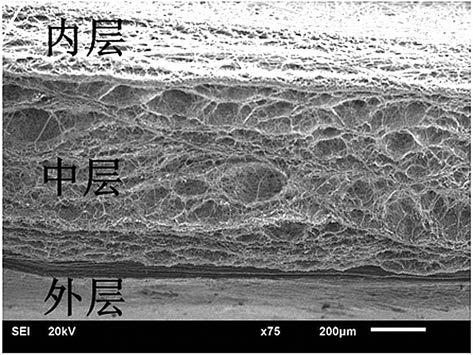
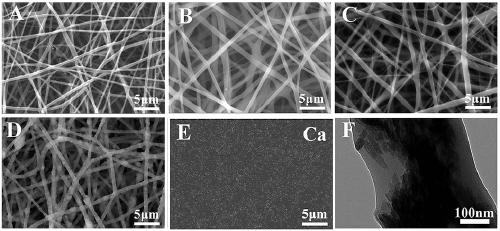
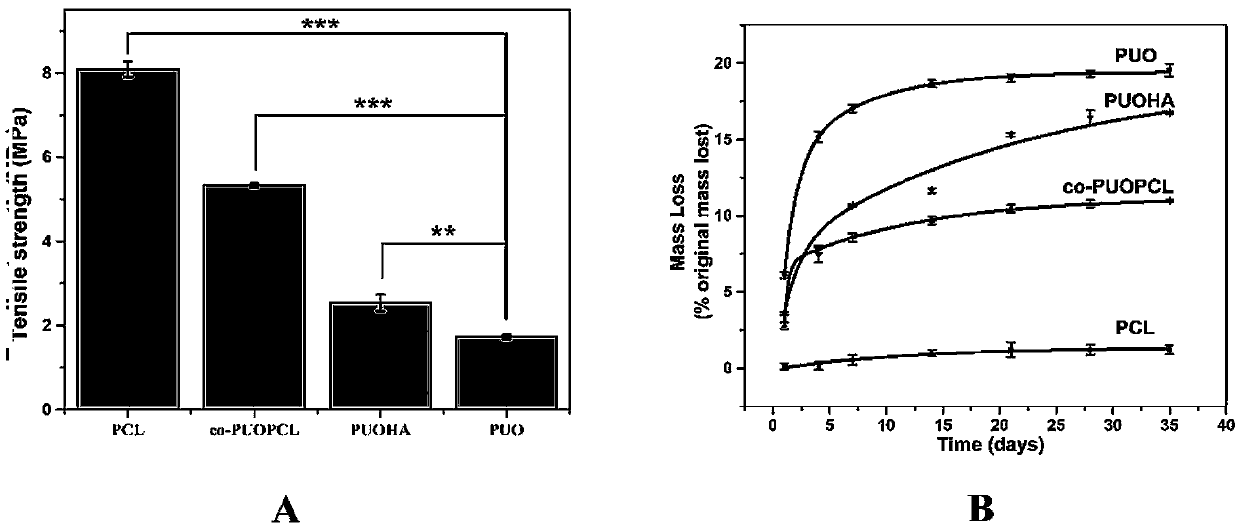
Examples
Embodiment 1
[0041] (1) Preparation of polycaprolactone (PCL) electrospinning solution
[0042] Weigh 0.6 g of PCL particles, dissolve in 5 mL of trifluoroethanol, add 1.2 mg of calcium chloride, and stir for 1 h to obtain polycaprolactone spinning solution.
[0043] (2) Preparation of polyurethane (PU) electrospinning solution
[0044]Polyurethane synthesis: 20g PCL (molecular weight 2000) and 11.1g isophorone diisocyanate (IPDI) (molecular weight 222.28) were pre-polymerized under mechanical stirring, nitrogen atmosphere, 75°C for 4 h, and then about 0.1 mL stannous octoate was added Continue to stir for 1 h, then add 5 g of lysine ethyl ester hydrochloride to continue the reaction for 3 h, then add about 0.1 mL of stannous octoate for 2 h, then add 10 mL of deionized water and place the reaction system at 90°C for 2 h , the target product of degradable medical polyurethane material can be obtained by cooling down at room temperature.
[0045] Composite polyurethane (PUO) electrospinni...
Embodiment 2
[0051] (1) Preparation of polycaprolactone electrospinning solution
[0052] Weigh 0.7 g of PCL particles, dissolve in 5 mL of trifluoroethanol, add 2.1 mg of calcium nitrate, and stir for 1 h to obtain polycaprolactone spinning solution.
[0053] (2) Preparation of polyurethane electrospinning solution and polyurethane / n-HA mixed electrospinning solution
[0054] Polyurethane synthesis: 20g PCL (molecular weight 2000) and 11.1g isophorone diisocyanate (IPDI) (molecular weight 222.28) were prepolymerized for 6 h under mechanical stirring, nitrogen atmosphere, and a temperature of 75°C; then about 0.15 mL stannous octoate was added Continue to stir for 1 h, then add 5 g of ethyl lysine hydrochloride to continue the reaction for 3 h, then add about 0.15 mL of stannous octoate to react for 3 h, then add 10 mL of deionized water and place the reaction system at 90°C for aging After cooling for 10 h at room temperature, the target product of degradable polyurethane was obtained. ...
Embodiment 3
[0065] (1) Preparation of polycaprolactone electrospinning solution
[0066] Weigh 0.8 g of PCL particles, dissolve in 5 mL of dichloromethane, add 3.2 mg of calcium bromide, and stir for 1 h to obtain polycaprolactone spinning solution.
[0067] (2) Preparation of composite polyurethane electrospinning solution
[0068] Polyurethane synthesis: 40 g polycaprolactone diol (molecular weight 4000) and 9.05 g lysine diisocyanate (LDI) (molecular weight 226.23) were prepolymerized under mechanical stirring, nitrogen atmosphere, and 40 °C for 10 h, and then about Stir 0.15 mL of stannous chloride for 2 h, then add 8 g of PEG (molecular weight 400) and continue to react for 4 h, then add about 0.15 mL of stannous chloride for 3 h, then add 8 mL of deionized water and place the reaction system at 70 The target product of degradable polyurethane can be obtained by aging at ℃ for 10 h and cooling down at room temperature.
[0069] Composite polyurethane spinning solution: Dissolve 1.8...
PUM
| Property | Measurement | Unit |
|---|---|---|
| diameter | aaaaa | aaaaa |
| thickness | aaaaa | aaaaa |
| thickness | aaaaa | aaaaa |
Abstract
Description
Claims
Application Information
 Login to View More
 - R&D
- Intellectual Property
- Life Sciences
- Materials
- Tech Scout
- Unparalleled Data Quality
- Higher Quality Content
- 60% Fewer Hallucinations
Browse by: Latest US Patents, China's latest patents, Technical Efficacy Thesaurus, Application Domain, Technology Topic, Popular Technical Reports.
© 2025 PatSnap. All rights reserved.Legal|Privacy policy|Modern Slavery Act Transparency Statement|Sitemap|About US| Contact US: help@patsnap.com