
A Diameter Measuring Device Based on Scissors
A technology of diameter measurement and scissors, which is applied in the field of diameter measurement devices based on scissors, can solve the problems of high requirements for the operating environment of the measurement object, inconvenient carrying, measurement, and limited range of measurement diameters, etc., to facilitate remote data collection , easy to implement and low cost
- Summary
- Abstract
- Description
- Claims
- Application Information
AI Technical Summary
Problems solved by technology
Method used
Image

Examples
Embodiment 1
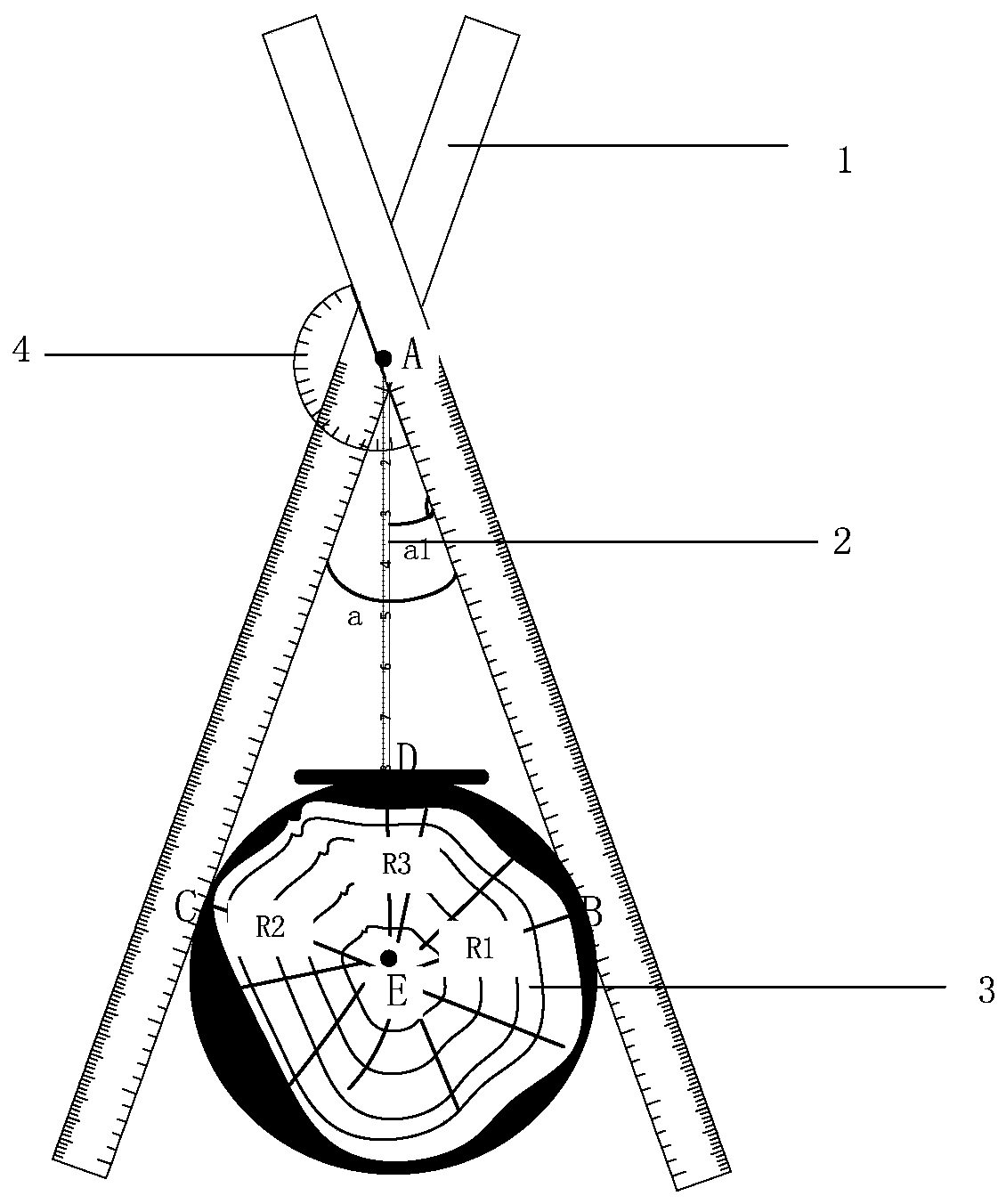
[0070] Embodiment 1: as figure 2 , a diameter measuring device based on scissors, including scissors 1, a straightedge and a protractor 4; the first end of the straightedge is connected with the hinge point A of the scissors, and the second end of the straightedge is used to connect with the measured Object (such as trunk 3) surface contact; The measured object is cylindrical or cylindrical;
[0071] Open the two arms of the scissors to clamp the measured object, and the second end of the ruler is in contact with the surface of the measured object;
[0072] The diameter Φ of the measured object is calculated based on the length of the ruler and the opening angle of the scissors measured by the protractor.
[0073] Described ruler is T-square 2.
[0074] The diameter of the measured object Φ=2R=2*L0*sin(a / 2) / [1-sin(a / 2)];
[0075] Where L0 is the length of the straightedge from the hinge point to the second end; generally the length of the straightedge is a fixed length.
...
Embodiment 2
[0080] Such as Figure 2-5 , a diameter measuring device based on scissors, comprising scissors (1), a ruler and a protractor (4); the first end of the ruler is connected with the hinge point A of the ruler, and the second end of the ruler is connected with In contact with the surface of the measured object; the measured object is cylindrical or cylindrical;
[0081] Open the two arms of the scissors to clamp the measured object, and the second end of the ruler is in contact with the surface of the measured object;
[0082] The diameter Φ of the measured object is calculated based on the length of the ruler and the opening angle of the scissors measured by the protractor.
[0083] Described ruler is T-square (2).
[0084] The diameter of the measured object Φ=2*(R1+R2+R3) / 3;
[0085] in:
[0086] R1 is the radius corresponding to the contact point D between the second end of the ruler and the surface of the measured object;
[0087] R2 is the radius corresponding to the p...
PUM
 Login to View More
 Abstract
Description
Claims
Application Information
 Login to View More