Reagents and methods for enriching circulating rare cells
A rare cell and nucleated cell technology, applied in the field of oncology, can solve problems such as high detection cost, complicated device operation, and inability to analyze samples
- Summary
- Abstract
- Description
- Claims
- Application Information
AI Technical Summary
Problems solved by technology
Method used
Image


Examples
Embodiment 1
[0101] Embodiment 1, the preparation of CRC microfluidic detection system
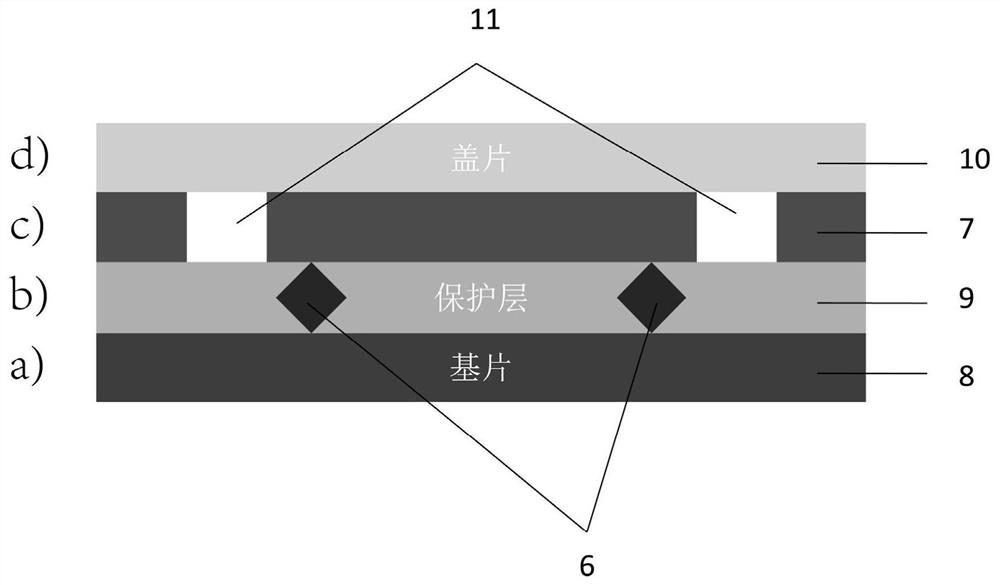
[0102] The core of the hardware part of the CRC microfluidic detection system of the present invention is a miniature metal conductor. By receiving the sorting signal of the CRC fluorescence detection component 5, the microthermal bubbles emitted from the microfluidic generator 6 are triggered to drive the microthermal bubbles in the cavity of the jet unit. The fluid ejected out of the cavity pushes the CRC just past the sorting node into the positive channel.
[0103] Its preparation process is as figure 2 As shown, at first the substrate 8 is provided, and the metal conductor (such as aluminum or copper) that the micro heat bubble occurs is processed on a silicon or glass substrate by photolithography technology, and a protective layer (such as silicon dioxide) is deposited thereon ( figure 2 Steps a), b)). At the same time, process the microfluidic structure on another glass cover slip 9, and bo...
Embodiment 2
[0105] Example 2, Screening of white blood cell fluorescently labeled antibodies
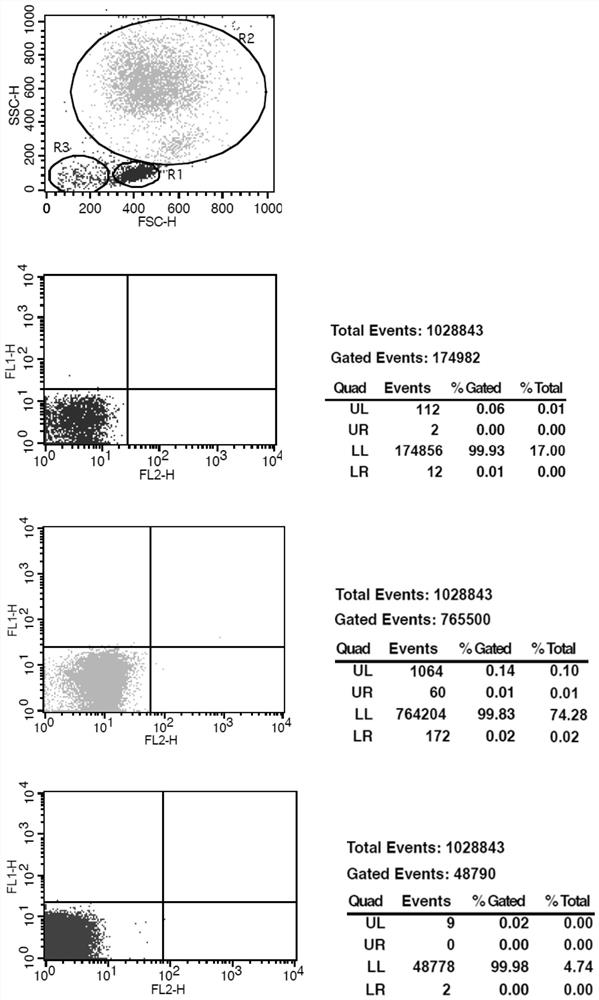
[0106] For the mixed sample of CRC and white blood cells after pretreatment, the key is how to effectively use multiple markers to remove white blood cells to the greatest extent and improve the recognition rate and specificity of CRC. The present inventors investigated the labeling efficiency of leukocytes by multiple CD fluorescent antibodies using flow cytometry.
[0107] Take two 3mL healthy human blood samples, the experimental steps are as follows:
[0108] (1) Removal of red blood cells: Dilute the whole blood with an equal amount of PBS and slowly add it to a centrifuge tube with an equal volume of histopaque, and centrifuge at 2000rpm for 30 minutes; after the blood is centrifuged, obtain the cell layer between the plasma and the red blood cell layer;
[0109] (2) Washing: Gently remove the cells from the cell layer of (1), add an equal amount of PBS to wash, centrifuge at 600g for 15m...
Embodiment 3
[0119] Embodiment 3, the establishment of the CRC microfluidic detection system of the present invention
[0120] like figure 1 , Establish the microfluidic detection device of the present invention. The microfluidic detection device includes a microfluidic structure 7, which includes a single cell channel that allows single cells to pass through at a stable flow rate. The single cell channel starts from the sample inlet 1, and there are multiple single cell channels downstream of it to allow single cells to pass through. For the shunting of cells, one channel leads to the CRC collection tube 3, and the other or more channels lead to the remaining cell collection tube 2; the fluorescence detection component 5 can identify each cell according to different fluorescent signals, and quickly confirm its identity. Determine whether to sort them in the next step; the micro-fluidic generator 6, which includes a miniature metal conductor, receives the sorting signal from the fluoresce...
PUM
 Login to View More
 Abstract
Description
Claims
Application Information
 Login to View More
 - R&D
- Intellectual Property
- Life Sciences
- Materials
- Tech Scout
- Unparalleled Data Quality
- Higher Quality Content
- 60% Fewer Hallucinations
Browse by: Latest US Patents, China's latest patents, Technical Efficacy Thesaurus, Application Domain, Technology Topic, Popular Technical Reports.
© 2025 PatSnap. All rights reserved.Legal|Privacy policy|Modern Slavery Act Transparency Statement|Sitemap|About US| Contact US: help@patsnap.com