Built-in magnetic steel hybrid excitation motor based on brushless AC excitation
A hybrid excitation motor, AC excitation technology, applied in synchronous motors with static armatures and rotating magnets, synchronous machine parts, magnetic circuit rotating parts, etc., can solve the problem of low space utilization, serious geometric constraints of the stator, Low power density, etc.
- Summary
- Abstract
- Description
- Claims
- Application Information
AI Technical Summary
Problems solved by technology
Method used
Image


Examples
Embodiment 1
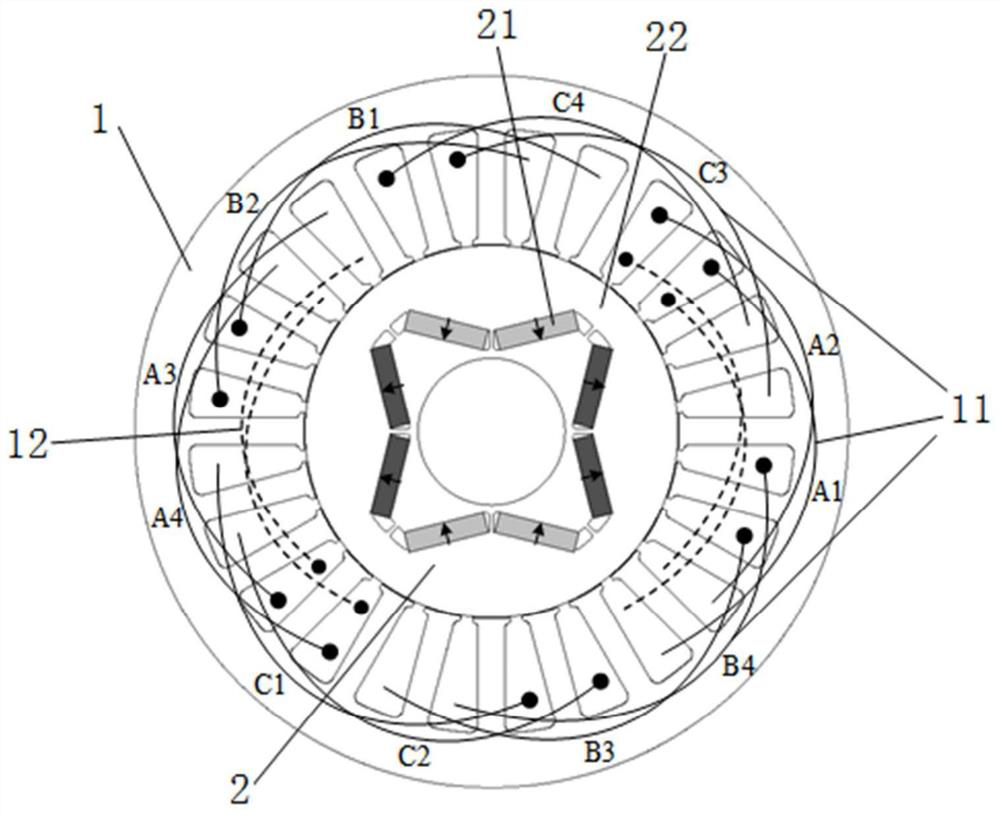
[0054]With three-phase inner rotor motor m=3, N s =24, p =2 as an example, where m represents the number of motor phases, N s Indicates the number of stator slots, and p indicates the number of pole pairs of the built-in magnetic steel rotor.
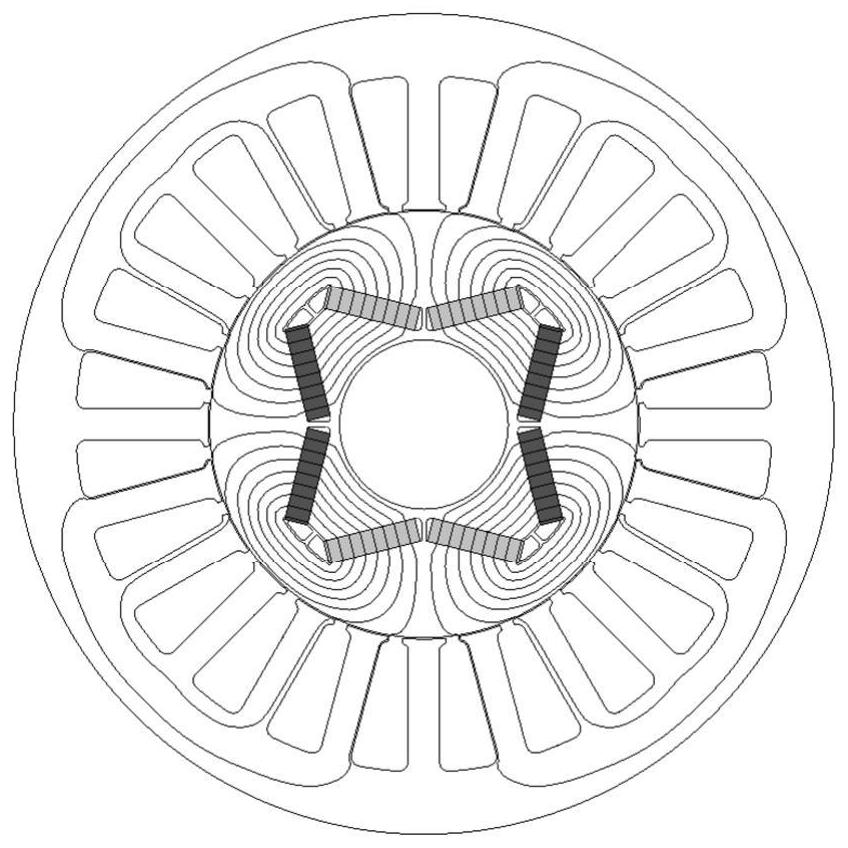
[0055] Such as figure 1 As shown, a hybrid excitation motor with built-in magnet steel based on brushless AC excitation includes a stator 1 and a built-in magnet steel rotor, and there is an air gap between the stator and the built-in magnet steel rotor.
[0056] The stator slots of the stator are respectively wound with an armature winding 11 and an AC field winding 12, both of which are AC windings, and the number of pole pairs of the armature winding is equal to the number of pole pairs of the AC field winding, and both are equal to the The pole pair number p of the magnetic steel rotor is 2.
[0057] The armature winding and the field winding are respectively wound on both sides of the stator slot in the stator. The relative ...
Embodiment 2
[0074] A magnetic barrier is set on the quadrature-axis magnetic circuit of the inner magnetic steel rotor in Embodiment 1 to reduce the influence of the armature reaction on the AC excitation magnetic field and the permanent magnetic field, and improve the output capacity of the motor.
[0075] The magnetic barriers in this embodiment 1 are surface cross-axis magnetic barriers 23, and the number of surface cross-axis magnetic barriers is 2p, which is 4 in this embodiment 2, and they are evenly arranged along the outer surface of the built-in magnetic steel rotor in the circumferential direction; as Figure 4 As shown, the purpose is to increase the air gap of the quadrature axis magnetic circuit. The cross-axis magnetic barrier is an air gap or a non-magnetically permeable material.
Embodiment 3
[0077] On the basis of Embodiment 2, 2p (that is, 4) strip-shaped built-in quadrature-axis magnetic barriers 24 are also arranged in the rotor core of the built-in magnetic steel rotor, and the strip-shaped built-in quadrature-axis magnetic barriers are arranged on each group of built-in magnetic steel on the axis of symmetry, such as Figure 5 shown. The bar-shaped built-in cross-axis magnetic barrier is an air gap or a non-magnetic material.
PUM
 Login to View More
 Abstract
Description
Claims
Application Information
 Login to View More
 - R&D
- Intellectual Property
- Life Sciences
- Materials
- Tech Scout
- Unparalleled Data Quality
- Higher Quality Content
- 60% Fewer Hallucinations
Browse by: Latest US Patents, China's latest patents, Technical Efficacy Thesaurus, Application Domain, Technology Topic, Popular Technical Reports.
© 2025 PatSnap. All rights reserved.Legal|Privacy policy|Modern Slavery Act Transparency Statement|Sitemap|About US| Contact US: help@patsnap.com