

Self-adaptive construction and decoding method based on random convolution network error correction codes
A random convolution and self-adaptive technology, applied in the field of network coding, can solve problems such as low complexity, and achieve the effect of low complexity, low coding complexity, and complexity reduction
- Summary
- Abstract
- Description
- Claims
- Application Information
AI Technical Summary
Problems solved by technology
Method used
Image

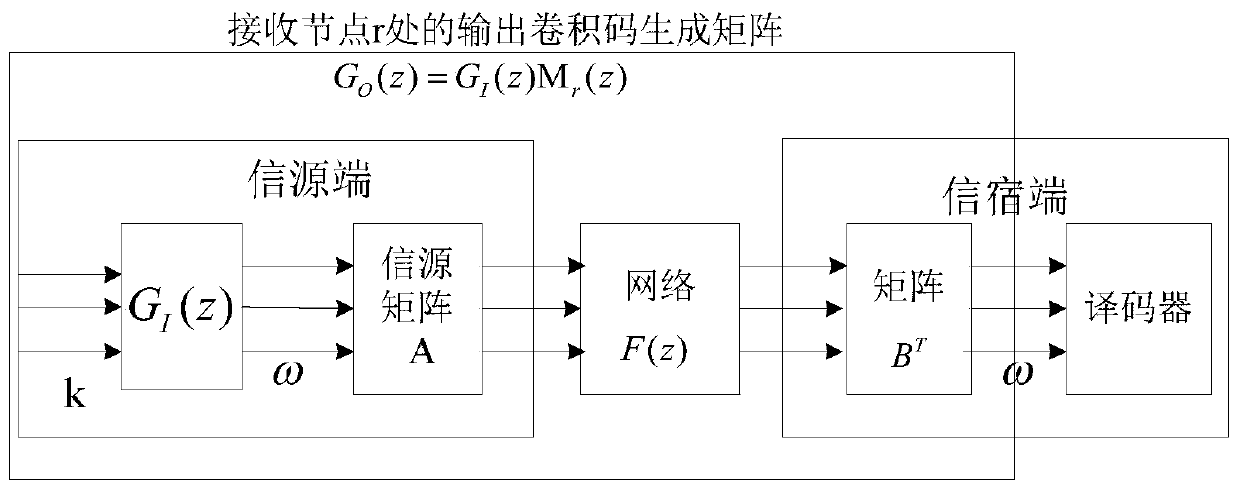


Examples
Embodiment 1
[0029] The essence of network coding is to allow intermediate nodes to perform forwarding operations after processing the received information. It has potential advantages in throughput, load balancing, security, etc., and has attracted widespread attention. Random Network Coding (RNC) allows intermediate nodes to randomly select coding coefficients in a finite field, and is suitable for networks with unknown topology. Convolutional network coding (CNC) allows nodes to combine information received from different input channels and different time slots, which is feasible for time-delayed networks.
[0030] The existing technology provides an algorithm for constructing error correction codes for convolutional networks. Although they have certain error correction capabilities, they are only suitable for coherent networks; subspace codes and rank distance codes are used for error correction in random networks, but they are complicated It is difficult to achieve because of the high de...
Embodiment 2
[0043] The adaptive construction and decoding method based on random convolutional network error correction codes are the same as in embodiment 1. The adaptive construction of random convolutional network coding described in step 1 includes the following steps:
[0044] The ω group of all zero data is sent to the network, so that the network starts to be self-adaptively constructed; the convolutional network coding is physically achievable if and only if the local coding kernel constant coefficient K 0 The corresponding coding topology is acyclic. The edges in the network are directed and numbered e i ,1≤i≤|E|, a pair of edges are marked as inflection points when the number is e'>e, that is, the number of edge e'is greater than e. The initial value of all local coding cores and global coding cores is 0. At time 0, for e′≥e, let the local coding core k e',e,0 =0, otherwise select from small domains uniformly and randomly. This initialization step ensures the local coding core K 0 ...
Embodiment 3
[0049] The adaptive construction and decoding method based on random convolutional network error correction codes are the same as those in embodiment 1-2. The adaptive construction of random convolutional network coding described in step 1 has the mathematical model of random convolutional network coding:
[0050] Convolutional network coding adopts adaptive random coding method, F r The information of (z) is transmitted to the receiving node according to the time slot along with the transmitted characters. The data generated by the source can be expressed as:
[0051] x(z)=x 0 +x 1 ·Z+…+x t-1 ·z t-1 +...,
[0052] The transmission matrix of the sink node r can be expressed as:
[0053] M r (z)=M r,0 +M r,1 z+…+M r,τ z τ +...,
[0054] The error-free output at each moment when passing through the random convolutional network should be:
[0055]
[0056] The error output corresponding to each moment is:
[0057]
[0058] Where z is the delay factor, x(z) is the input sequence, x t Is th...
PUM
 Login to View More
 Abstract
Description
Claims
Application Information
 Login to View More