Unlock instant, AI-driven research and patent intelligence for your innovation.

Method for inverting cloud micro-physical parameters through thermal infrared remote sensing

A thermal infrared remote sensing and physical parameter technology, which is applied in the field of cloud parameter inversion of satellite remote sensing data, can solve the problem of inability to invert night cloud microphysical parameters, etc., and achieves the effects of fast calculation speed, wide application range and high precision

Active Publication Date: 2020-01-14
INST OF REMOTE SENSING & DIGITAL EARTH CHINESE ACADEMY OF SCI
View PDF8 Cites 2 Cited by
  • Summary
  • Abstract
  • Description
  • Claims
  • Application Information

AI Technical Summary

Problems solved by technology

[0004] This application provides a method for inverting cloud microphysical parameters by thermal infrared remote sensing, which solves the problem that the existing technology cannot invert cloud microphysical parameters at night

Method used

the structure of the environmentally friendly knitted fabric provided by the present invention; figure 2 Flow chart of the yarn wrapping machine for environmentally friendly knitted fabrics and storage devices; image 3 Is the parameter map of the yarn covering machine
View more

Image

Smart Image Click on the blue labels to locate them in the text.
Viewing Examples
Smart Image
  • Method for inverting cloud micro-physical parameters through thermal infrared remote sensing
  • Method for inverting cloud micro-physical parameters through thermal infrared remote sensing
  • Method for inverting cloud micro-physical parameters through thermal infrared remote sensing

Examples

Experimental program
Comparison scheme
Effect test

Embodiment 1

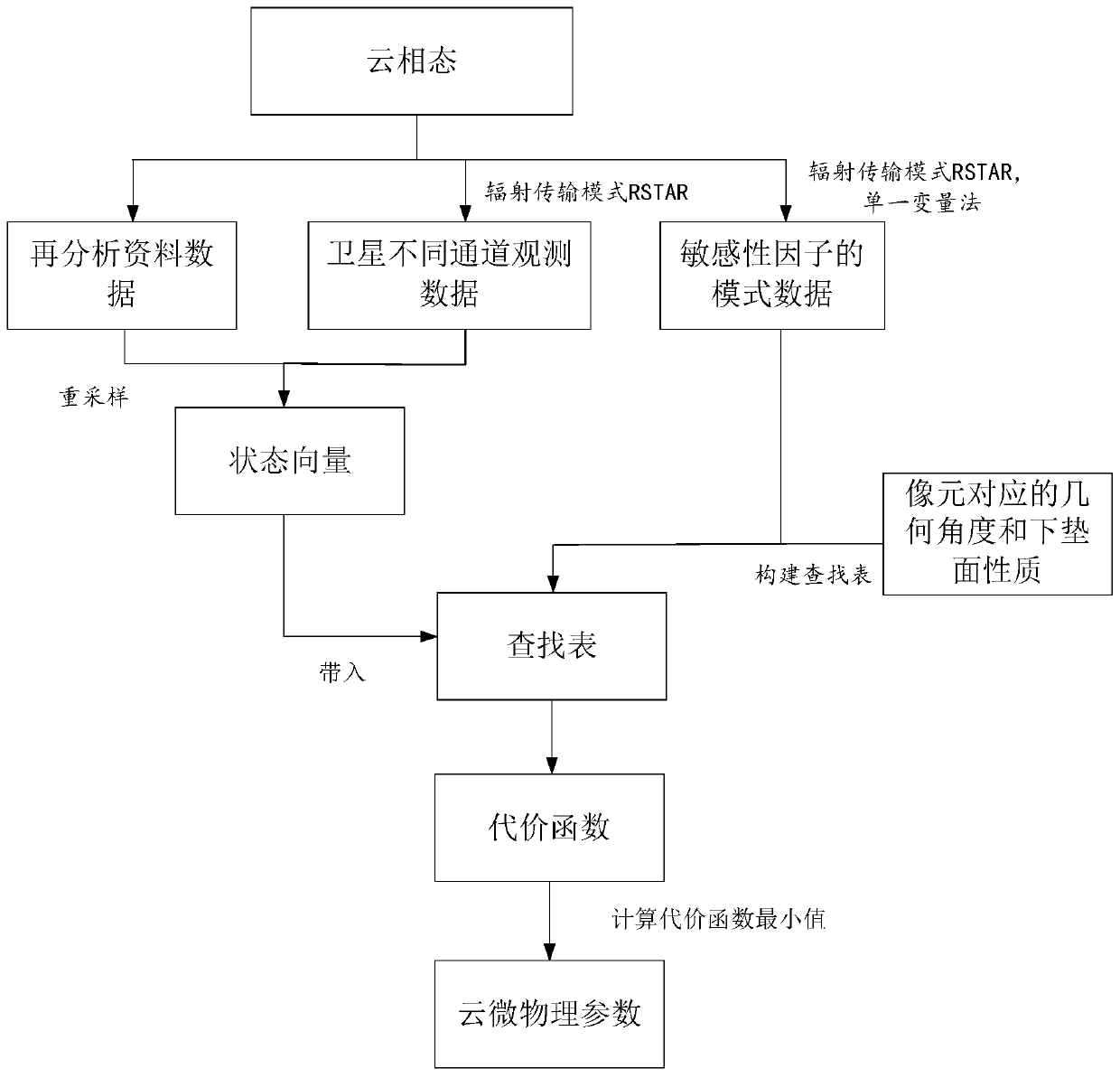
[0039] figure 2 It is a flowchart of a method for inverting cloud microphysical parameters by thermal infrared remote sensing.

[0040] The embodiment of the present application provides a method for inverting cloud microphysical parameters by thermal infrared remote sensing, comprising the following steps:

[0041] Step 101, using the radiative transfer model RSTAR to determine the sensitivity factors of the three channels of thermal infrared satellite channel data affecting cloud microphysical parameters.

[0042] The three channels are the three channels most sensitive to cloud microphysical parameters for satellites that obtain satellite channel data;

[0043] The thermal infrared satellite channel data is brightness temperature data, including the brightness temperature data of a single channel, and also includes the difference value of the brightness temperature data between channels. In the prior art, the visible light and near-infrared satellite channel data are ref...

Embodiment 2

[0070] image 3 It is a flow chart of another embodiment of the method for retrieving cloud microphysical parameters by thermal infrared remote sensing.

[0071] Step 101, using the radiative transfer model RSTAR to determine the sensitivity factors of thermal infrared satellite channel data affecting cloud microphysical parameters.

[0072] Step 102, selecting a plurality of typical band response function nodes on the band response function curve of the thermal infrared channel data as integration nodes.

[0073] The typical band response function node needs to achieve a dense satellite observation channel data integral value of 0.99.

[0074] Select several typical wavelengths on the band response function curve as the integration nodes to obtain the integration and the direct integration of the band response function of the satellite channel data. The similarity is greater than 0.99.

[0075] For example, the number of typical band response function nodes is about 30. In ...

Embodiment 3

[0080] Figure 4 It is a flow chart of the third embodiment of the method for retrieving cloud microphysical parameters for thermal infrared remote sensing.

[0081] Step 101, using the radiative transfer model RSTAR to determine the sensitivity factors of thermal infrared satellite channel data affecting cloud microphysical parameters.

[0082] Step 103, using the radiative transfer model RSTAR, simulating the sensitivity factor with a single variable method, and constructing a data set.

[0083] Step 104, according to the factor sensitivities of the sensitivity factors, use the data set to build a lookup table.

[0084] Step 105, resampling the reanalysis data according to the spatial resolution of the satellite channel data.

[0085] The purpose of the resampling is to make the horizontal resolution of the reanalysis data the same as that of the satellite channel data, so the reanalysis data can be resampled to make it have the same spatial resolution as the satellite cha...

the structure of the environmentally friendly knitted fabric provided by the present invention; figure 2 Flow chart of the yarn wrapping machine for environmentally friendly knitted fabrics and storage devices; image 3 Is the parameter map of the yarn covering machine
Login to View More

PUM

No PUM Login to View More

Abstract

The invention discloses a method for inverting cloud micro-physical parameters through thermal infrared remote sensing. The problem that in the prior art, night cloud micro-physical parameters cannotbe inverted is solved. The method comprises the following steps: determining a sensitivity factor of thermal infrared satellite channel data influencing cloud micro-physical parameters by using a radiation transmission mode RSTAR; simulating a sensitivity factor by using the radiation transmission mode RSTAR and a single variable method, and constructing a data set; constructing a lookup table byusing the data set according to the factor sensitivity of the sensitivity factor; and inputting the satellite channel data and the re-analysis data into a lookup table to calculate the cloud micro-physical parameters. Rapid and stable all-time cloud parameter detection is achieved, calculation is efficient, and the application range is wide. The method can be suitable for determining the cloud micro-physical parameters under the condition of no sunlight irradiation. The method can quickly and stably realize inversion of cloud micro-object parameters of satellite remote sensing data, and is high in calculation speed and high in precision.

Description

technical field [0001] The present application relates to the technical field of cloud parameter inversion of satellite remote sensing data, in particular to a method for inverting cloud microphysical parameters by thermal infrared remote sensing. Background technique [0002] Clouds cover about 50% of the Earth's surface and play an important role in the surface radiation budget, which in turn affects global climate patterns. The physical and optical properties of clouds have a great influence on the radiation budget of the earth-atmosphere system. Accurately obtaining the microphysical and optical properties of clouds is helpful to calculate the radiative properties of clouds. Cloud radiative properties are largely related to cloud optical thickness and effective particle radius, and the importance of inversion forms the basis of cloud radiative parameterization methods. [0003] The inversion of cloud microphysical parameters has been carried out for many years. Internat...

Claims

the structure of the environmentally friendly knitted fabric provided by the present invention; figure 2 Flow chart of the yarn wrapping machine for environmentally friendly knitted fabrics and storage devices; image 3 Is the parameter map of the yarn covering machine
Login to View More

Application Information

Patent Timeline
no application Login to View More
IPC IPC(8): G06F17/10
CPCG06F17/10
Inventor 胡斯勒图旭日尚华哲马润格根塔娜
Owner INST OF REMOTE SENSING & DIGITAL EARTH CHINESE ACADEMY OF SCI