Check patentability & draft patents in minutes with Patsnap Eureka AI!

Ligand modified perovskite optoelectronic devices

A perovskite and optoelectronic technology, applied in photovoltaic power generation, circuits, capacitors, etc., can solve problems that affect the separation and transmission of perovskite charges and increase the risk of unexpected impurities

Pending Publication Date: 2020-07-31
THE UNIVERSITY OF HONG KONG
View PDF5 Cites 5 Cited by
  • Summary
  • Abstract
  • Description
  • Claims
  • Application Information

AI Technical Summary

Problems solved by technology

Although improved stability, these methods incorporate insulating moieties on the perovskite lattice or film surface, which may affect the charge separation and transport process in the perovskite, or from the perovskite to the carrier transport layer. charge extraction
Furthermore, these methods are introduced during core device manufacturing, thus increasing the risk of introducing unintended impurities into the manufacturing process

Method used

the structure of the environmentally friendly knitted fabric provided by the present invention; figure 2 Flow chart of the yarn wrapping machine for environmentally friendly knitted fabrics and storage devices; image 3 Is the parameter map of the yarn covering machine
View more

Image

Smart Image Click on the blue labels to locate them in the text.
Viewing Examples
Smart Image
  • Ligand modified perovskite optoelectronic devices
  • Ligand modified perovskite optoelectronic devices
  • Ligand modified perovskite optoelectronic devices

Examples

Experimental program
Comparison scheme
Effect test

Embodiment approach 1

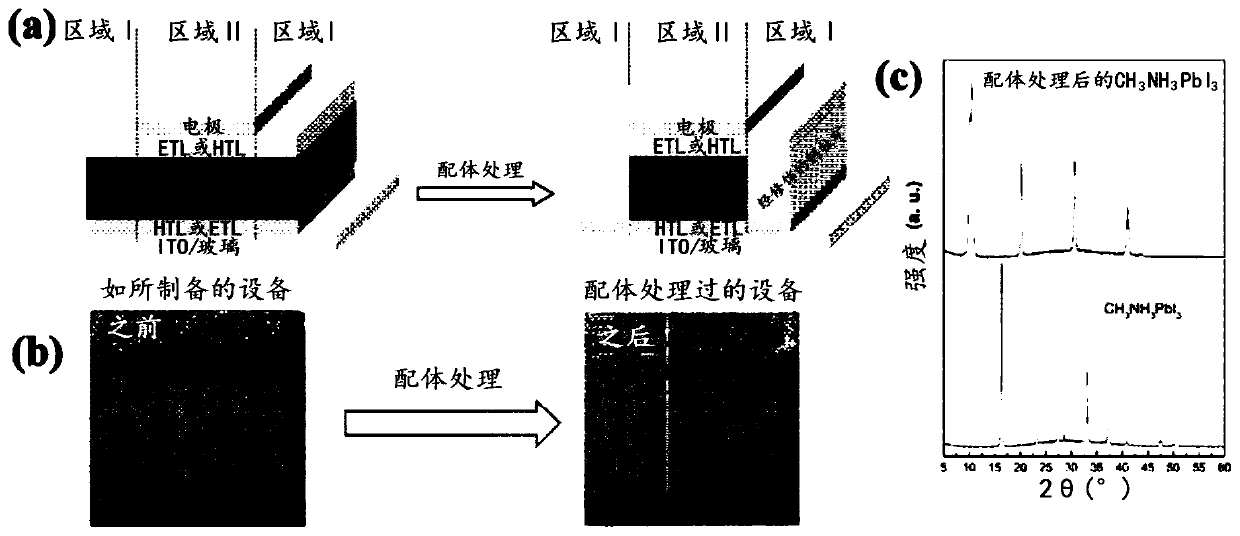
[0028] Embodiment 1. A ligand-induced processing method for a perovskite optoelectronic device, the method comprising:

[0029] create a ligand atmosphere;

[0030] exposing the perovskite optoelectronic device to the ligand atmosphere; and

[0031] The perovskite optoelectronic device is removed from the ligand atmosphere.

Embodiment approach 2

[0032] Embodiment 2. The method of Embodiment 1, wherein the ligand used to generate the ligand atmosphere is methylamine, dimethylamine, trimethylamine, ethylamine, diethylamine, triethylamine, ethylenediamine, diamine Ethylene triamine, propylamine, 1,3-diaminopropane, dipropylamine, tri-n-propylamine, isopropylamine, diisopropylamine, 1,2-dimethylpropylamine, 1,2-diaminopropane, diallyl base amine, cyclopropylamine, butylamine, dibutylamine, isobutylamine, sec-butylamine, 1,4-diaminobutane, tert-butylamine, diisobutylamine, pentylamine, hexylamine, 2-ethylhexylamine, Hexamethylenediamine, heptylamine, octylamine, tri-n-octylamine, 1,10-diaminodecane, N,N'-dimethylpropylenediamine, trimethylenediamine, N,N'- Dihexyltrimethylenediamine, decamethylenediamine, bis(trimethylene)triamine, bis(heptamethylene)triamine, triethylenetetramine, tripropylenetetramine, tetraethylenetetramine Pentaamine, pentaethylenehexamine, imidazoline, methylimidazoline, bis(aminoethyl)imidazoline, p...

Embodiment approach 3

[0033] Embodiment 3. The method of any of Embodiments 1-2, wherein the perovskite film of the PVSC is an organic-inorganic hybrid or inorganic material and has ABX 3 of the form, where A is CH 3 NH 3 +, HC (NH 2 ) 2 + , Cs + or any combination thereof; B is Pb, Sn, Bi, or any combination thereof; and X is I, Cl, Br, SCN, or any combination thereof.

the structure of the environmentally friendly knitted fabric provided by the present invention; figure 2 Flow chart of the yarn wrapping machine for environmentally friendly knitted fabrics and storage devices; image 3 Is the parameter map of the yarn covering machine
Login to View More

PUM

No PUM Login to View More

Abstract

A method of ligand-induced regional modification of a perovskite film of perovskite optoelectronic device can include generating a ligand atmosphere, exposing a perovskite optoelectronic device in theligand atmosphere, and removing the perovskite optoelectronic device from the ligand atmosphere. Methods for improving the performance and stability of perovskite optoelectronic devices are performedby using a ligand-induced modification of complete devices at room temperature. This post-device treatment, completely separated from the fabrication process of common perovskite optoelectronic devices, provides a general strategy to improve the stability of different completed perovskite optoelectronic devices (i.e., perovskite solar cells, perovskite light-emitting diodes, and photodetectors) without introducing any undesirable impurities during device fabrication.

Description

[0001] Background of the Invention [0002] Perovskite optoelectronic devices (e.g., perovskite solar cells, perovskite light-emitting diodes, and perovskite photodetectors) have attracted much attention due to their excellent high performance and expected low-cost fabrication. Recently, perovskite solar cells were demonstrated to achieve efficiencies of 22.1%, making them very promising candidates for next-generation photovoltaics. However, the stability of perovskite optoelectronic devices remains low due to the effects of moisture, oxygen, light, applied electric fields, thermal stress, and iodine vapor. Among them, moisture has been shown to be the most important factor leading to the decomposition of perovskites due to the strong interaction with water molecules. Some strategies to address this problem have been reported, such as forming a water-repellent layer, adding water-repellent additives, and using two-dimensional (2D) / three-dimensional (3D) perovskite hybrids. Whi...

Claims

the structure of the environmentally friendly knitted fabric provided by the present invention; figure 2 Flow chart of the yarn wrapping machine for environmentally friendly knitted fabrics and storage devices; image 3 Is the parameter map of the yarn covering machine
Login to View More

Application Information

Patent Timeline
no application Login to View More
Patent Type & Authority Applications(China)
IPC IPC(8): H01L51/42H01L31/00H10K99/00
CPCC03C17/42Y02E10/549Y02E10/542Y02P70/50H10K30/88H10K85/50H10K30/35H10K30/50C07F7/24H01G9/0036H01G9/2009H01G9/2018H10K30/30H10K30/81H10K71/12H10K85/30
Inventor C.H.W.蔡H.张
Owner THE UNIVERSITY OF HONG KONG
Features
  • R&D
  • Intellectual Property
  • Life Sciences
  • Materials
  • Tech Scout
Why Patsnap Eureka
  • Unparalleled Data Quality
  • Higher Quality Content
  • 60% Fewer Hallucinations
Social media
Patsnap Eureka Blog
Learn More