Check patentability & draft patents in minutes with Patsnap Eureka AI!

Method for calculating heat capacity of block material based on sound velocity and computer readable storage medium

A technology of bulk materials and sound velocity, applied in computer-aided design, calculation, design optimization/simulation, etc.

Active Publication Date: 2021-06-18
TSINGHUA UNIV
View PDF3 Cites 0 Cited by
  • Summary
  • Abstract
  • Description
  • Claims
  • Application Information

AI Technical Summary

Problems solved by technology

However, the Dulong-Petit law originated from the ideal gas state equation, which not only ignores the influence of the lattice vibration of the solid at low temperature, but also ignores the influence of the thermal expansion of the solid at high temperature
Therefore there are also certain limitations, such as overestimation of C at temperatures below room temperature p value, underestimated C at high temperature p value, it is difficult to calculate the C of the material for composite materials p Wait

Method used

the structure of the environmentally friendly knitted fabric provided by the present invention; figure 2 Flow chart of the yarn wrapping machine for environmentally friendly knitted fabrics and storage devices; image 3 Is the parameter map of the yarn covering machine
View more

Image

Smart Image Click on the blue labels to locate them in the text.
Viewing Examples
Smart Image
  • Method for calculating heat capacity of block material based on sound velocity and computer readable storage medium
  • Method for calculating heat capacity of block material based on sound velocity and computer readable storage medium
  • Method for calculating heat capacity of block material based on sound velocity and computer readable storage medium

Examples

Experimental program
Comparison scheme
Effect test

Embodiment 1

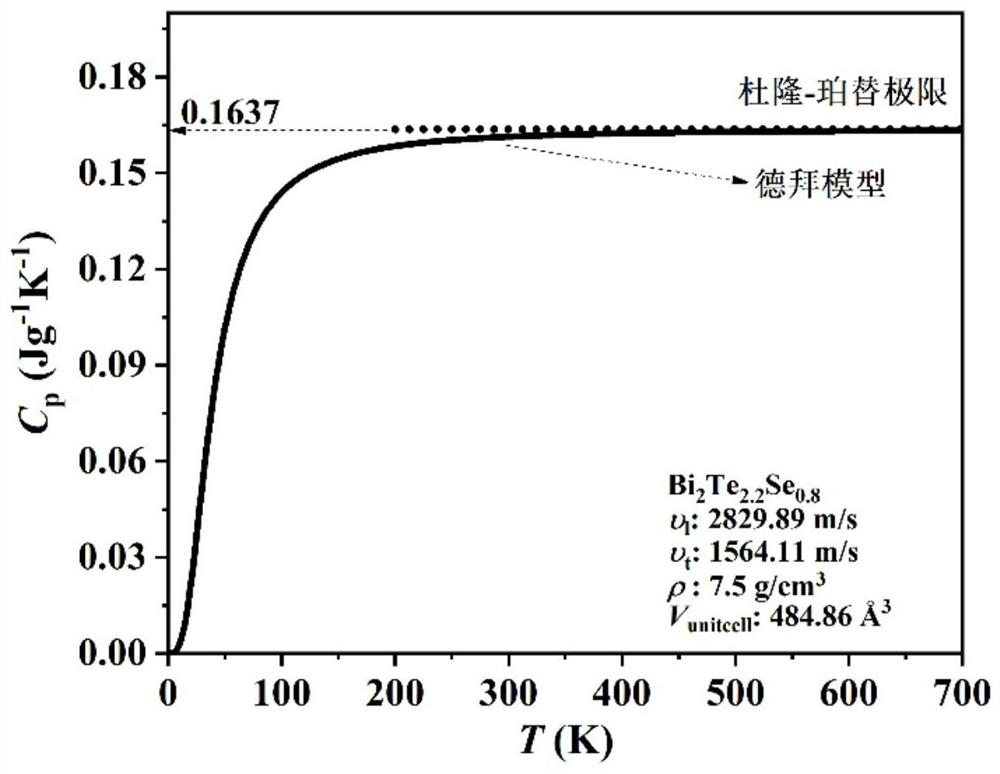
[0140] This embodiment tests and calculates Bi 2 Te2.2 Se 0.8 Sample C p , the test steps are as follows:

[0141] (1) will Bi 2 Te 2.2 Se 0.8 The sample is processed into a disc with a diameter of about 10 mm and a thickness of about 1 mm. The thickness of the wafer is 2.145mm, marked as d, and the thickness error of different positions of the wafer should be less than ±0.005mm.

[0142] (2) Place the processed wafer on the longitudinal wave / shear wave probe. In order to form a good contact between the probe and the sample, a thin layer of longitudinal wave / shear wave coupling agent should be applied between the probe and the sample;

[0143] (3) Turn on the ultrasonic generator and debug the oscilloscope. Periodic oscillation signals can be observed in the oscilloscope. Select n cycles, mark the start time of n cycles as t1 and end time as t2, then the time of a single cycle t=(t2-t1) / 2.

[0144] (4) Calculate the longitudinal sound velocity v of the above-mentioned ...

Embodiment 2

[0151] This embodiment tests and calculates Bi 0.4 Sb 1.6 Te 3 Sample C p , the test procedure is the same as in Example 1, and the thickness of the sample is 1.017mm. Figure 6 for the same Bi 0.4 Sb 1.6 Te 3 5 repeated test results of the sample shear wave sound velocity and longitudinal wave sound velocity, it can be seen from the figure that the relative standard deviation of the multiple measurement results is about 0.5%. Adopt the method described in this embodiment to measure Bi 0.4 Sb 1.6 Te 3 Sample C p The result is as Figure 7 Its relative standard deviation is shown in Table 2. When temperature is 1-20K, embodiment 2 records Bi 0.4 Sb 1.6 Te 3 C p The relative standard deviation is 1-2%. Further increasing the temperature, the relative standard deviation decreases rapidly, above room temperature, the relative standard deviation is less than 1%.

[0152] Table 2

[0153]

Embodiment 3

[0155] This embodiment tests and calculates Mg 3.2 Sb 1.5 Bi 0.49 Te 0.01 Sample C p , the test procedure is the same as in Example 1, and the thickness of the sample is 1.019mm. Figure 8 for the same Mg 3.2 Sb 1.5 Bi 0.49 Te 0.01 5 repeated test results of the sample shear wave sound velocity and longitudinal wave sound velocity, it can be seen from the figure that the relative standard deviation of the multiple measurement results is less than 1%. Adopt the method described in this embodiment to measure Mg 3.2 Sb 1.5 Bi 0.49 Te 0.01 Sample C p The result is as Figure 9 Its relative standard deviation is shown in Table 3. When temperature is 1-20K, embodiment 3 records Mg 3.2 Sb 1.5 Bi 0.49 Te 0.01 C p The relative standard deviation is 1-2%. Further increasing the temperature, the relative standard deviation decreases rapidly, above room temperature, the relative standard deviation is less than 1%.

[0156] table 3

[0157]

the structure of the environmentally friendly knitted fabric provided by the present invention; figure 2 Flow chart of the yarn wrapping machine for environmentally friendly knitted fabrics and storage devices; image 3 Is the parameter map of the yarn covering machine
Login to View More

PUM

No PUM Login to View More

Abstract

The invention discloses a method for calculating the heat capacity of a block material based on sound velocity and a computer readable storage medium. The method comprises the following steps: (1) calculating the heat capacity Cp of a to-be-tested sample according to a formula (100); (2) calculating CH and ph according to a formula (12), and calculating CD according to a formula (13); (3) calculating [theta]D according to a formula (14); (4) calculating va according to a formula (15); (5) calculating Va according to a formula (16); and (6) calculating BT according to a formula (17). The method is not only based on the lattice vibration theory, but also based on the lattice expansion theory, the measured result is more reasonable, the data repeatability is very good, the relative standard deviation of multiple tests is about 1%, and the Cp test time is short and only needs several minutes.

Description

technical field [0001] The invention relates to the technical field of heat capacity, in particular, the invention relates to a method for calculating the heat capacity of a bulk material based on sound velocity and a computer-readable storage medium. Background technique [0002] Heat capacity C p is an important thermodynamic parameter to reasonably evaluate the C of the material p is of great significance. C p The definition can be given by Q=C p mΔT, where Q represents the heat absorbed by the sample, m represents the mass of the sample, and ΔT represents the temperature difference generated by the sample after absorbing the heat Q. The method of directly measuring Q and ΔT according to the definition can measure C very intuitively p , but it is rarely used in actual tests, because the sample has thermal effects such as radiation, convection, and heat transfer at high temperatures that affect the accurate measurement of Q. Therefore, in order to reduce the test err...

Claims

the structure of the environmentally friendly knitted fabric provided by the present invention; figure 2 Flow chart of the yarn wrapping machine for environmentally friendly knitted fabrics and storage devices; image 3 Is the parameter map of the yarn covering machine
Login to View More

Application Information

Patent Timeline
no application Login to View More
Patent Type & Authority Applications(China)
IPC IPC(8): G06F30/20G06F119/08G06F119/14
CPCG06F30/20G06F2119/08G06F2119/14
Inventor 李敬锋裴俊
Owner TSINGHUA UNIV
Features
  • R&D
  • Intellectual Property
  • Life Sciences
  • Materials
  • Tech Scout
Why Patsnap Eureka
  • Unparalleled Data Quality
  • Higher Quality Content
  • 60% Fewer Hallucinations
Social media
Patsnap Eureka Blog
Learn More