
Application of reagent for detecting IgA immune complex
A technology of immune complexes and reagents, applied in the field of immune detection, can solve the problems of low specificity of IgA nephropathy, lack of specific markers, missing correlation of patients, etc., and achieve the effect of wide application prospects
- Summary
- Abstract
- Description
- Claims
- Application Information
AI Technical Summary
Problems solved by technology
Method used
Image

Examples
Embodiment 1
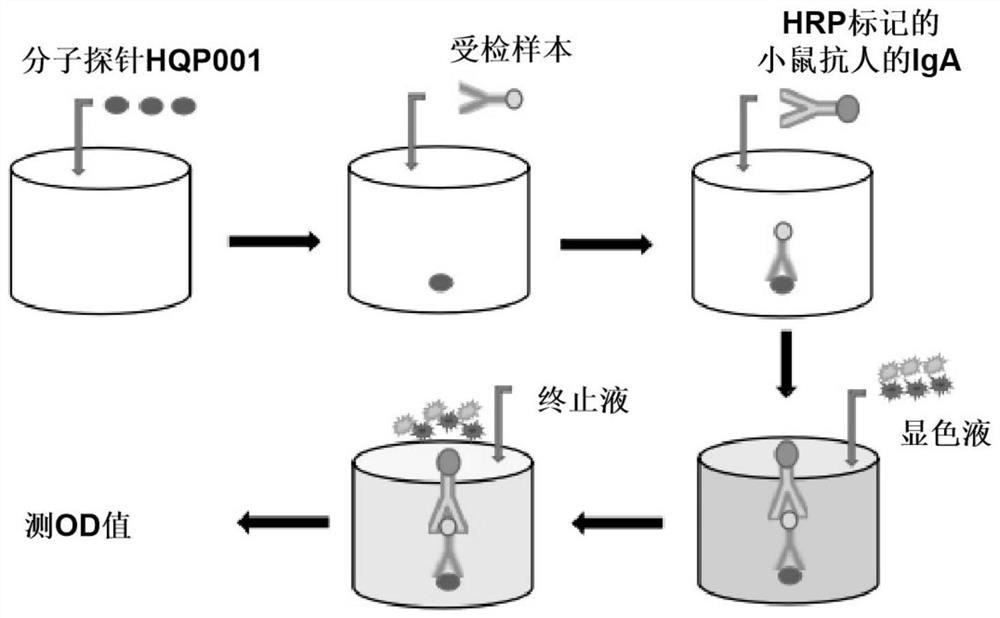
[0057] This example provides a reagent for detecting IgA immune complexes (IgA immune activity index is characterized by detecting the concentration of IgA immune complexes, and the IgA immune activity index refers to the concentration of IgA immune complexes in serum / plasma) The kit includes a molecular probe named HQP001, and the molecular probe HQP001 is the Fc receptor protein (FCAR or CD89) of IgA.
[0058] The above kit includes: molecular probe HQP001 lyophilized powder, coating buffer, ELISA plate, standard substance, enzyme-labeled secondary antibody, chromogenic solution, stop solution, washing solution, diluent and blocking solution.
[0059] Among them, molecular probe HQP001 freeze-dried powder is recombinant FCAR protein freeze-dried powder;
[0060] The coating buffer is 0.05M carbonate buffer (pH=9.6);
[0061] 96-well plate was selected for the microplate plate;
[0062] The standard is commercial human serum IgA;
[0063] The enzyme-labeled secondary antib...
Embodiment 2
[0074] In this example, the kit proposed in Example 1 is used to detect the IgA immune activity index in the peripheral blood serum of patients diagnosed with renal puncture (IgA nephropathy), so as to verify the diagnosis result of renal puncture.
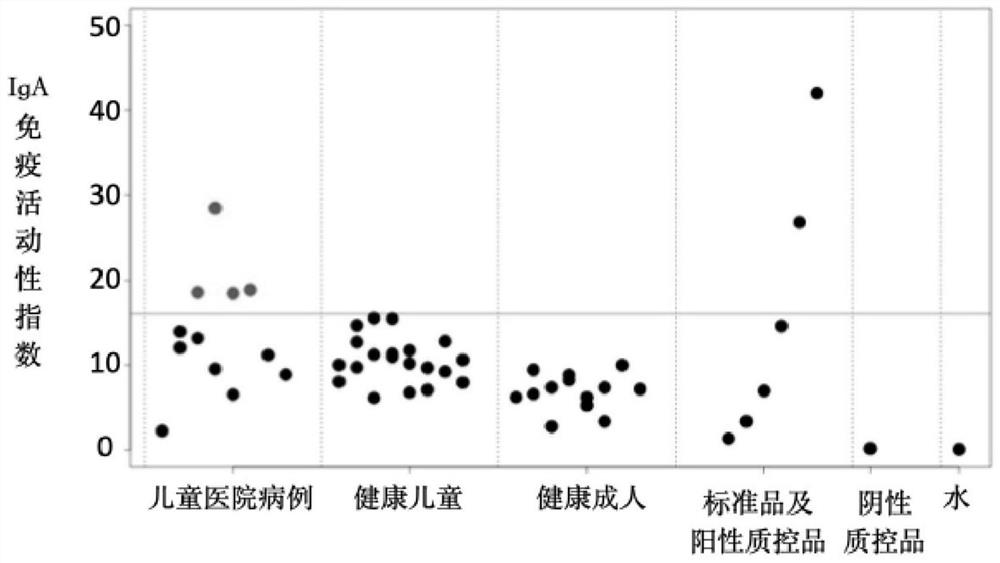
[0075] figure 2 IgA immune activity index was tested in sera from 12 children's hospital patients with IgA nephropathy (confirmed by renal biopsy), 19 healthy children and 13 healthy adults. Collect the peripheral blood of the above-mentioned three groups of people, extract serum, and then use the kit proposed in Example 1 to detect according to the detection method proposed in Example 1, and the results are as follows: figure 2 shown. figure 2 , the horizontal line between 10 and 20 is the maximum value (=16) of the IgA immune activity index of healthy people (including children and adults), which is set as the threshold line, and the IgA immune activity index is higher than the threshold line 16 is positive, below the thres...
Embodiment 3
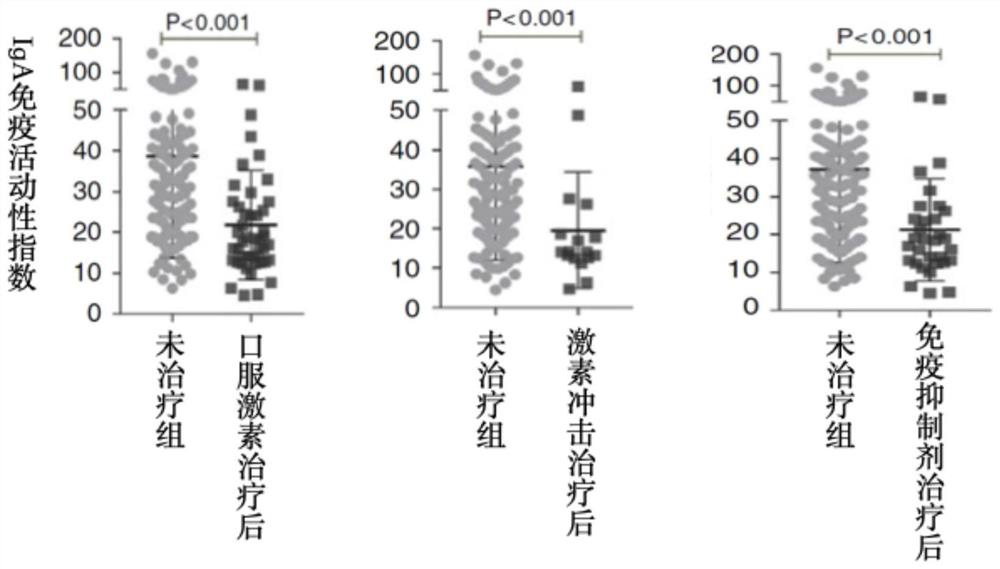
[0077] In this example, the kit proposed in Example 1 is used to evaluate the drug effect of renal puncture in patients with IgA nephropathy.
[0078] At present, there is no complete cure for IgA nephropathy, and the main goal of treatment is disease control. The clinical manifestations of disease control are reflected in three aspects: (1) proteinuria decreases or disappears; (2) creatinine remains stable for a long time, and the normal range of serum creatinine is 44-133, including 53-106 in males and 44-97 in females; (3) ) blood pressure is normal. For patients with effective treatment, the treatment process generally takes six months to two years to control the disease, that is, the above three indicators improve and reach the normal range. However, 40% of IgA nephropathy patients eventually develop renal failure (End Stage Kidney Disease, ESKD). It can be seen that the response time of the above clinical indicators to the treatment effect lags 3-6 months.
[0079] Th...
PUM
| Property | Measurement | Unit |
|---|---|---|
| Sensitivity | aaaaa | aaaaa |
Abstract
Description
Claims
Application Information
 Login to View More