Method and system for second-degree friend query
a second-degree friend and query technology, applied in the field of network data query technologies, can solve the problems of large amount of machine resources, inability to update second-degree friend relationships in time, etc., and achieve the effect of greatly reducing machine resources and high real-tim
- Summary
- Abstract
- Description
- Claims
- Application Information
AI Technical Summary
Benefits of technology
Problems solved by technology
Method used
Image

Examples
embodiment 1
[0020
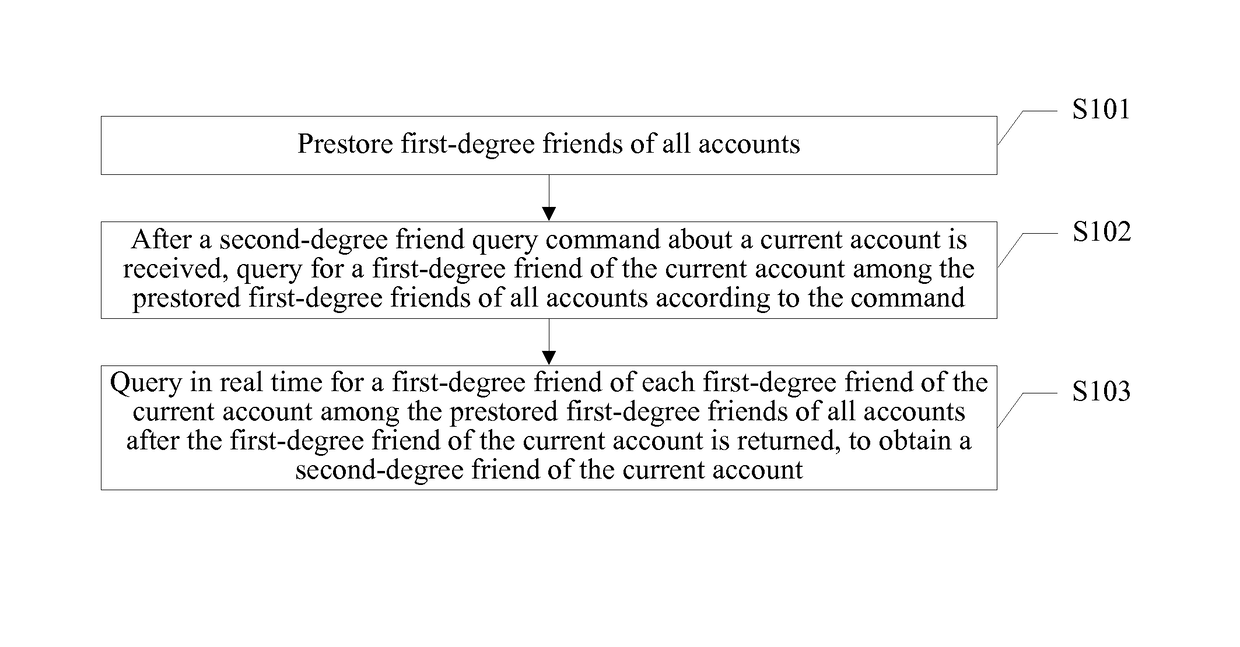
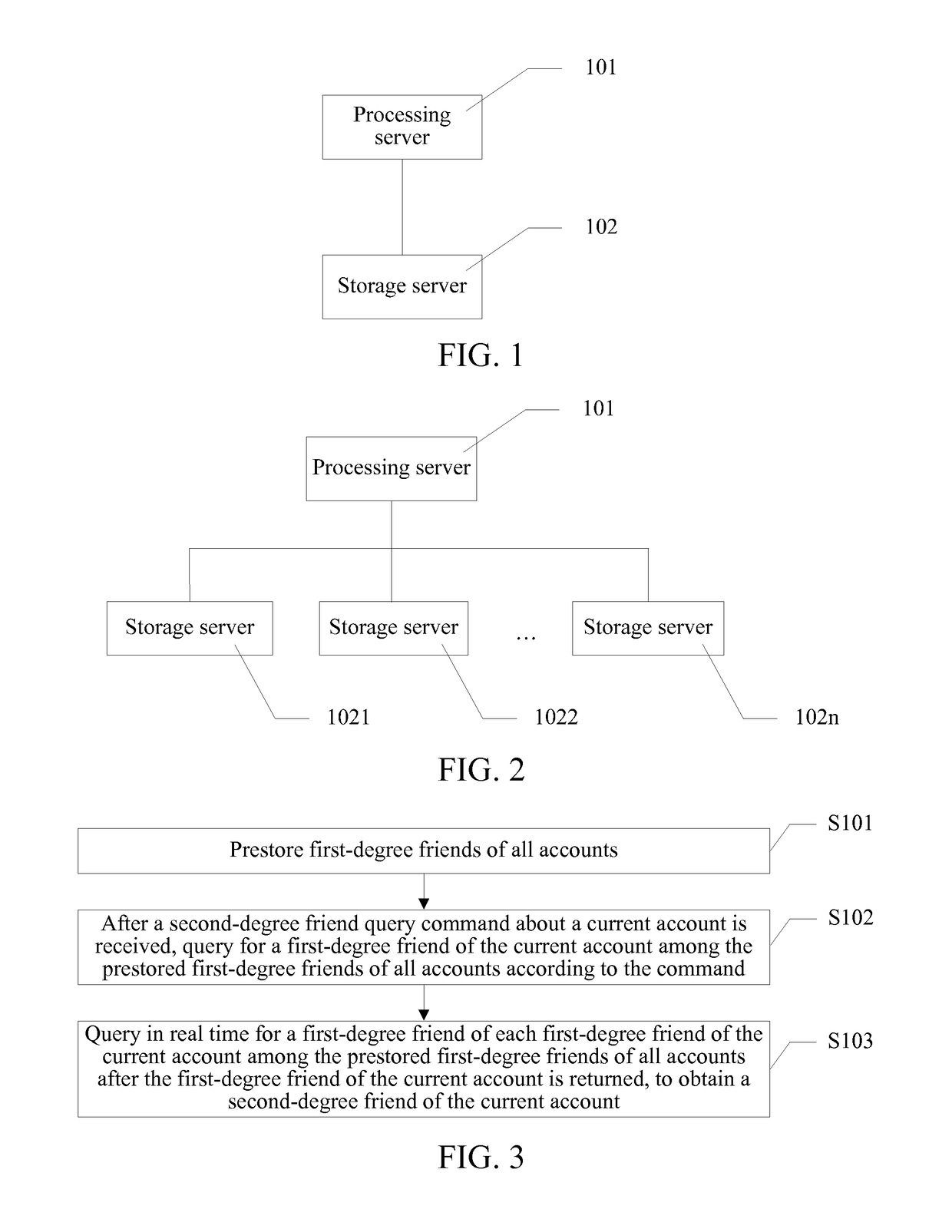
[0021]As shown in FIG. 1, a system for second-degree friend querying in this embodiment includes a processing server 101 and a storage server 102. The storage server 102 stores first-degree friends of all accounts. After receiving a second-degree friend query command about a current account sent by a client, the processing server 101 sends a first-degree friend query request about the current account to the storage server 102. The storage server 102 queries for a first-degree friend of the current account among the stored first-degree friends of all accounts and returns the first-degree friend of the current account. The processing server 101 sends a first-degree friend query request about each returned first-degree friend of the current account to the storage server 102. The storage server 102 queries for a first-degree friend of each first-degree friend of the current account among the stored first-degree friends of all accounts and returns the first-degree friend of each fir...
embodiment 2
[0025
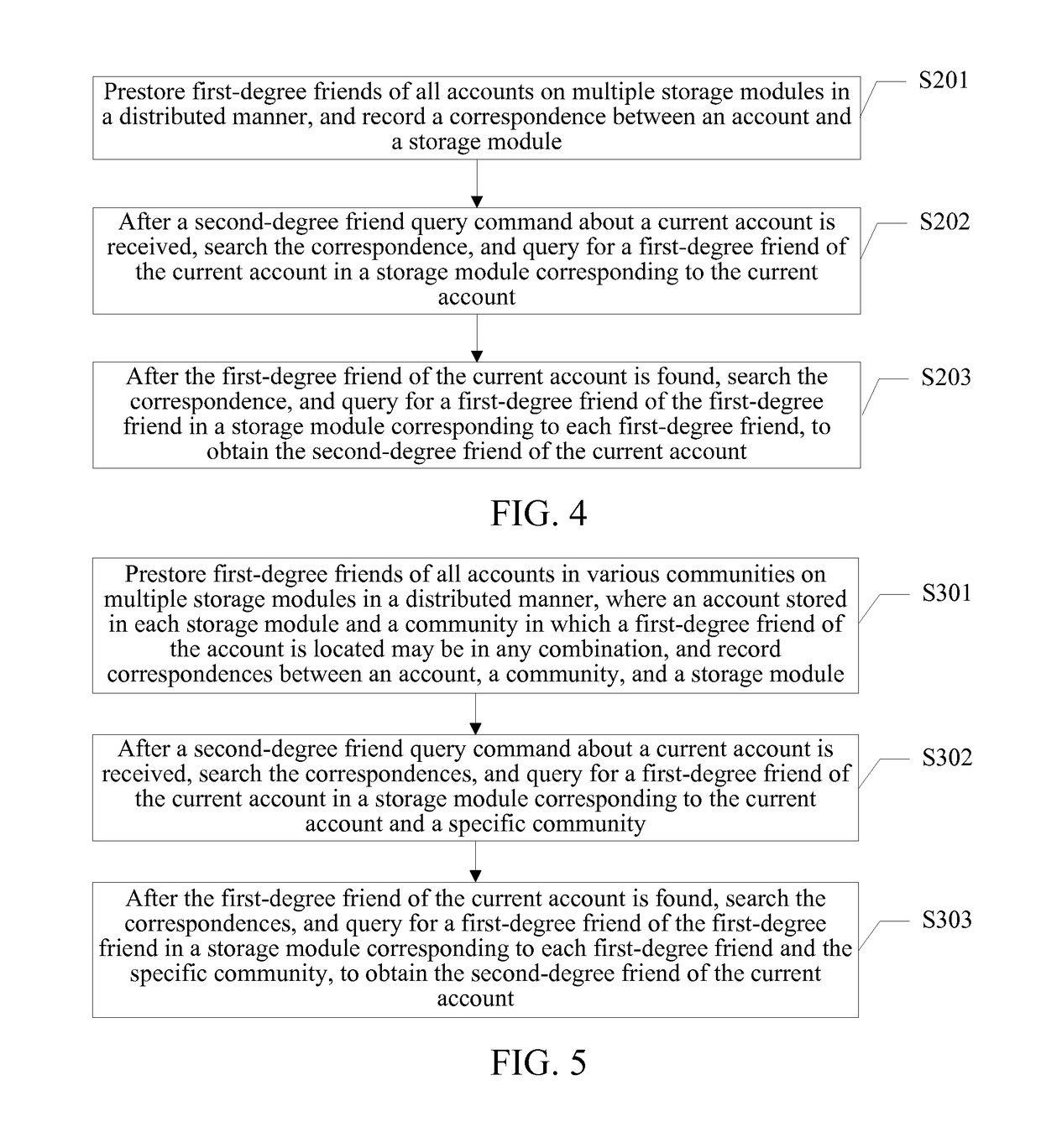
[0026]If resources for accounts that need to be stored are limited, there may be only one storage server. If there are too many accounts, and a friend relationship is complex, there may be multiple storage servers. As shown in FIG. 2, this embodiment includes 1 processing server 101 and n storage servers (a storage server 1021, a storage server 1022, . . . , and a storage server 102n). One storage server stores first-degree friends of some accounts, for example, first-degree friends of accounts whose ending number is 0, another storage server stores first-degree friends of some other accounts, and so on.
[0027]Based on the foregoing storage manner, the processing server 101 in this embodiment needs to perform node management on the storage servers. The processing server 101 records a link between a storage server and an account. A specific representation form of the link may be an index or a list. After a client sends a second-degree friend query command about a current account,...
embodiment 3
[0029
[0030]Nowadays, types of online communities (for example, QQ, microblog, and space) are growing. One user generally registers with various communities. For convenience of management, a unified account is generally used to associate respectively information about the same user in the communities. At the same time, the user may have a specific friend in each community. The user's friends in different communities may be the same or different. In this embodiment, to better identify the first-degree friend and the second-degree friend, consideration about the communities is added.
[0031]A system for second-degree friend querying in this embodiment includes 1 processing server 101 and n storage servers (a storage server 1021, a storage server 1022 . . . and a storage server 102n). The storage servers separately store first-degree friends of some accounts in some communities, and the some accounts and the some communities may be of any combination.
[0032]Based on the foregoing storage m...
PUM
 Login to View More
 Abstract
Description
Claims
Application Information
 Login to View More
 - R&D
- Intellectual Property
- Life Sciences
- Materials
- Tech Scout
- Unparalleled Data Quality
- Higher Quality Content
- 60% Fewer Hallucinations
Browse by: Latest US Patents, China's latest patents, Technical Efficacy Thesaurus, Application Domain, Technology Topic, Popular Technical Reports.
© 2025 PatSnap. All rights reserved.Legal|Privacy policy|Modern Slavery Act Transparency Statement|Sitemap|About US| Contact US: help@patsnap.com