Multiplexed linking PCR
a multi-linked, complex technology, applied in the field of synthetic biology, can solve the problems of limiting the design of primers and imposing a significant challenge to creating orthogonal and functional primer sets, and achieve the effect of rapid and inexpensive genotyping, and rapid and efficient genotyping
- Summary
- Abstract
- Description
- Claims
- Application Information
AI Technical Summary
Benefits of technology
Problems solved by technology
Method used
Image



Examples
example 1
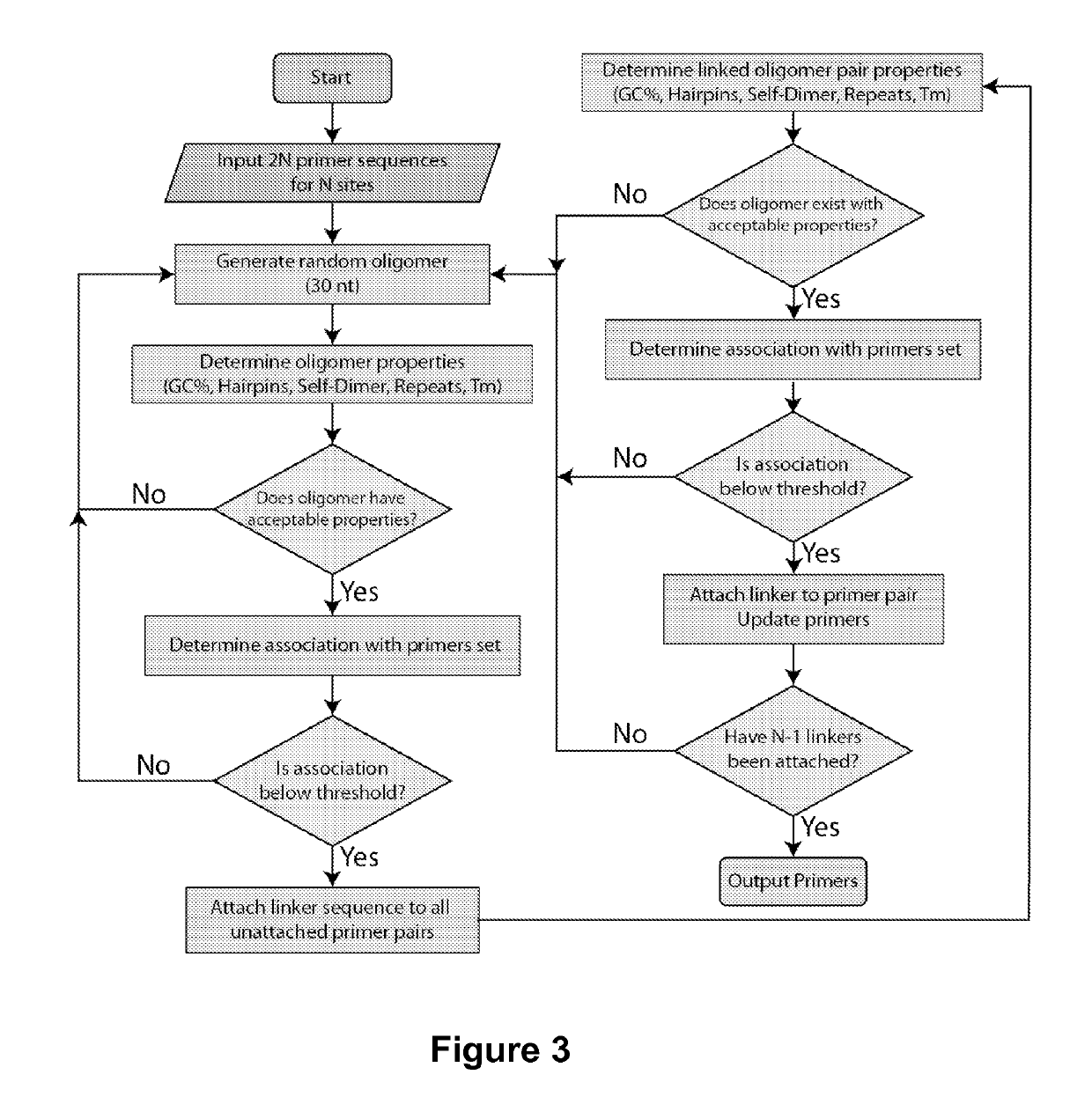
[0099]The basic reaction scheme of the invention comprises a two-step PCR process to condense genetic information and create repeating primer-template-primer-linker DNA constructs (FIG. 1). In the first PCR reaction, information from a low-concentration template genome is simultaneously amplified and linked to a neighboring site using a custom random linker sequence. A second PCR reaction selectively amplifies desired constructs (FIG. 1). Using this methodology, linking N sites together requires a one-pot reaction containing 2N primer species with N−1 linker sequences, resulting in 2N2+N interacting primers that must be thermodynamically designed to minimize cross- and self-hybridization. The complexity of this problem requires an automated and systematic approach to thermodynamic design of primer-linkers that can create a large number of high density constructs.
[0100]This example provides a demonstration of these methods. The inventors identified ten-sites across an E. coli genome ...
example 2
[0102]Linking PCR can be applied to stitch together PCR products from distal chromosomal origins in a single pot reaction. Not only does this significantly reduce the costs associated with colony based Sanger sequencing by reducing the number of sequencing reactions per clone, but combining this method with emulsification technologies (emulsion PCR (Griffith, Tawfick Trends in Biotechnology 2007)) offers a potentially useful route to multiplexed genotyping of large populations. The limited number of assemblies have limited the effectiveness of other one-pot genotyping methods like emulsion PCR. To be widely applicable as a technology for tracking targeted genomic libraries, such an approach would ideally enable sampling of many genomic sites. To expand the number of gene targets that can be tracked and improve the overall efficiency of this approach requires an automated de novo primer design approach that optimizes the many criteria necessary for efficient PCR based assembly and su...
example 3
[0124]Linking genomic sites, as exemplified in Example 2, relies on the ability to extend orthogonal homologous segments in parallel using a multiplexed primer pool, while mitigating undesirable interactions. This problem is inherently complex, involving intermediate species, non-linearly changing species concentrations as the reaction proceeds and undesirable interactions occurring by nature of the complexity of the species pool. Beyond understanding the thermodynamics, which contribute part of the complexity of multiplexed linking PCR, understanding the reaction conditions and dynamics that arise when amplifying from diverse primer pools is critical towards understanding and engineering protocol towards reliably creating desired constructs.
[0125]The kinetics of PCR processes are typically modelled to predict the efficiency of quantitative DNA amplification technologies like quantitative PCR. For amplifying a single site, these models use 7 ordinary differential equations (ODEs) de...
PUM
| Property | Measurement | Unit |
|---|---|---|
| melting temperature | aaaaa | aaaaa |
| temperature | aaaaa | aaaaa |
| temperatures | aaaaa | aaaaa |
Abstract
Description
Claims
Application Information
 Login to View More
 - R&D
- Intellectual Property
- Life Sciences
- Materials
- Tech Scout
- Unparalleled Data Quality
- Higher Quality Content
- 60% Fewer Hallucinations
Browse by: Latest US Patents, China's latest patents, Technical Efficacy Thesaurus, Application Domain, Technology Topic, Popular Technical Reports.
© 2025 PatSnap. All rights reserved.Legal|Privacy policy|Modern Slavery Act Transparency Statement|Sitemap|About US| Contact US: help@patsnap.com