Supercharge Your Innovation With Domain-Expert AI Agents!

Hydrogen-redox flow battery assembly

a flow battery and redox technology, applied in the direction of electrochemical generators, fuel cells, electrical equipment, etc., can solve the problems of increasing the cost associated with the system, high purchase and maintenance costs, and challenging energy-efficient devices of hydrogen compressors, so as to improve the efficiency of the battery cell, increase the reliability, and simplify the construction of the flow battery assembly

Active Publication Date: 2019-11-05
ELESTOR BV
View PDF7 Cites 0 Cited by
  • Summary
  • Abstract
  • Description
  • Claims
  • Application Information

AI Technical Summary

Benefits of technology

This design simplifies the construction, reduces manufacturing and maintenance costs, enhances reliability, and increases efficiency by eliminating the need for energy-inefficient pressure control systems while maintaining optimal storage and power capacity.

Problems solved by technology

A hydrogen compressor is typically a technically challenging and energy inefficient device, which requires high purchase and maintenance costs.
This use of an external mechanical compressor therefore increases the costs associated with the system, reduces its long-term reliability and reduces its efficiency.
The pressure in the electrolyte chamber is therefore continuously controlled in function of the pressure in the hydrogen chamber, which makes the use of the flow battery assembly complicated and requires the implementation of extra components such as pumps and sensors which increases the cost associated with such an assembly and reduces its robustness because of an increased risk of component failure.
This requires a manual intervention in order to pre-select the value of the pressure in the hydrogen chamber, which makes the use of the flow battery assembly less reliable.
The control of the pressure in the hydrogen chamber further requires the implementation of components such as pumps and sensors, which increases the costs associated with such a flow battery assembly.
The difference occurring between the amounts of gases generated in the course of electrolysis results in significant pressure difference on the two sides of the membrane of the fuel cell.

Method used

the structure of the environmentally friendly knitted fabric provided by the present invention; figure 2 Flow chart of the yarn wrapping machine for environmentally friendly knitted fabrics and storage devices; image 3 Is the parameter map of the yarn covering machine
View more

Image

Smart Image Click on the blue labels to locate them in the text.
Viewing Examples
Smart Image
  • Hydrogen-redox flow battery assembly
  • Hydrogen-redox flow battery assembly
  • Hydrogen-redox flow battery assembly

Examples

Experimental program
Comparison scheme
Effect test

Embodiment Construction

)

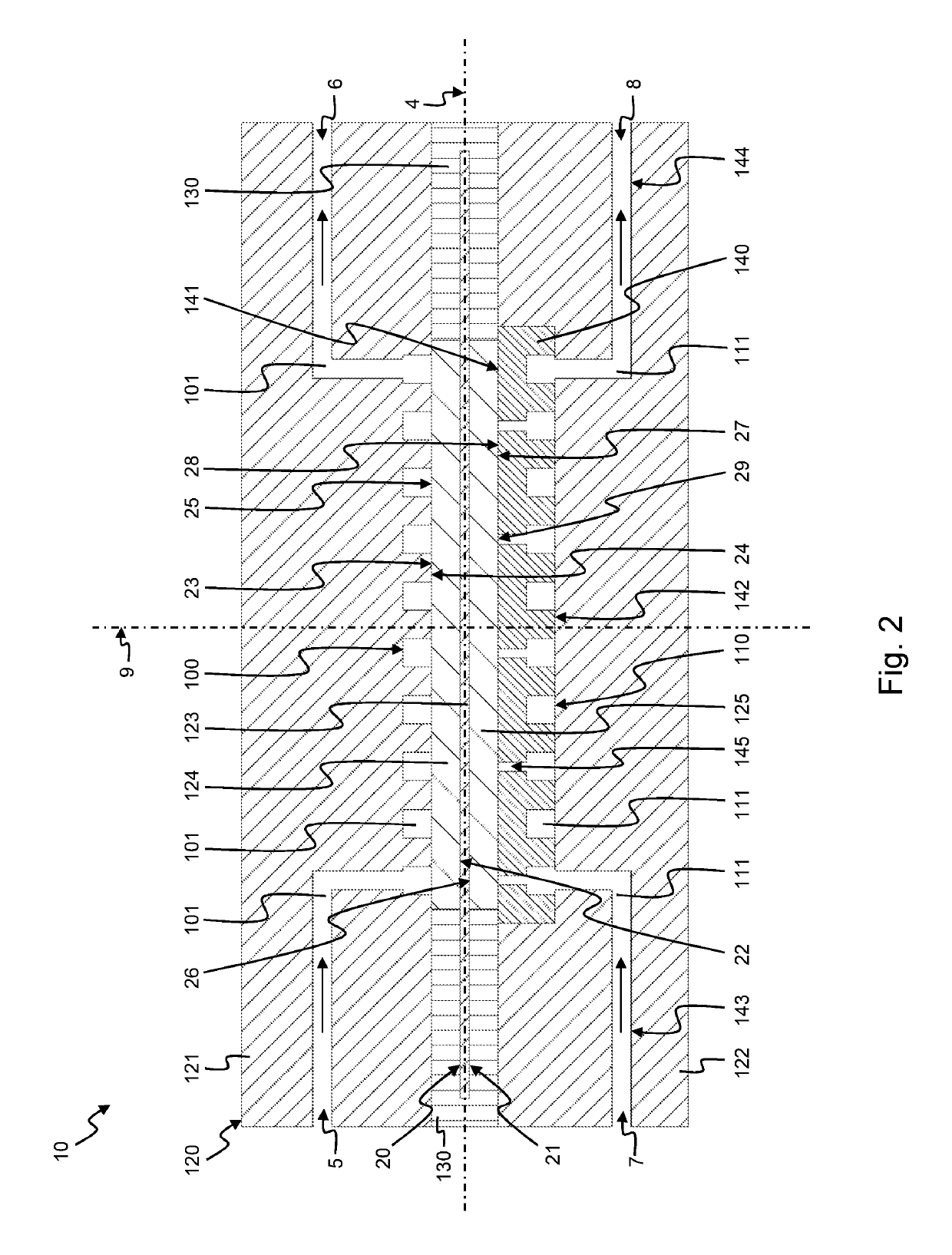
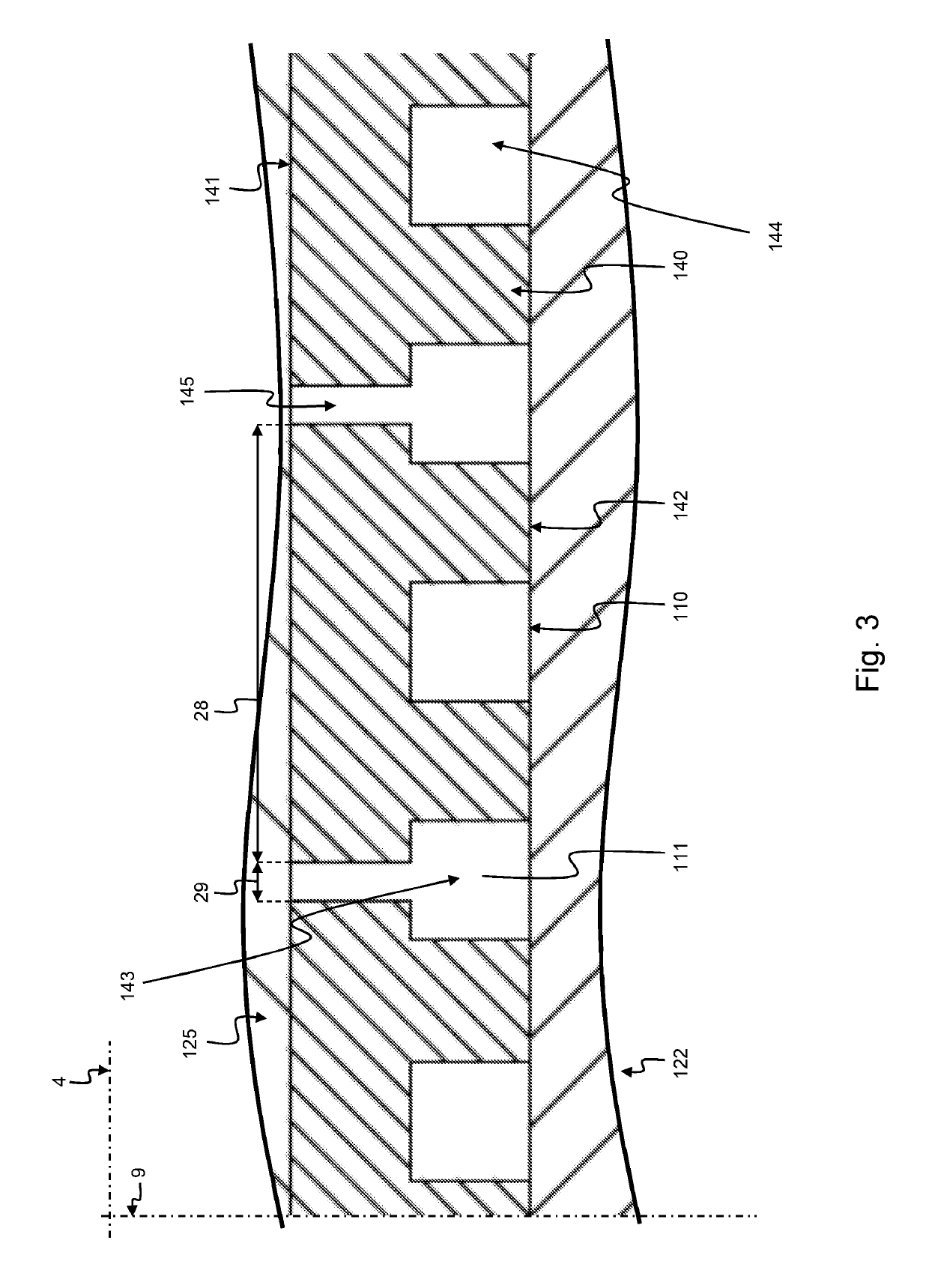
[0088]According to an embodiment shown in FIG. 1, a flow battery assembly 1 comprises a battery cell 10 comprising a hydrogen chamber 100, an electrolyte chamber 110. In between the hydrogen chamber 100 and the electrolyte chamber 110 there is positioned a membrane 123 of a membrane electrode assembly 120 which further comprises a hydrogen electrode 121 and an electrolyte electrode 122. In an alternative embodiment, the flow battery assembly 1 comprises a plurality of battery cells 10 similar to the battery cell 10 depicted in FIG. 1, as will be explained in further detail below with reference to the embodiment of FIG. 5. As shown, the planar membrane 123 comprises a central plane 4. The hydrogen electrode 121 is positioned on one side of the central plane 4 and the electrolyte electrode 122 is positioned on the opposite side of the central plane 4. As shown the hydrogen electrode 121 is positioned at the same side of the central plane 4 as the hydrogen chamber 100; while the elect...

the structure of the environmentally friendly knitted fabric provided by the present invention; figure 2 Flow chart of the yarn wrapping machine for environmentally friendly knitted fabrics and storage devices; image 3 Is the parameter map of the yarn covering machine
Login to View More

PUM

PropertyMeasurementUnit
pressureaaaaaaaaaa
pressureaaaaaaaaaa
pressureaaaaaaaaaa
Login to View More

Abstract

A hydrogen-redox flow battery assembly comprises one or more battery cells and is used to electrochemically generate and store electric power. Each battery cell includes a hydrogen chamber, an electrolyte chamber, a membrane electrode assembly positioned between the hydrogen chamber and the electrolyte chamber, a hydrogen reservoir and an electrolyte reservoir. The hydrogen-redox flow battery assembly is configured to allow an uncontrolled pressure difference between the pressure in the hydrogen chamber and the pressure in the electrolyte chamber, the pressure difference determined by a diffusion of protons through the membrane electrode assembly during a charge and / or a discharge operation. The one or more battery cells of the hydrogen-redox flow battery assembly is / are completely positioned in the hydrogen reservoir.

Description

FIELD OF THE INVENTION[0001]The present invention generally relates to a flow battery assembly used to electrochemically generate and store electric power, especially to a flow battery assembly in which both charging and discharging reactions happen in the presence of hydrogen and of an electrolyte comprising a halogen ion or a mixture of halogen ions.BACKGROUND OF THE INVENTION[0002]Solar or wind energy-based systems as well as flow batteries provide solutions to the ever increasing need for the low cost generation and storage of electricity. A flow battery that uses hydrogen and a halogen ion, such as for example bromine, as active materials was invented in 1961 by the National Aeronautics and Space Administration. This type of flow battery demonstrates a high power density, i.e. it can store or release a high power per unit of membrane area. A flow battery relying on hydrogen and a halogen ion can indeed reach a power density of 10 kW·m−2, which is 20 times higher than the power ...

Claims

the structure of the environmentally friendly knitted fabric provided by the present invention; figure 2 Flow chart of the yarn wrapping machine for environmentally friendly knitted fabrics and storage devices; image 3 Is the parameter map of the yarn covering machine
Login to View More

Application Information

Patent Timeline
no application Login to View More
Patent Type & Authority Patents(United States)
IPC IPC(8): H01M8/18H01M8/20H01M4/86H01M8/04089H01M8/04186H01M8/08
CPCH01M8/04089H01M8/08H01M8/20H01M8/188H01M4/8605H01M8/04186Y02E60/528Y02E60/50
Inventor KOUT, WIEBRAND
Owner ELESTOR BV
Features
  • R&D
  • Intellectual Property
  • Life Sciences
  • Materials
  • Tech Scout
Why Patsnap Eureka
  • Unparalleled Data Quality
  • Higher Quality Content
  • 60% Fewer Hallucinations
Social media
Patsnap Eureka Blog
Learn More