Method for the manufacture of poly(aryl ethers) using at least one organic base
a technology of poly(aryl ethers) and organic bases, which is applied in the field of method for the manufacture of poly(aryl ethers) using at least one organic base, can solve the problems of high cost of salt processing
- Summary
- Abstract
- Description
- Claims
- Application Information
AI Technical Summary
Benefits of technology
Problems solved by technology
Method used
Image

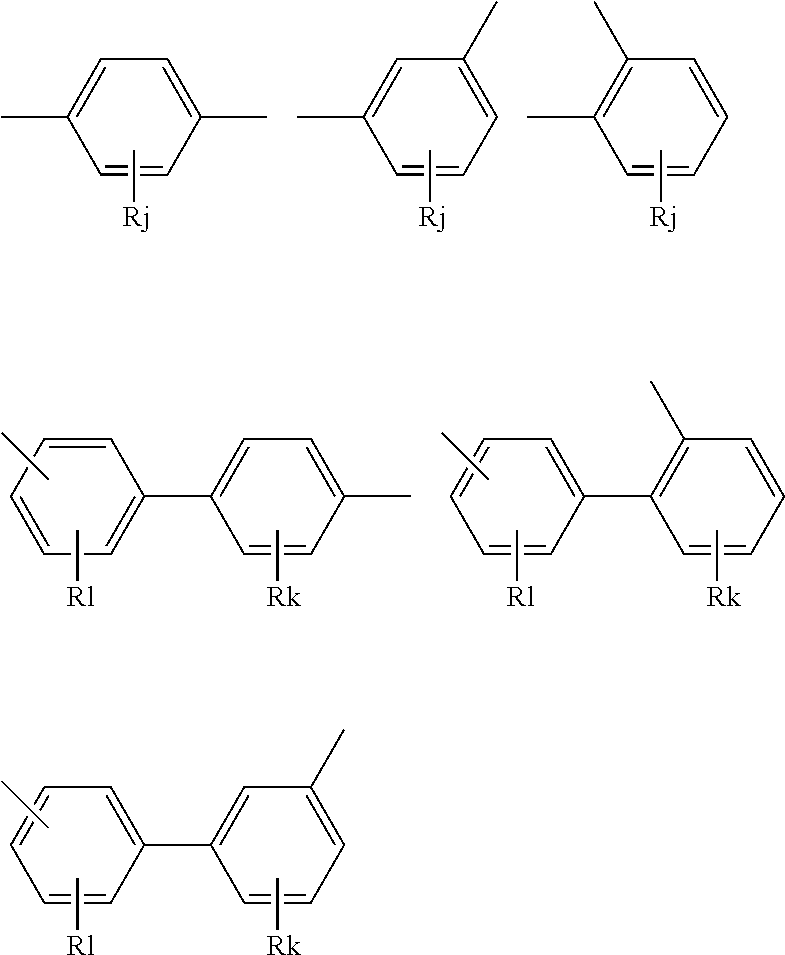
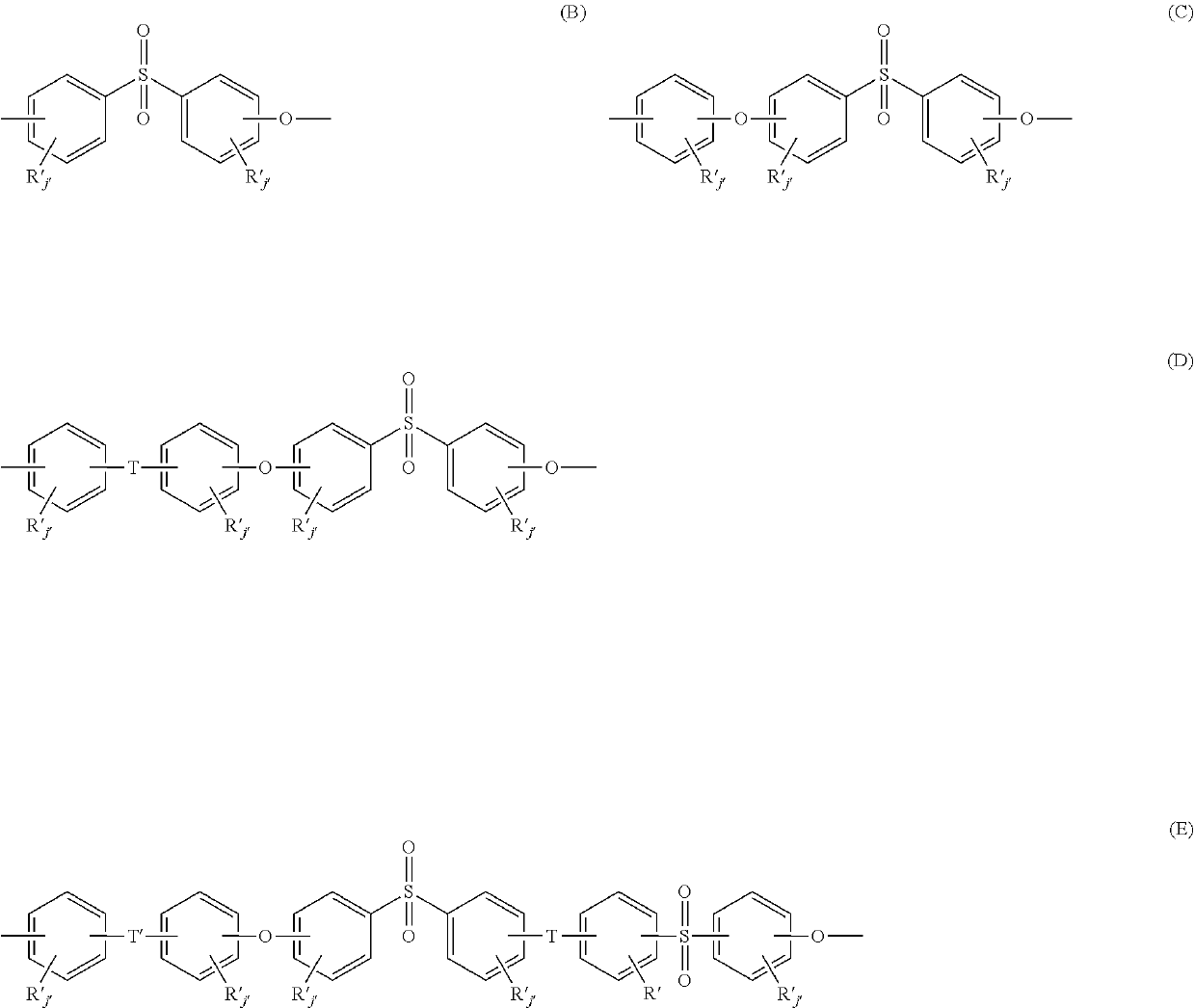
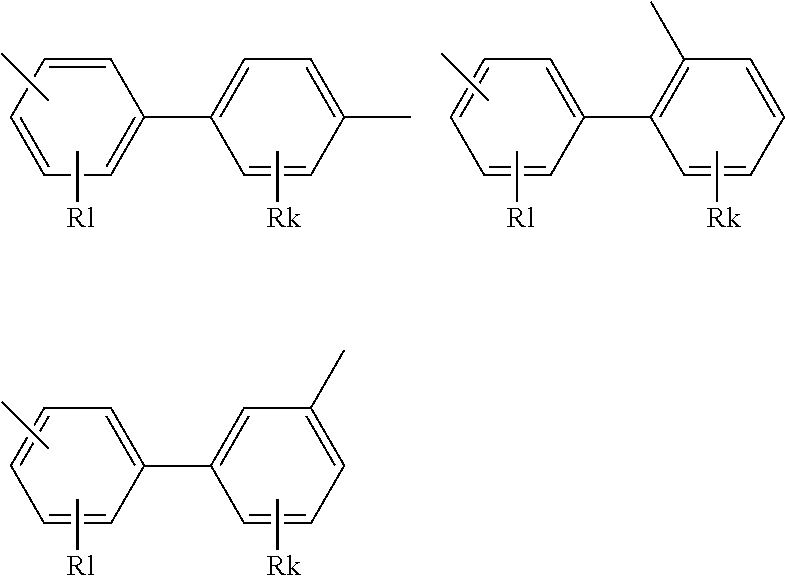
Examples
example 1 (
E1)
Polysulfone Synthesized from an Excess of Organic Base (25 mol.-% More than the Hydroxyls) and with a Stoichiometric Content of DCDPS and Bisphenol A, without any Solvent
[0126]In a 250 mL 4-necks reactor equipped with a condenser and a trap were introduced first 34.24 g (0.15 mol) of bisphenol A, 43.08 g (0.15 mol) of 4,4′-dichlorodiphenylsulfone and 57.67 g (0.379 mol) of DBU. After introduction of a nitrogen blanket in the reaction mixture, the reaction mixture was stirred and heated to 210° C. within 1 hour and let react for 60 min (E1A) and for additional 3 hours (E1B). The yellowish-orange transparent polymer melt has a higher viscosity than in reference example 3. Upon cooling, the viscosity increases quickly up to be a transparent strong yellowish-orange solid. The GPC analysis of the solid E1A (after 1 hour reaction at 210° C.) gives Mn=2832 g / mol and Mw=5149 g / mol and the GPC analysis of the solid E1B (after 4 hours reaction at 210° C.) gives Mn=3607 g / mol and Mw=8691 g / ...
example 2 (
E2)
Polysulfone Synthesized from an Excess of Organic Base (50 mol.-% More than the Hydroxyls) and with a Stoichiometric Content of DCDPS and Bisphenol A, without any Solvent at 230° C.
[0128]In a 250 mL 4-necks reactor equipped with a condenser and a trap were introduced first 34.24 g (0.15 mol) of bisphenol A, 43.08 g (0.15 mol) of 4,4′-dichlorodiphenylsulfone and 69.24 g (0.455 mol) of DBU. After introduction of a nitrogen blanket in the reaction mixture, the reaction mixture was stirred and heated to 230° C. within 1 hour and let react for 60 min. Upon cooling, the viscosity increases quickly up to be a transparent strong redish solid. The GPC analysis of the solid polymer (after 1 hour reaction at 230° C.) gives Mn=3835 g / mol and Mw=6391 g / mol.
[0129]It appears that the increase in temperature and excess of DBU allows increasing the molecular weight.
example 3 (
E3)
Polysulfone Synthesized from a Mixture of Organic Base and Inorganic Base in Excess (25 mol.-% More than the Hydroxyls) and with a Stoichiometric Content of DCDPS and Bisphenol A, without any Solvent at 210° C.
[0130]In a 250 mL 4-necks reactor equipped with a condenser and a trap were introduced first 34.24 g (0.15 mol) of bisphenol A, 43.08 g (0.15 mol) of 4,4′-dichlorodiphenylsulfone, 5.18 g (0.038 mol) of potassium carbonate and 46.13 g (0.3 mol) of DBU. After introduction of a nitrogen blanket in the reaction mixture, the reaction mixture was stirred and heated to 210° C. within 2 hours and let react for 60 min (E3A) and let react for additional 3 hours (E3B). Upon cooling, the viscosity increases quickly up to be a transparent light tan solid. The GPC analysis of the solid E3A (after 1 hour reaction at 210° C.) gives Mn=2143 g / mol and Mw=3646 g / mol and the GPC analysis of the solid E3B (after 4 hours reaction at 210° C.) gives Mn=3128 g / mol and Mw=6062 g / mol. E3C was obtaine...
PUM
| Property | Measurement | Unit |
|---|---|---|
| pKa | aaaaa | aaaaa |
| temperature | aaaaa | aaaaa |
| temperature | aaaaa | aaaaa |
Abstract
Description
Claims
Application Information
 Login to View More
 - R&D
- Intellectual Property
- Life Sciences
- Materials
- Tech Scout
- Unparalleled Data Quality
- Higher Quality Content
- 60% Fewer Hallucinations
Browse by: Latest US Patents, China's latest patents, Technical Efficacy Thesaurus, Application Domain, Technology Topic, Popular Technical Reports.
© 2025 PatSnap. All rights reserved.Legal|Privacy policy|Modern Slavery Act Transparency Statement|Sitemap|About US| Contact US: help@patsnap.com