Cellulose acetate and producing method therefor
a technology of cellulose acetate and cellulose acetate, which is applied in the direction of cleaning using liquids, grain treatment, chemistry apparatus and processes, etc., can solve problems such as optical defects, and achieve the effect of excellent production efficiency and high crystallinity
- Summary
- Abstract
- Description
- Claims
- Application Information
AI Technical Summary
Benefits of technology
Problems solved by technology
Method used
Image


Examples
example 1
(1) Grinding Step
[0104]As a raw material, sheet-shaped cotton linter pulp (mannose units: 0.02 mol %, α-cellulose content: 97%) was treated with a disc refiner to obtain cotton-like cellulose (water content: 8.0% by weight).
(2) Activation Step
[0105]In a first pretreatment step, a predetermined amount of acetic acid shown in Table 1 was sprayed to 100 parts by weight of cotton-like cellulose, adequately stirred, and left standing at a temperature of 24° C. for 60 minutes.
[0106]In a second pretreatment step, sulfuric acid-containing acetic acid shown in Table 1 was added to the cellulose subjected to the first activation step, and the mixture was left standing at a temperature of 24° C. for 60 minutes.
(3) Acetylation Step
[0107]Predetermined amounts of acetic acid, acetic anhydride and sulfuric acid shown in Table 1 were mixed with cellulose activated through the second activation step, the mixture was held at 15° C. or lower for about 20 minutes, and the temperature of the reaction sy...
example 2
(1) Grinding Step
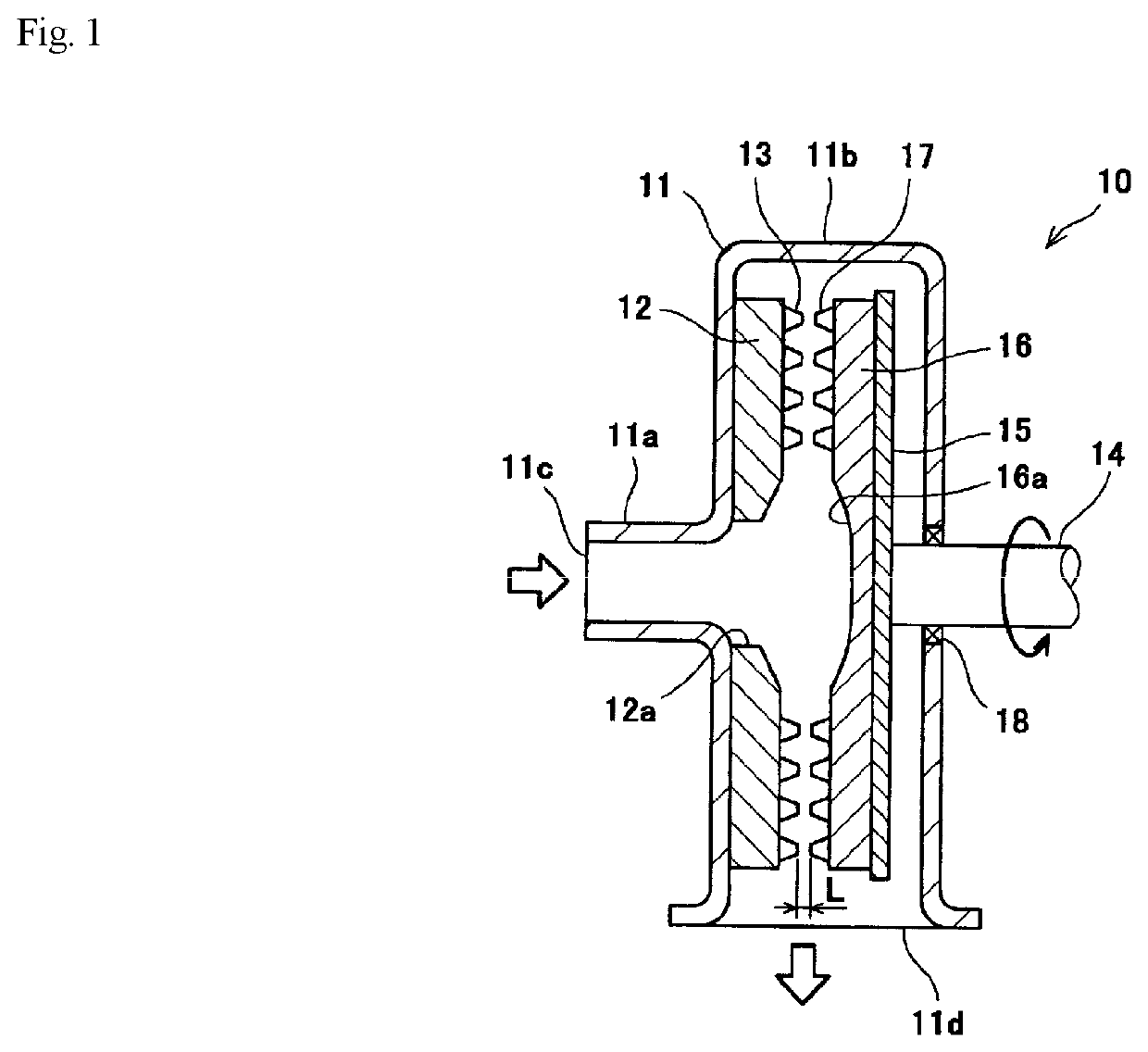
[0126]As a raw material, sheet-shaped cotton linter pulp (mannose units: 0.01 mol %, α-cellulose content: 98%) was ground into pulp pieces having an average area of 45 cm2 or less by a disc refiner, and further, using a turbo mill (T1000) manufactured by Freund Turbo Corporation was used as an airflow grinder which includes a casing provided with an inlet and an outlet and having a cylindrical shape, and a rotor facing the inner peripheral surface of the casing and having a plurality of blade portions provided on an outer peripheral portion of the rotor, the pulp pieces were ground at 1750 rpm to obtain cotton-like cellulose (water content: 7.4% by weight).
[0127]Except that in the steps subsequent to the activation step (2), acetic acid containing a predetermined amount of sulfuric acid as shown in Table 1 was added in the second pretreatment step of the activation step (2), and predetermined amounts of acetic acid, acetic anhydride and sulfuric acid shown in Table ...
example 3
[0128]Except that the raw material used in Example 2 was used, the raw material was ground under the same conditions as in Example 2 in the grinding step (1), and the acetylation reaction time was changed to one shown in Table 1 in the acetylation step (3), the same procedure as in Example 1 was carried out to obtain cellulose acetate. For the obtained cellulose acetate flakes, the constituent ratio of a sugar chain component (content ratio of mannose units), the filtration index K, the number of insoluble foreign matters, the calcium content and the magnesium content were determined in accordance with the same procedure as in Example 1. The results are shown in Table 2.
PUM
| Property | Measurement | Unit |
|---|---|---|
| diameter | aaaaa | aaaaa |
| equivalent spherical diameter | aaaaa | aaaaa |
| weight ratio | aaaaa | aaaaa |
Abstract
Description
Claims
Application Information
 Login to View More
 - R&D
- Intellectual Property
- Life Sciences
- Materials
- Tech Scout
- Unparalleled Data Quality
- Higher Quality Content
- 60% Fewer Hallucinations
Browse by: Latest US Patents, China's latest patents, Technical Efficacy Thesaurus, Application Domain, Technology Topic, Popular Technical Reports.
© 2025 PatSnap. All rights reserved.Legal|Privacy policy|Modern Slavery Act Transparency Statement|Sitemap|About US| Contact US: help@patsnap.com