Check patentability & draft patents in minutes with Patsnap Eureka AI!

Irradiated membrane for cell expansion

a cell and membrane technology, applied in the field of membranes, can solve the problems of adverse reactions in patients treated, many cells are not available in any quantity, and cells often lose their ability to differentiate and respond to hormones, and achieve the effect of promoting cell attachmen

Active Publication Date: 2021-04-13
GAMBRO LUNDIA AB
View PDF60 Cites 0 Cited by
  • Summary
  • Abstract
  • Description
  • Claims
  • Application Information

AI Technical Summary

Benefits of technology

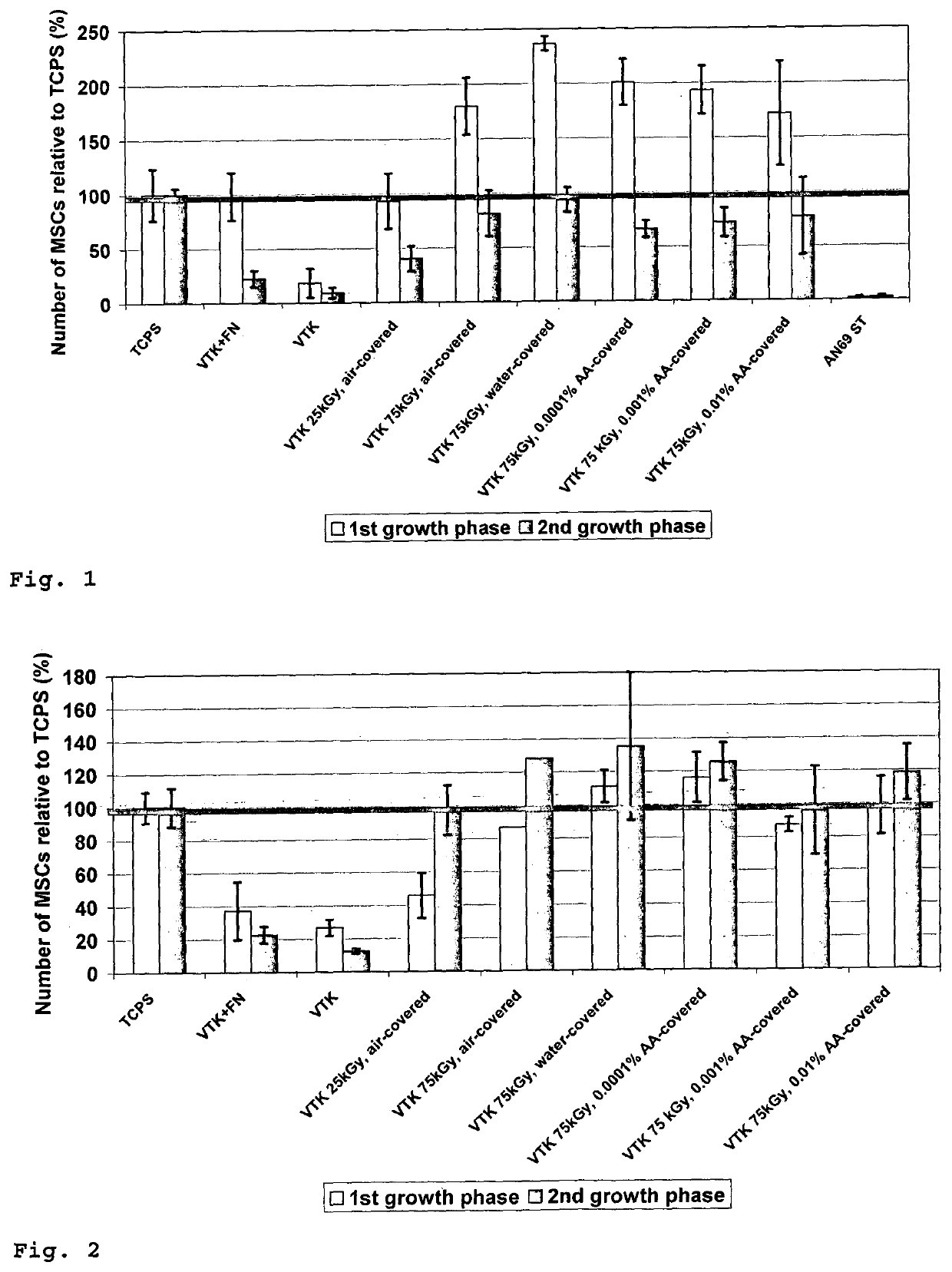
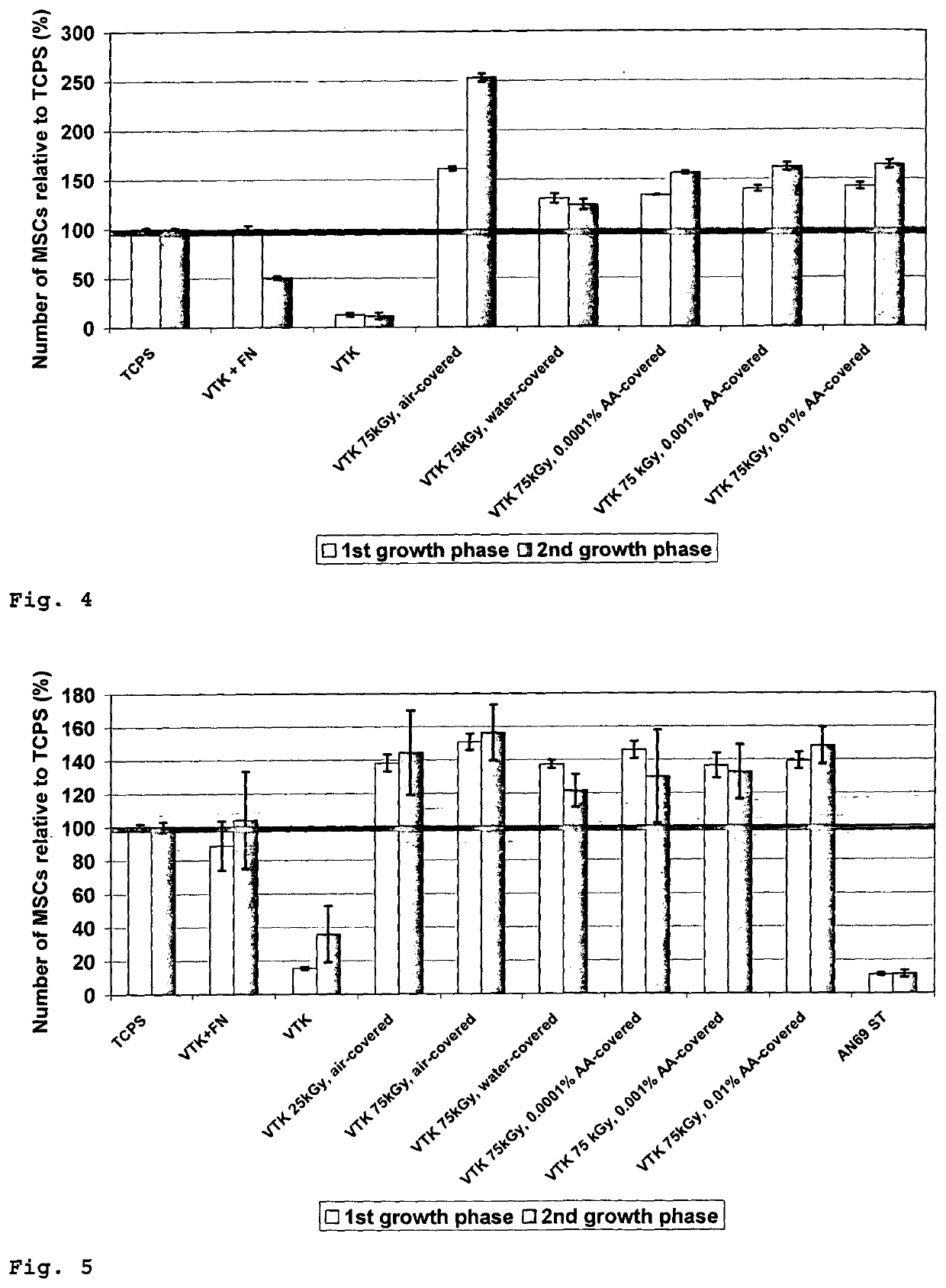
The irradiated membranes exhibit growth characteristics similar to or superior to tissue culture polystyrene plates, supporting cell expansion, re-attachment, and maintaining cell morphology and differentiation potential, reducing contamination risks and process complexity.

Problems solved by technology

While many anchorage-dependent cells may grow on glass or synthetic surfaces, these cells often lose their ability to differentiate and respond to hormones.
Longer-term cultivation would however be of great significance, for example, with the use of human cells for tissue culture, and many cells are not available in any quantity.
However, the use of xenogenic factors is a clear disadvantage, especially if the cells as such or on a matrix as used for medical treatment of human beings, as it will bring along risks of contamination and may result in adverse reactions in the patient treated.
The failure of cells to grow on such surfaces or keep their abilities is, for example, a major limitation of current tissue culture techniques.
Apart from the problem of identifying membrane compositions which could be used as a matrix for the cultivation of adherent cells, membranes currently known in the art suffer from their inability to sufficiently promote and sustain adherence, expansion, differentiation and extended lifespan without the pre-treatment of said membranes or matrices, or the addition of exogenous factors, such as, for example, fibronectin, laminin or collagen.
Lower doses will result in insufficient sterilization while higher doses will disintegrate the components of the membrane.
When the dosage of gamma-rays is too high, the hydrophobic polymer, the hydrophilic polymer and / or the housing may be disintegrated and deteriorated.
When non-degassed water is used, the oxygen dissolved in the water oxidizes and deteriorates the components of the membrane.

Method used

the structure of the environmentally friendly knitted fabric provided by the present invention; figure 2 Flow chart of the yarn wrapping machine for environmentally friendly knitted fabrics and storage devices; image 3 Is the parameter map of the yarn covering machine
View more

Image

Smart Image Click on the blue labels to locate them in the text.
Viewing Examples
Smart Image
  • Irradiated membrane for cell expansion
  • Irradiated membrane for cell expansion
  • Irradiated membrane for cell expansion

Examples

Experimental program
Comparison scheme
Effect test

example 1

Preparation of a Flat Sheet Membrane

[0126]A polymer solution was prepared by dissolving polyethersulfone (Ultrason® 6020, BASF), polyvinylpyrrolidone (K30 and K85, BASF), polyurethane (Desmopan® 9665 DU, Bayer MaterialScience AG) as well as distilled water in N-methylpyrrolidone (NMP) at 60° C. until a clear, highly viscous solution was obtained.

[0127]The weight fraction of the different components in the polymer spinning solution, PES / PVP(K85) / PVP(K30) / 9665DU / H2O / NMP was 14 / 3 / 5 / 2 / 3 / 73. The viscosity of the resulting polymer solution was 21,000 mPa·s.

[0128]The solution was filtrated and degassed. Degassing of the polymer solution was performed in a drying oven at increased temperature (<100° C.) and reduced pressure (approximately 100 mbar). The final polymer solution was then cast (automatically) as an uniform film onto a smooth surface (glass slide) which acted as supporting area by utilizing a special coating knife. First, the polymer solution was heated to 60° C. in an oven and ...

example 2

Preparation of a Flat Sheet Membrane

[0129]A polymer solution was prepared by dissolving polyethersulfone (Ultrason® 6020, BASF), polyvinylpyrrolidone (K30 and K90, BASF), as well as distilled water in N-methylpyrrolidone (NMP) at 60° C. until a clear, highly viscous solution was obtained.

[0130]The weight fraction of the different components in the polymer spinning solution, PES / PVP(K90) / PVP(K30) / H2O / NMP was 13.6 / 2 / 5 / 3 / 76.4. The viscosity of the resulting polymer solution was 5,900 mPa·s.

[0131]A membrane was prepared as described in Example 1. The membrane thickness was 50 μm.

example 3

Preparation of a Hollow Fiber Membrane

[0132]A polymer solution was prepared by mixing 13.5% of polyethersulfone, 0.5% of polyamide, 7.5% of PVP K30 and 78.5% of NMP. A mixture of 59 wt.-% water and 41 wt.-% NMP served as center fluid. The viscosity of the polymer solution, measured at a temperature of 22° C. was 4,230 mPa·s.

[0133]The center fluid was heated to 55° C. and pumped through a two-component hollow fiber spinneret. The polymer solution was leaving the spinneret through an annular slit with an outer diameter of 0.5 mm and an inner diameter of 0.35 mm. The center fluid was leaving the spinneret in the center of the annular polymer solution tube in order to start the precipitation of the polymer solution from the inside and to determine the inner diameter of the hollow fiber.

[0134]At the same time the two components (polymer solution and center fluid) were entering a space separated from the room atmosphere. The space is called spinning shaft. A mixture of steam (100° C.) and...

the structure of the environmentally friendly knitted fabric provided by the present invention; figure 2 Flow chart of the yarn wrapping machine for environmentally friendly knitted fabrics and storage devices; image 3 Is the parameter map of the yarn covering machine
Login to View More

PUM

PropertyMeasurementUnit
molecular weightaaaaaaaaaa
pore sizeaaaaaaaaaa
molecular weightaaaaaaaaaa
Login to View More

Abstract

A membrane for cultivating adherent or suspension cells, in particular adherent cells. The membrane permits adhesion and proliferation of the cells due to the irradiation of the wet or dry membrane with gamma or beta rays or an electron beam in a dose of from 12.5 to 175 kGy in the presence of oxygen. The resulting membrane may be used without any pre-treatment with surface-modifying substances. A method for preparing such an irradiated membrane for cultivating adherent or suspension cells. Methods of using such a membrane for cultivating adherent or suspension cells.

Description

CROSS-REFERENCE TO RELATED APPLICATIONS[0001]This application is the U. S. national phase of PCT / EP2009 / 006847 filed Sep. 23, 2009. PCT / EP2009 / 006847 claims priority to European patent application 08016834.7 filed Sep. 25, 2008. The disclosures of both European patent application 08016834.7 and PCT / EP2009 / 006847 are hereby incorporated herein by reference.TECHNICAL FIELD[0002]The invention relates to a membrane which can be used for cultivating adherent or suspension cells, in particular adherent cells, wherein said membrane allows for the adhesion and proliferation of the cells due to the irradiation of the wet or dry membrane with gamma- or beta-rays or an electron beam in a dose of from 12.5 to 175 kGy in the presence of oxygen. The resulting membrane may be used without any pre-treatment with surface-modifying substances. The invention further relates to a method for preparing said irradiated membrane which can be used for the cultivation of cells, in particular adherent cells, ...

Claims

the structure of the environmentally friendly knitted fabric provided by the present invention; figure 2 Flow chart of the yarn wrapping machine for environmentally friendly knitted fabrics and storage devices; image 3 Is the parameter map of the yarn covering machine
Login to View More

Application Information

Patent Timeline
no application Login to View More
Patent Type & Authority Patents(United States)
IPC IPC(8): C12M1/12B01D67/00C12N5/00C12N5/0775A61L2/02
CPCB01D67/009C12M25/02C12N5/0068C12N5/0663A61L2/022C12N2533/30C12N2533/52
Inventor KRAUSE, BERNDNEUBAUER, MARKUSLOERCHER, JOACHIM
Owner GAMBRO LUNDIA AB
Features
  • R&D
  • Intellectual Property
  • Life Sciences
  • Materials
  • Tech Scout
Why Patsnap Eureka
  • Unparalleled Data Quality
  • Higher Quality Content
  • 60% Fewer Hallucinations
Social media
Patsnap Eureka Blog
Learn More