Supercharge Your Innovation With Domain-Expert AI Agents!

Cyanine dyes as labeling reagents for detection of biological and other materials by luminescence methods

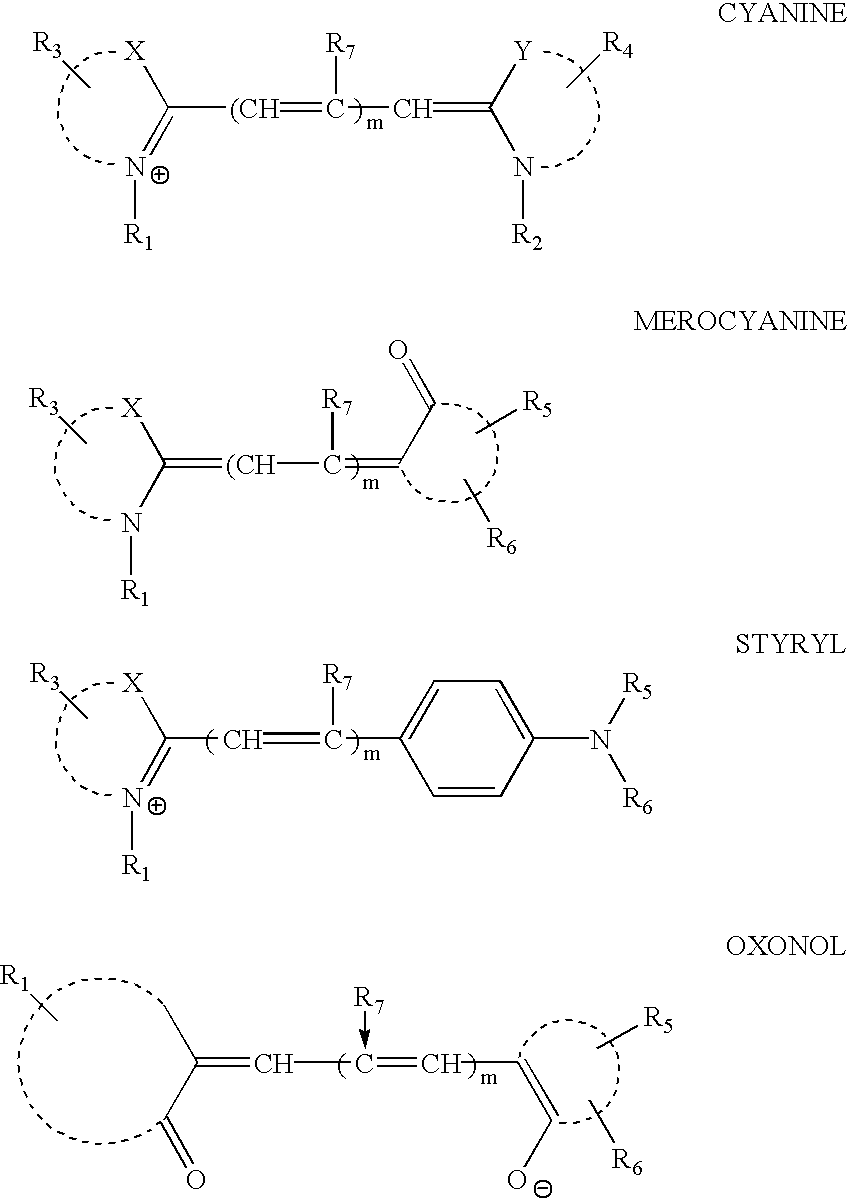
a technology of luminescence and labeling reagents, applied in the field of cyanine dyes as labeling reagents, can solve the problems of affecting the accuracy of detection, and affecting the detection effect of biological and other materials,

Inactive Publication Date: 2002-10-10
CARNEGIE MELLON UNIV
View PDF0 Cites 3 Cited by
  • Summary
  • Abstract
  • Description
  • Claims
  • Application Information

AI Technical Summary

Problems solved by technology

When employing fluorescers for the above purposes, there are many constraints on the choice of the fluorescer.
One constraint is the absorption and emission characteristics of the fluorescer, since many ligands, receptors, and materials in the sample under test, e.g. blood, urine, cerebrospinal fluid, will fluoresce and interfere with an accurate determination of the fluorescence of the fluorescent label.
In many situations, conjugation to another molecule may result in a substantial change in the fluorescent characteristics of the fluorescer and, in some cases, substantially destroy or reduce the quantum efficiency of the fluorescer.
Also of concern is whether the fluorescent molecules will interact with each other when in close proximity, resulting in self-quenching.
Fluorescein, a widely used fluorescent compound, is a useful emitter in the green region although in certain immunoassays and cell analysis systems background autofluorescence generated by excitation at fluorescein absorption wavelengths limits the detection sensitivity.
However, the conventional red fluorescent label rhodamine has proved to be less effective than fluorescein.
The phycobiliproteins have the disadvantages that (1) the protein labeling procedure is relatively complex; (2) the protein labeling efficiency is not usually high (typically an average of 0.5 phycobiliprotein molecules per protein); (3) the phycobiliprotein is a natural product and its preparation and purification is complex; (4) the phycobiliproteins are expensive; (5) there are at present no phycobiliproteins available as labeling reagents that fluoresce further to the red region of the spectrum than allophycocyanine, which fluoresces maximally at 680 nm; (6) the phycobiliproteins are large proteins with molecular weights ranging from 33,000 to 240,000 and are larger than many materials that it is desirable to label, such as metabolites, drugs, hormones, derivatized nucleotides, and many proteins including antibodies.
The latter disadvantage is of particular importance because antibodies, avidin, DNA-hybridization probes, hormones, and small molecules labeled with the large phycobiliproteins may not be able to bind to their targets because of steric limitations imposed by the size of the conjugated complex.

Method used

the structure of the environmentally friendly knitted fabric provided by the present invention; figure 2 Flow chart of the yarn wrapping machine for environmentally friendly knitted fabrics and storage devices; image 3 Is the parameter map of the yarn covering machine
View more

Image

Smart Image Click on the blue labels to locate them in the text.
Viewing Examples
Smart Image
  • Cyanine dyes as labeling reagents for detection of biological and other materials by luminescence methods
  • Cyanine dyes as labeling reagents for detection of biological and other materials by luminescence methods
  • Cyanine dyes as labeling reagents for detection of biological and other materials by luminescence methods

Examples

Experimental program
Comparison scheme
Effect test

example 1

[0068] Reactive Dye I: Anhydro-1-methyl-1'-sulfobutyl-5-N-(3,5-dichloro-2,-4,6-triazinyl)-aminomethyl-indodicarbocyanine Hydroxide 8

[0069] 5-aminomethyl-1,3,3 trimethyl-2-methylene-indolenine (A) was synthesized according to Gale et al., Austr. J. Chem. 30:689-694 (1977). To a solution of 1.0 g cynuric chloride in dry methylene dichloride (40 ml) cooled to -12.degree. C. under nitrogen was added dropwise with stirring a solution of 1.01 g of the aminomethyl-indolenine and 0.7 ml triethylamine in 60 ml methylene dichloride. The resulting brown solution was stirred for 1.5 hr. at 0.degree. C., diluted with 100 ml methylene dichloride and washed with 80 ml water. The light red organic layer was washed with sat. salt solution, dried over sodium sulfate and concentrated to give 1.07 g of a reddish oil, (B).

[0070] 2,3,3-trimethyl-(3H)-indole (0.48 g) and butane-1, 4-sultone (0.42 g) were heated for three hours in a stoppered flask at 120.degree. C. The viscous semi-solid red mass was cool...

example 2

[0073] Reactive Dye II: 1-(.gamma.)-isothiocyanatopropyl-1'-methyl-indocar-bocyanine Bromide, 9

[0074] 2,3,3-trimethyl-(3H)-indole and N-(3-bromo-propyl)-phthalimide (2.7 g) were heated at 110.degree. C. in a sealed tube for four hours. The resulting red viscous mass solidified on cooling was washed with ether (2.times.20 ml) and then dried. The 1-(3-phthalimido propyl)-2,3,3-trimethyl indolinium bromide intermediate (C) was crystallized from ethanol-ether.

[0075] To produce the second intermediate (D), 2,3,3-trimethyl (3H)-indole (1.6 g) and methyl toluenesulfonate (1.9 g) were heated at 120.degree. C. for 4 hours then cooled to room temperature. To form the cyanine dye intermediate, (E), N, N'-diphenyl formamidine (2 g) and acetic anhydride (25 ml) were added to the solution containing (D) and the mixture was heated with stirring for ten minutes at 110.degree. C. then cooled. To this solution was added an ethanol solution containing intermediate (C). The mixture was heated to comple...

example 3

[0079] Reactive Dye III: Anhydro-1-methyl-1'-(3-sulfopropyl)-5-iodoacetami-do-indocarbocyanine Hydroxide 10

[0080] The first intermediate, 5-amino-1,3,3 trimethyl-2-methylene-indolen-ine (F) was prepared according to Gale and Wilshire (1974). The second intermediate, 5-chloroacetamido-1,3,3-trimethyl-2-methylene indolenine (G) was prepared by adding chloroacetylchloride (3.2 ml) in 180 ml dry benzene dropwise with stirring to 1.88 g of (F) in 180 ml dry benzene at 0-5.degree. C. After stirring for 2 hr. more, 100 ml cold water was added. The aqueous layer was separated, made alkaline with ammonium hydroxide and extracted with ether. The ether extract was dried over anhydrous magnesium sulfate and concentrated. Recrystallization of the residue from dichloromethane-hexane (3-10) gave 2 g of yellow crystals, (G), m.p. 128-131.degree. C..

[0081] The third intermediate, (H), was formed by the following procedure. A 1.7 g sample of 2,3,3-trimethyl-(3H)-indole and 1.3 g propane-1,3-sultone w...

the structure of the environmentally friendly knitted fabric provided by the present invention; figure 2 Flow chart of the yarn wrapping machine for environmentally friendly knitted fabrics and storage devices; image 3 Is the parameter map of the yarn covering machine
Login to View More

PUM

PropertyMeasurementUnit
pHaaaaaaaaaa
wavelengthaaaaaaaaaa
excitation wavelengthaaaaaaaaaa
Login to View More

Abstract

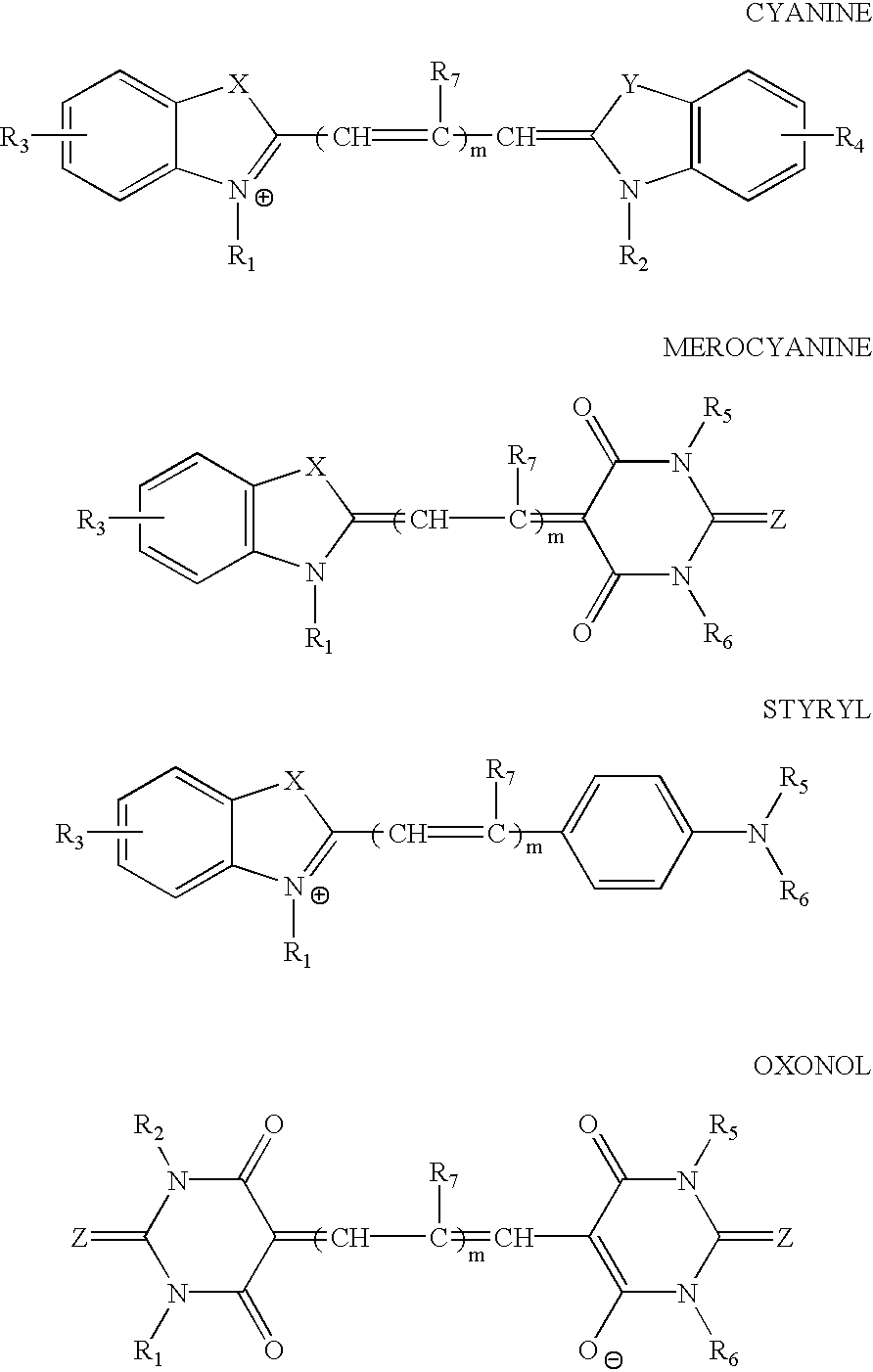
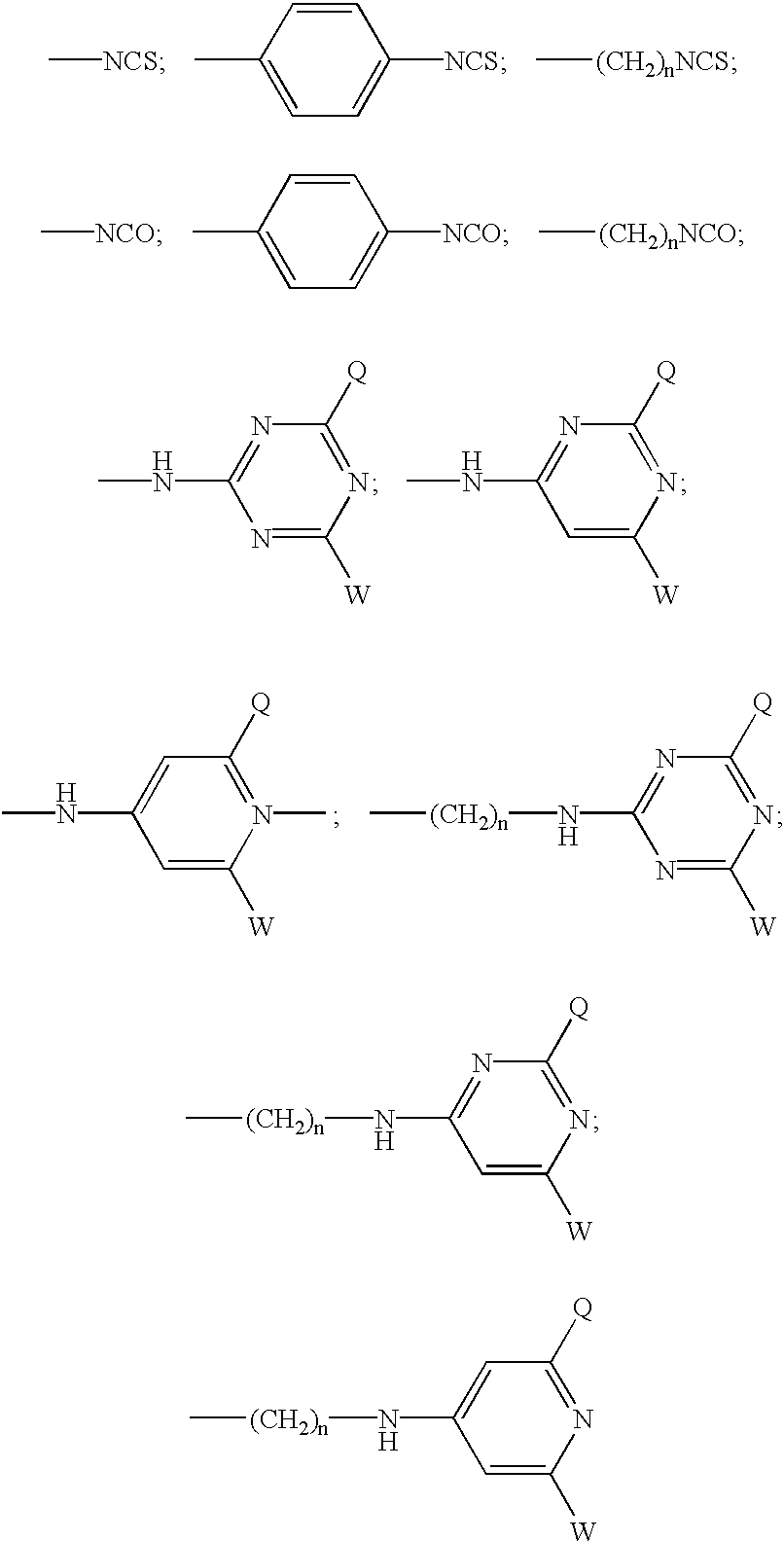
The present invention pertains to luminescent dyes and methods for covalently attaching the dyes to a component or mixture of components so that the components may be detected and / or quantified by luminescence detection methods. The dyes are cyanine and cyanine-type dyes that contain or are derivatized to contain a reactive group. The reactive group is covalently reactive with amine, hydroxy and / or sulfhydryl groups on the component so that the dye can be covalently bound to the component. In addition, the dyes are preferably soluble in aqueous or other medium in which the component is contained. The components to be labeled can be either biological materials, such as antibodies, antigens, peptides, nucleotides, hormones, drugs, or non-biological materials, such as polymers, glass, or other surfaces. Any luminescent or light absorbing detecting step can be employed in the method of the invention.

Description

[0002] Cyanine and related polymethine dyes having light absorbing properties have been employed in photographic films. Although such dyes require light absorbing properties, they do not require luminescence (fluorescent or phosphorescent) properties. Cyanine dyes having luminescence properties heretofore have had very limited utilization. One such utilization involved specifically labeling the sulfhydryl group of proteins. In one report, Salama, G., Waggoner, A. S., and Abramson, J. have reported under the title Sulfhydryl Reagent Dyes Trigger the Rapid Release of Ca.sup.2+ from Sarcoplasmic Reticulum Vesicles (SR), Biophysical Journal, 47, 456a (1985) that cyanine chromophores having an iodoacetyl group was used to form covalent bonds with sulfhydryl groups on the Sarcoplasmic Reticulum protein at Ph 6.7 to trigger Ca.sup.2+ release. The report also stated that fluorescent dyes were used to label and isolate those proteins.[0003] In a report of A. S. Waggoner, P. L. Jenkins and J....

Claims

the structure of the environmentally friendly knitted fabric provided by the present invention; figure 2 Flow chart of the yarn wrapping machine for environmentally friendly knitted fabrics and storage devices; image 3 Is the parameter map of the yarn covering machine
Login to View More

Application Information

Patent Timeline
no application Login to View More
Patent Type & Authority Applications(United States)
IPC IPC(8): C07H21/00C09B23/02
CPCC07D209/14C07D209/60C07D403/12Y10T436/173845C07H21/00C09B23/02C07H5/06
Inventor WAGGONER, ALAN S.
Owner CARNEGIE MELLON UNIV
Features
  • R&D
  • Intellectual Property
  • Life Sciences
  • Materials
  • Tech Scout
Why Patsnap Eureka
  • Unparalleled Data Quality
  • Higher Quality Content
  • 60% Fewer Hallucinations
Social media
Patsnap Eureka Blog
Learn More