Check patentability & draft patents in minutes with Patsnap Eureka AI!

Low triggering N MOS transistor for ESD protection working under fully silicided process without silicide blocks

a low-triggering n-mos transistor and esd protection technology, applied in the direction of transistors, semiconductor devices, semiconductor/solid-state device details, etc., can solve the problems of reducing esd performance, ldd junction silicide, and high snapback voltage of some devices

Inactive Publication Date: 2003-06-05
KARMIC DESIGN USA
View PDF8 Cites 0 Cited by
  • Summary
  • Abstract
  • Description
  • Claims
  • Application Information

AI Technical Summary

Problems solved by technology

It is well known that silicidation of the drain and LDD junctions reduce ESD performance significantly.
However, this kind of device has high snapback voltage.
Also, the high snapback voltage of the stacked NMOS degrades its IT2 (IT2 is the second breakdown trigger current)) since the power dissipation is great.
So, the need for high voltage tolerant I / O's severely complicates ESD protection.
There is a challenge to device a new ESD device for silicide process that improve the ESD performance by lowering the Vt1 and lower leakage.

Method used

the structure of the environmentally friendly knitted fabric provided by the present invention; figure 2 Flow chart of the yarn wrapping machine for environmentally friendly knitted fabrics and storage devices; image 3 Is the parameter map of the yarn covering machine
View more

Image

Smart Image Click on the blue labels to locate them in the text.
Viewing Examples
Smart Image
  • Low triggering N MOS transistor for ESD protection working under fully silicided process without silicide blocks
  • Low triggering N MOS transistor for ESD protection working under fully silicided process without silicide blocks
  • Low triggering N MOS transistor for ESD protection working under fully silicided process without silicide blocks

Examples

Experimental program
Comparison scheme
Effect test

first embodiment

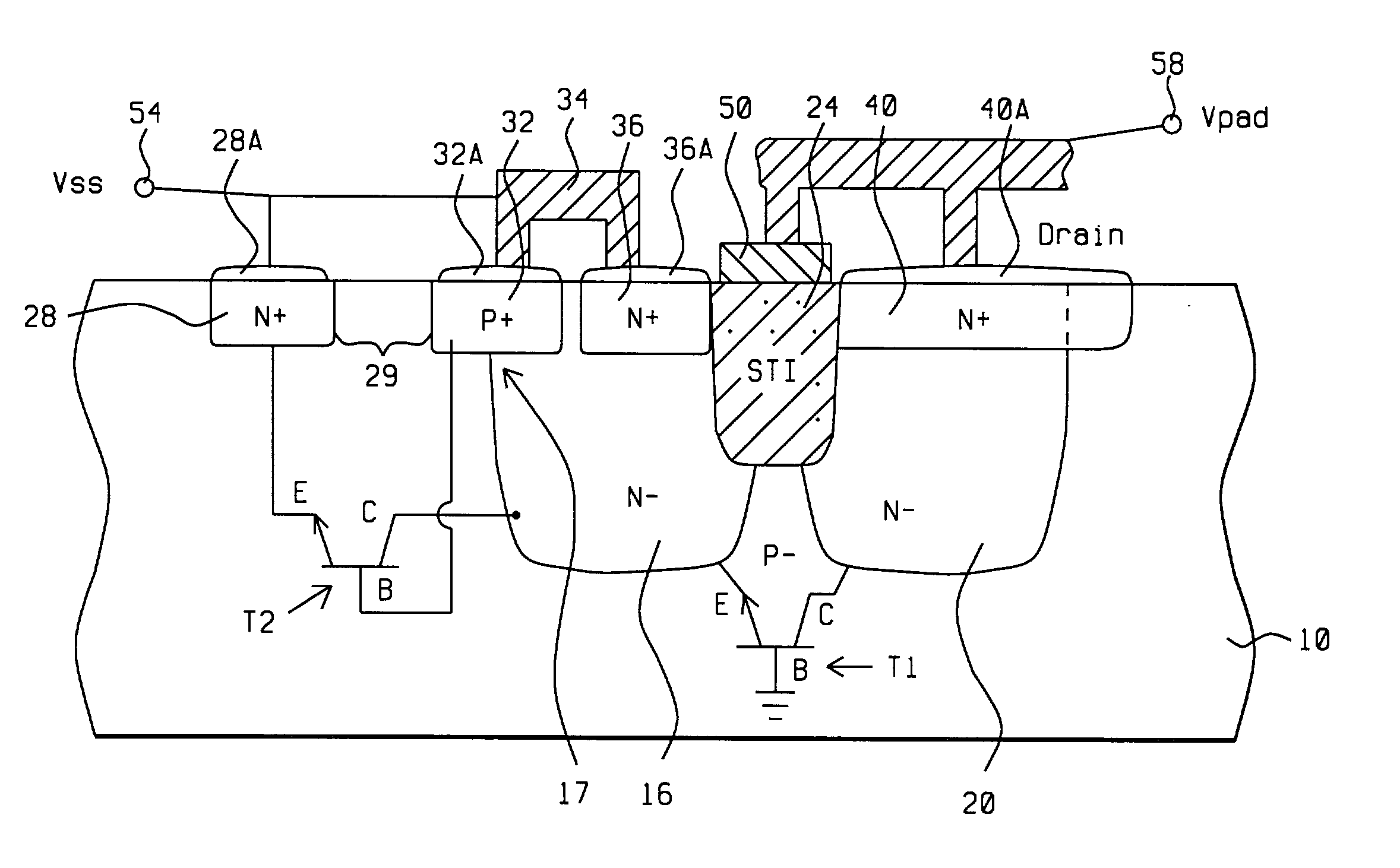
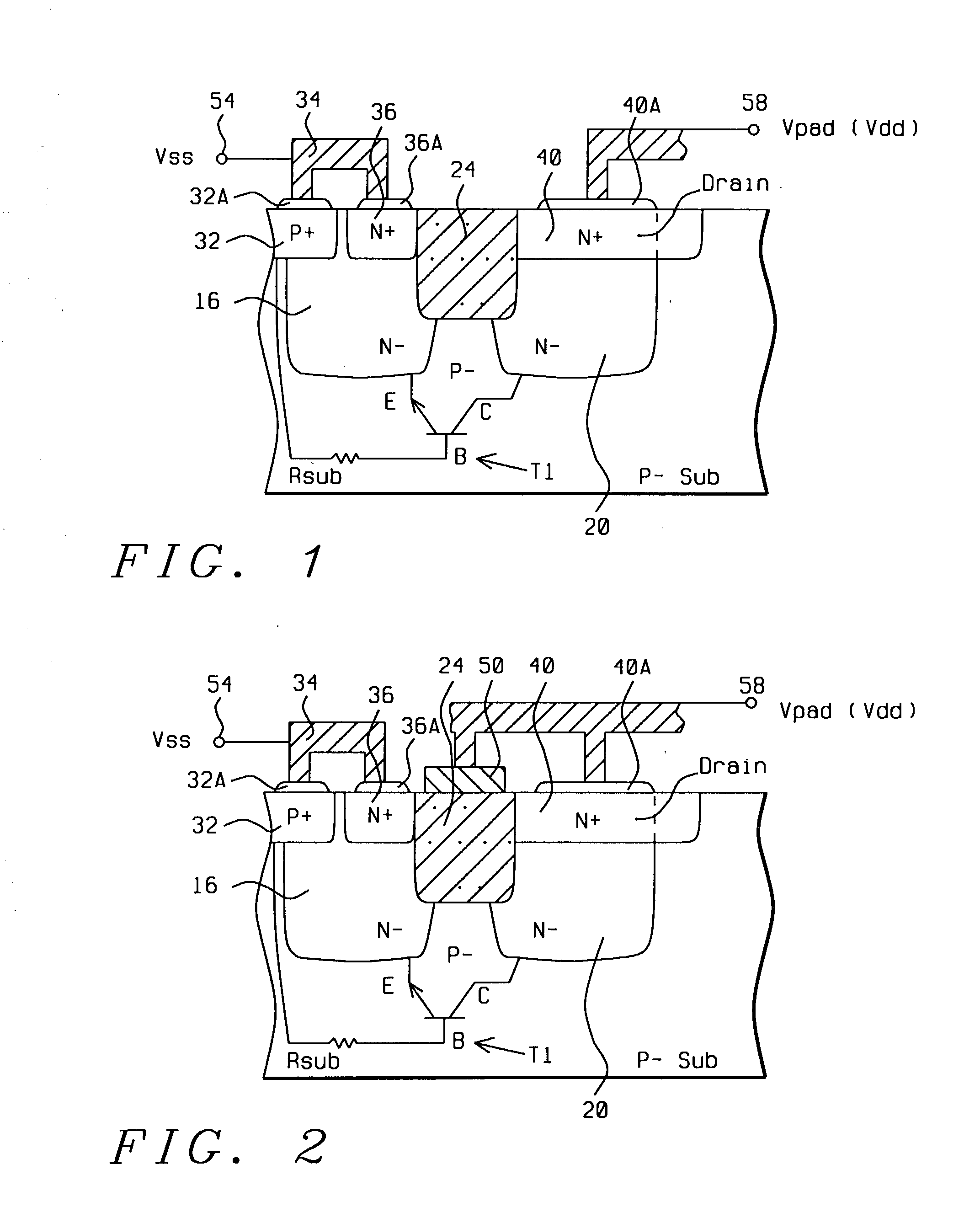
[0042] Method for First Embodiment

[0043] We form a first n+ region 40 and a second n+ region 36 are separated by a first isolation region 24 in a substrate 10. The substrate 10 is p- doped.

[0044] We form a first n- well 20 overlaps only a portion of the first isolation region 24 and overlapping a portion of the first n+ region 40.

[0045] We form a first p+ region 32 is adjacent to, but does not contact the second n+ region 36.

[0046] We form a second n- well 16 overlaps a portion of the first p+ region 32 and all of a second n+ region 36. The second n+ region 36 abutting a first isolation region 24. The second n- well 16 overlaps a portion of the first isolation region 24. The second n- well is between the first p+ region 32 and the second n+ region 36.

[0047] The first P+ region 32 and the second N+ region 36 are connected (e.g., 34) in parallel to a source 54. We can form this connection using conductive lines.

[0048] We form silicide regions 32A 36A 40A are over the first and second ...

second embodiment

[0050] B. Second Embodiment

[0051] The second embodiment is similar to the first embodiment with the addition of the first gate 50 over the isolation region 24. The first gate 50 is preferably connected to the first n+ region 40 and the Vpad 58

[0052] The method of the second embodiment is similar to the first embodiment with the additional step of forming the first gate 50 over the isolation region 24. Also, we preferably connect the first gate 50 to the first n+ region 40 and the Vpad 58.

[0053] It is theorized that the gate 50, when charged by a Vpad voltage, will create an electric field under the first isolation region 24 and possibly create an inversion layer or a accumulation layer. This layer could lower the Vt1 (trigger voltage) of the parasitic bipolar ESD device.

third embodiment

[0054] C. Third Embodiment

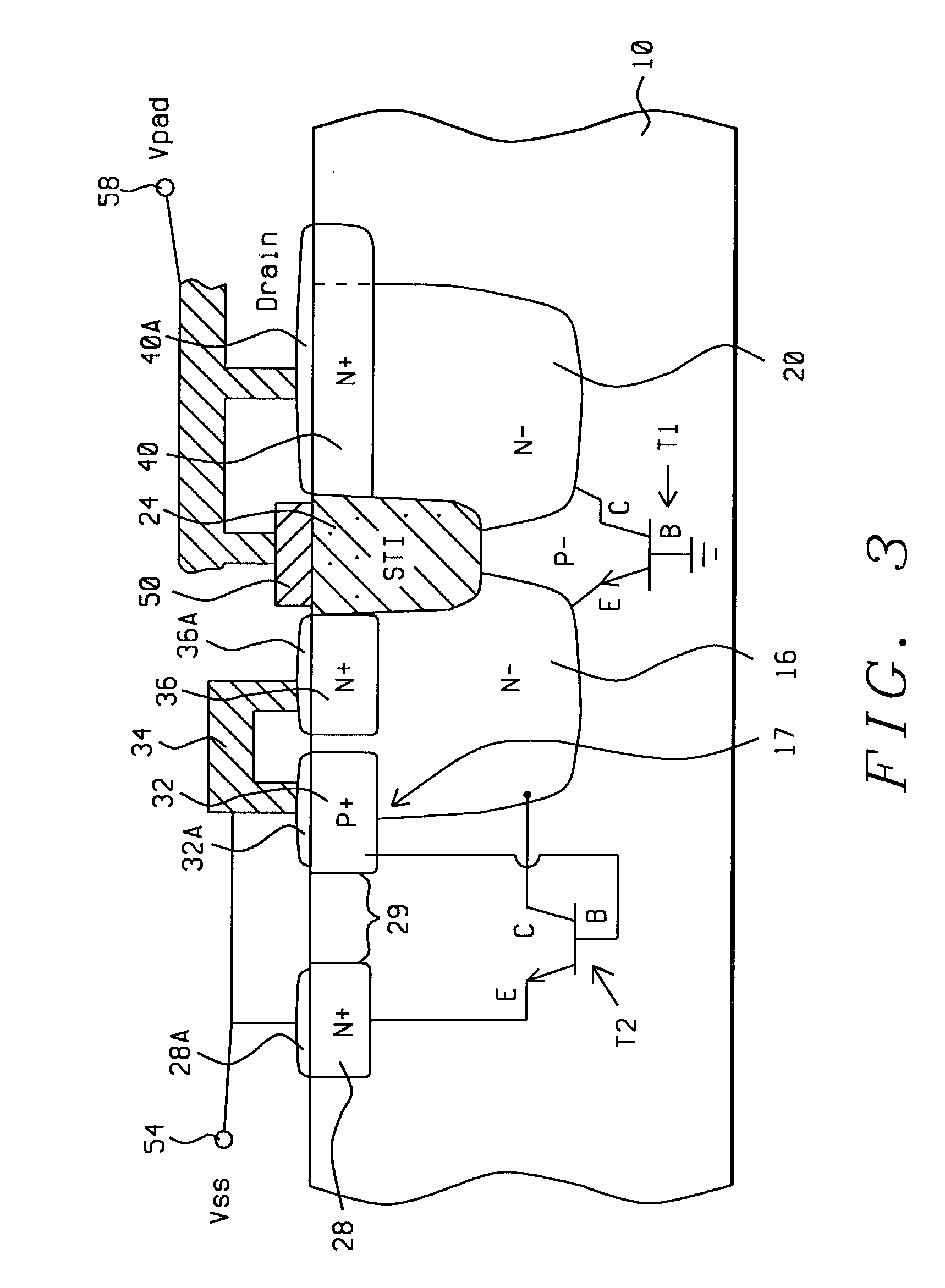
[0055] As shown in FIG. 3, the third embodiment contains the same elements as the second embodiment with the addition of a third n+ region 28. As shown in FIG. 3, a second NPN bipolar (T2) is formed: collector (e g., N+ 36, N- well 16), base (p+ 32 and P- substrate 10) and emitter (N+28).

[0056] The method of the third embodiment is similar to the second embodiment with the additional step(s) of forming the a third n+ region 28.

[0057] The third n+ region 28 is preferably shorted (or connected 34) to the first p+ region 32 and the second n+ region 36. Also, all the n+ and P+ regions have silicide regions overlying (e.g., 28A silicide).

[0058] Circuit Analysis for the 3.sup.rd Embodiment

[0059] The device can go into snap back mode because of the third n+ region 28.

[0060] The 3.sup.rd embodiment's ESD device forms two parasitic bipolar transistors. The first Tx (T1) is the same as in the first and second embodiment. The second parasitic bipolar Tx (T2) is made u...

the structure of the environmentally friendly knitted fabric provided by the present invention; figure 2 Flow chart of the yarn wrapping machine for environmentally friendly knitted fabrics and storage devices; image 3 Is the parameter map of the yarn covering machine
Login to View More

PUM

No PUM Login to View More

Abstract

An ESD device and method using parasitic bipolar transistors that are silicided. The first embodiment is a parasitic Bipolar Junction Transistor comprised of n+ / n- / p- / n- / n+ regions. The emitter is formed of the second N+ region and the second N- well. The parasitic base is formed by the p- substrate or well. The collector is formed of the first well and the first n+ region. The benefit of the first embodiment is the trigger voltage is lower because the junction between the n- well (emitter) and P- substrate (base) and the junction between P- substrate (base) and the n-well have lower cross over concentrations. The second embodiment is similar to the first embodiment with the addition of the first gate. The first gate is preferably connected to the first n+ region and the Vpad. The third embodiment contains the same elements as the second embodiment with the addition of a third n+ region. The third n+ region is preferably shorted (or connected) to the first p+ region and the second n+ region. The third embodiment forms a second NPN parasitic bipolar using the third N+ region as an emitter. The forth embodiment contains the same elements as the third embodiment with the addition of a second gate over the first isolation region. The second gate is preferably connected to the third n+ region to the first p+ region and the second n+ region. The gate changes the electrical characteristics of the first parasitic bipolar transistor.

Description

BACKGROUND OF INVENTION[0001] 1) Field of the Invention[0002] This invention relates generally to fabrication and structures of semiconductor devices and more particularly to the fabrication of an Electro Static Discharge (ESD) device and more particularly an Electro Static Discharge (ESD) device using a silicide process The invention related to a device for on-chip ESD protection.[0003] 2) Description of the Prior Art[0004] The n-type MOS transistor has been widely employed as the primary component for an ESD protection circuit in semiconductor IC devices. It is well known that silicidation of the drain and LDD junctions reduce ESD performance significantly. Most salicided process have a removal option which allows unsalicided areas (e.g., resistors) to be formed and use ESD implant to make junction deeper and to overdose the lightly doped region of the LDD for better ESD performance.[0005] NMOS transistors stacked in a cascade configuration provide robust ESD protection for mixed ...

Claims

the structure of the environmentally friendly knitted fabric provided by the present invention; figure 2 Flow chart of the yarn wrapping machine for environmentally friendly knitted fabrics and storage devices; image 3 Is the parameter map of the yarn covering machine
Login to View More

Application Information

Patent Timeline
no application Login to View More
Patent Type & Authority Applications(United States)
IPC IPC(8): H01L27/02
CPCH01L27/0259H01L29/0847H01L29/7835H01L29/66659H01L29/735H01L29/1087
Inventor HU, DAVIDCAI, JUN
Owner KARMIC DESIGN USA
Features
  • R&D
  • Intellectual Property
  • Life Sciences
  • Materials
  • Tech Scout
Why Patsnap Eureka
  • Unparalleled Data Quality
  • Higher Quality Content
  • 60% Fewer Hallucinations
Social media
Patsnap Eureka Blog
Learn More