Check patentability & draft patents in minutes with Patsnap Eureka AI!

Method for the production of multilayer discs

a technology of multi-layer discs and production methods, applied in the direction of data recording, instruments, electrical equipment, etc., can solve the problems of high cost of this material, inability to separate in both production processes, and degrade the accuracy of the surface structure of the substra

Inactive Publication Date: 2006-01-05
SINGULUS TECHNOLGIES AG
View PDF7 Cites 3 Cited by
  • Summary
  • Abstract
  • Description
  • Claims
  • Application Information

AI Technical Summary

Benefits of technology

[0010] It is therefore proposed for manufacturing an optical disc substrate to deposit onto a first substrate with at least one structured surface an anti-adhesive layer, preferably carbon, and a first layer on top of said anti-adhesive layer. On a second substrate with a structured surface also a layer is deposited. Both substrates are bonded together with the layers facing each other. The separation now easily can take place afterwards alongside the adhesive layer. This way the first layer from the first substrate is being transferred to the second substrate.
[0011] In a broader sense, this is a method for mapping the structure of the first substrate's surface onto a second substrate's surface, by introducing the first substrate in an evacuable chamber, reducing the pressure in the chamber to at least 103 mbar, introducing a working gas and depositing a carbon layer by means of magnetron sputtering onto the surface area to be mapped. After depositing a thin material layer onto the carbon layer this material layer can be transferred onto a second substrate, whereas the carbon layer remains at the first substrate. SOLUTION ACCORDING TO THE INVENTION
[0012] The disk separation method according to both production processes described above is improved by using Polycarbonate for the dummy substrate or stamper, respectively, coating it with a very thin film of carbon or a carbon containing compound conforming to the pit structure and then continue with the process steps necessary for the production of whatever disk has to be produced. In the case of the production of DVD-14 and DVD-18 the next process step is to coat with a reflective film, made e.g. of aluminum or silver. The carbon-based anti-adhesive film allows easy separation of the dummy substrate or stamper, respectively, after bonding with the first substrate.

Problems solved by technology

However, surface tension effects may lead an inhomogenous distribution of the release material and thus to degrade the accuracy of the substrate's surface structure.
Similar problems as in the production of PMMA occur, as different molding parameters as well as high cost of this material.
However, polycarbonate shows high adhesion and can not be separated in both production processes.

Method used

the structure of the environmentally friendly knitted fabric provided by the present invention; figure 2 Flow chart of the yarn wrapping machine for environmentally friendly knitted fabrics and storage devices; image 3 Is the parameter map of the yarn covering machine
View more

Image

Smart Image Click on the blue labels to locate them in the text.
Viewing Examples
Smart Image
  • Method for the production of multilayer discs
  • Method for the production of multilayer discs
  • Method for the production of multilayer discs

Examples

Experimental program
Comparison scheme
Effect test

Embodiment Construction

[0021] A preferred embodiment for the production method of an optical storage media, e. g. a DVD-18, is explained in more detail with reference to FIG. 3.

[0022] A first substrate 10, preferably made from polycarbonate (PC), is being produced, e. g. by injection molding. An anti-adhesive film 11 is applied to the surface of substrate 10, and, in a further production step a further layer 12 is applied on top of layer 11. Layer 12 may be reflective or semi reflective, preferably a thin metal layer.

[0023] The second substrate 13 is being produced like described above for the DVD 9 process, showing a layer 14, e. g. a semi-reflective layer. Adhesive 5 is being used to glue together first substrate 10 and second substrate 13. The separation after this bonding step results in a transfer of layer 12 from substrate 10 to substrate 13. Anti-adhesive film 11 should remain after separation preferably on subtrate 10.

[0024] The equipment used to pratice the inventive method may comprise: Vacuu...

the structure of the environmentally friendly knitted fabric provided by the present invention; figure 2 Flow chart of the yarn wrapping machine for environmentally friendly knitted fabrics and storage devices; image 3 Is the parameter map of the yarn covering machine
Login to View More

PUM

PropertyMeasurementUnit
thickaaaaaaaaaa
pressureaaaaaaaaaa
thicknessaaaaaaaaaa
Login to View More

Abstract

A Method for manufacturing an optical disc substrate comprises a first substrate with at least one structured surface, on which an anti-adhesive layer, preferably carbon, is deposited and first layer on top of said anti-adhesive layer. On a second substrate with a structured surface also a layer is deposited. Both substrates are bonded together with the layers facing each other. The separation now easily can take place afterwards alongside the adhesive layer. This way the first layer from the first substrate is being transferred to the second substrate.

Description

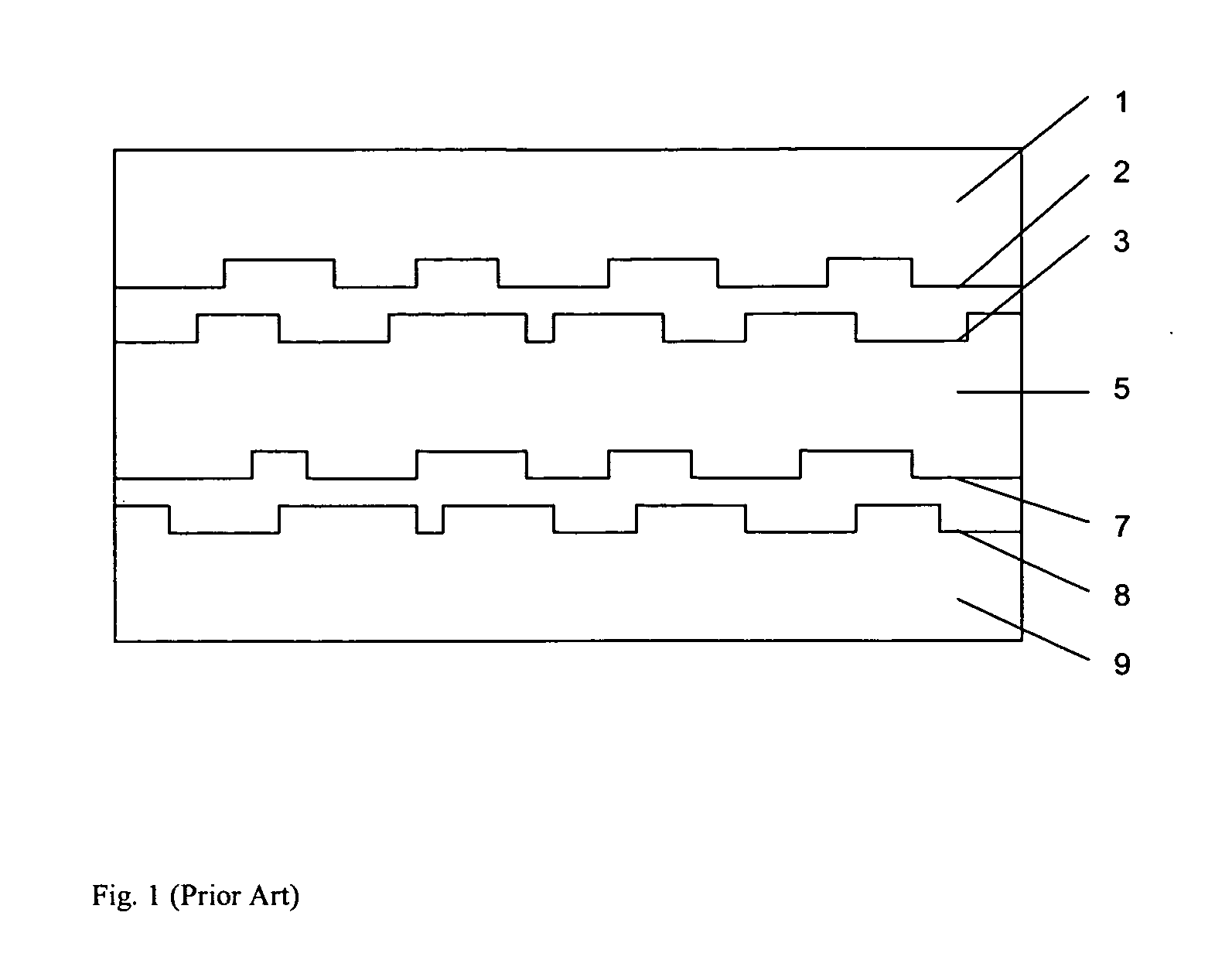
[0001] This invention relates to multilayer disks, in particular DVD14 / DVD18-disks, Dual-Layer-DVD / Recordable disks and Dual-Layer-Blu-Ray Disk. BACKGROUND OF THE INVENTION [0002] DVD-9 are produced by molding two separate disk halves with pits containing the information and then coating these disks with a semi-transparent and a reflective coating and bonding the two disk halves together. If more layers for higher capacity are desired, additional layers have to be added. RELATED ART [0003] In a first process step the double layer is produced as usual in a DVD-9 manufacturing process, as shown in FIG. 2: This requires a dummy substrate 60 made of PMMA or a similar material with a surface 60a. A metal layer 62, usually a fully reflective one, deposited on surface 60a adheres very weakly to the surface 60a. A second substrate 64 is made e. g. from polycarbonate PC by injection moulding. On this substrate 64 a layer 66, e. g. a semi-reflective one is being coated on. In a bonding step b...

Claims

the structure of the environmentally friendly knitted fabric provided by the present invention; figure 2 Flow chart of the yarn wrapping machine for environmentally friendly knitted fabrics and storage devices; image 3 Is the parameter map of the yarn covering machine
Login to View More

Application Information

Patent Timeline
no application Login to View More
Patent Type & Authority Applications(United States)
IPC IPC(8): H01L21/00H01L21/44B32B7/06G11B7/24G11B7/26
CPCG11B7/24038H01L21/2007G11B7/26G11B7/256
Inventor DUBS, MARTINNUTT, WOLFGANGWEINZERL, HELFRIEDEISENHAMMER, THOMAS
Owner SINGULUS TECHNOLGIES AG
Features
  • R&D
  • Intellectual Property
  • Life Sciences
  • Materials
  • Tech Scout
Why Patsnap Eureka
  • Unparalleled Data Quality
  • Higher Quality Content
  • 60% Fewer Hallucinations
Social media
Patsnap Eureka Blog
Learn More