Check patentability & draft patents in minutes with Patsnap Eureka AI!

Multilayer polymer light-emitting diodes for solid state lighting applications

a light-emitting diode and polymer technology, applied in the direction of discharge tube luminescnet screens, natural mineral layered products, transportation and packaging, etc., can solve the problems of successive layer interaction, large-area devices and the use of low-cost manufacturing technology, and can be destructive, so as to facilitate their fabrication and enhance their efficiency

Active Publication Date: 2006-09-14
RGT UNIV OF CALIFORNIA
View PDF29 Cites 12 Cited by
  • Summary
  • Abstract
  • Description
  • Claims
  • Application Information

AI Technical Summary

Benefits of technology

[0007] We have now discovered an improvement in multilayer PLEDs that enhances their efficiency and facilitates their fabrication.
[0008] We have found that the addition of an electron transport layer and / or a hole transport layer adjacent to the emissive layer of a PLED improves the PLED's performance. We have further found that these additional layers can be incorporated into PLEDs by solvent processing techniques if the materials employed in these additional layers are differentially soluble in solvents which differ in polarity from the solvents used to dissolve and solvent process the emissive layer.
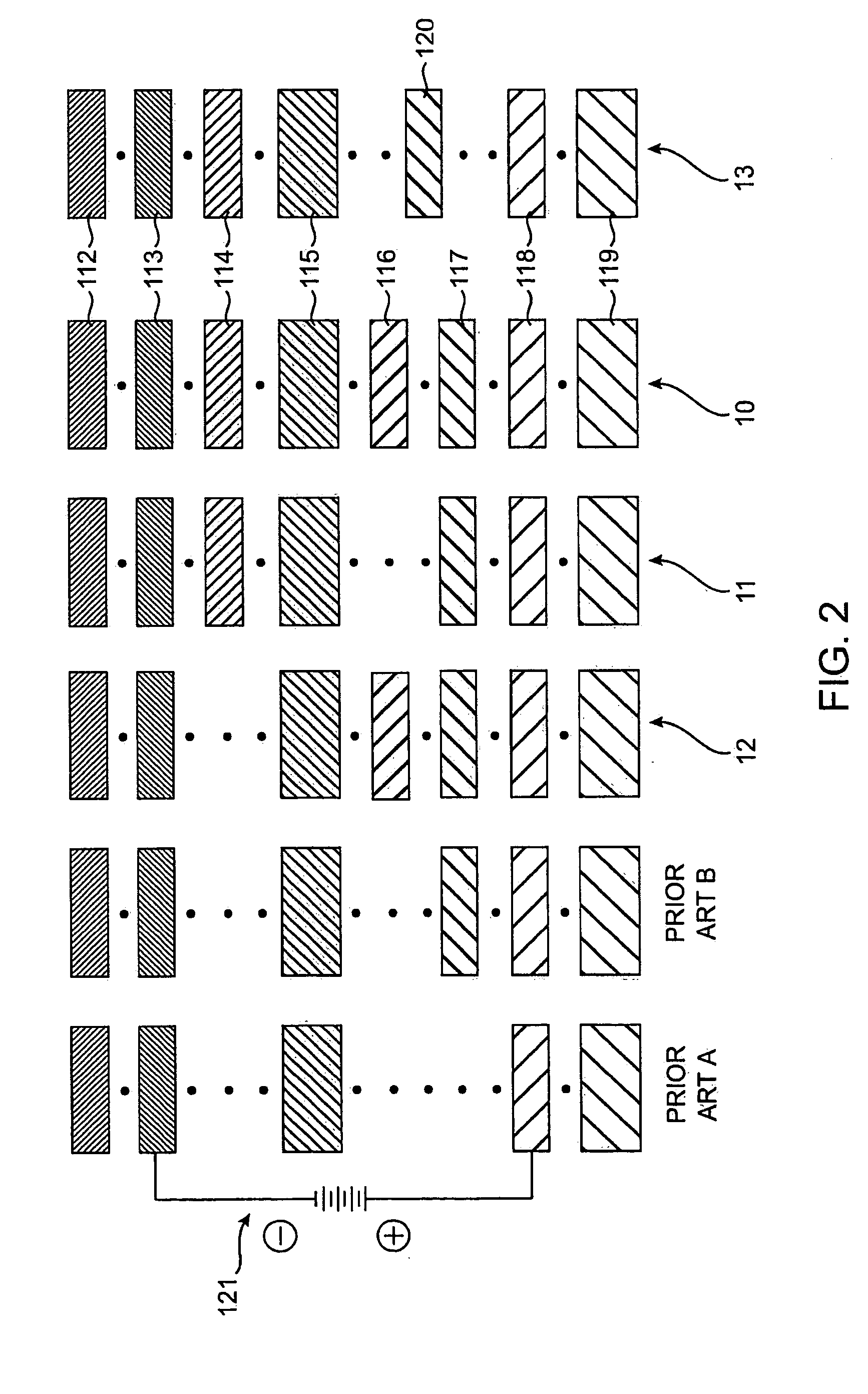
[0009] Thus, this invention can provide multilayer polymer light-emitting diodes (PLEDs) that in certain embodiment emit white light and are useful for solid state lighting applications. More specifically, the present invention can provide multilayer white PLEDs comprising semiconducting polymers blended with organometallic emitters as a relatively nonpolar solvent-soluble emissive layer, and relatively polar solvent-soluble organic materials (polymers or small molecules) as a hole injection / transport layer (HIL / HTL) and / or as an electron injection / transport layer (EIL / ETL); all layers preferably being cast from the corresponding solutions. The white emission of these preferred materials of the present invention can be used for backlights in liquid crystal displays (LCDs) and for solid state lighting applications. The white light is emitted from the polymer blend in a single emissive layer. The strategy developed in this invention enables the fabrication of multilayer white emitting PLEDs by casting the emissive polymer blends, HIL / HTL, and EIL / ETL from the corresponding solutions. This invention also enables the relatively simple fabrication of multilayer PLEDs which emit illumination quality light in all colors from blue to red and including white light. The methodology presented in this invention enables the relatively simple fabrication of multilayer PLEDs which emit illumination quality white light with high brightness, high efficiency, suitable color temperature, high color rendering index, and stable CIE (Commission Internationale de l'Eclairage) coordinates. The method for fabrication of multilayer PLEDs presented in this invention can be used for large-area multilayer displays and other large-area multilayer opto-electronic devices fabricated by casting the various layers from solution.

Problems solved by technology

In such applications, the fabrication of large-area devices and the use of low-cost manufacturing technology will be the major issues.
When multiple organic layers are present there can be problems with successive layers interacting.
It is often desirable to have each layer be smooth and coherent, thus this interaction can be destructive.

Method used

the structure of the environmentally friendly knitted fabric provided by the present invention; figure 2 Flow chart of the yarn wrapping machine for environmentally friendly knitted fabrics and storage devices; image 3 Is the parameter map of the yarn covering machine
View more

Image

Smart Image Click on the blue labels to locate them in the text.
Viewing Examples
Smart Image
  • Multilayer polymer light-emitting diodes for solid state lighting applications
  • Multilayer polymer light-emitting diodes for solid state lighting applications
  • Multilayer polymer light-emitting diodes for solid state lighting applications

Examples

Experimental program
Comparison scheme
Effect test

example 1

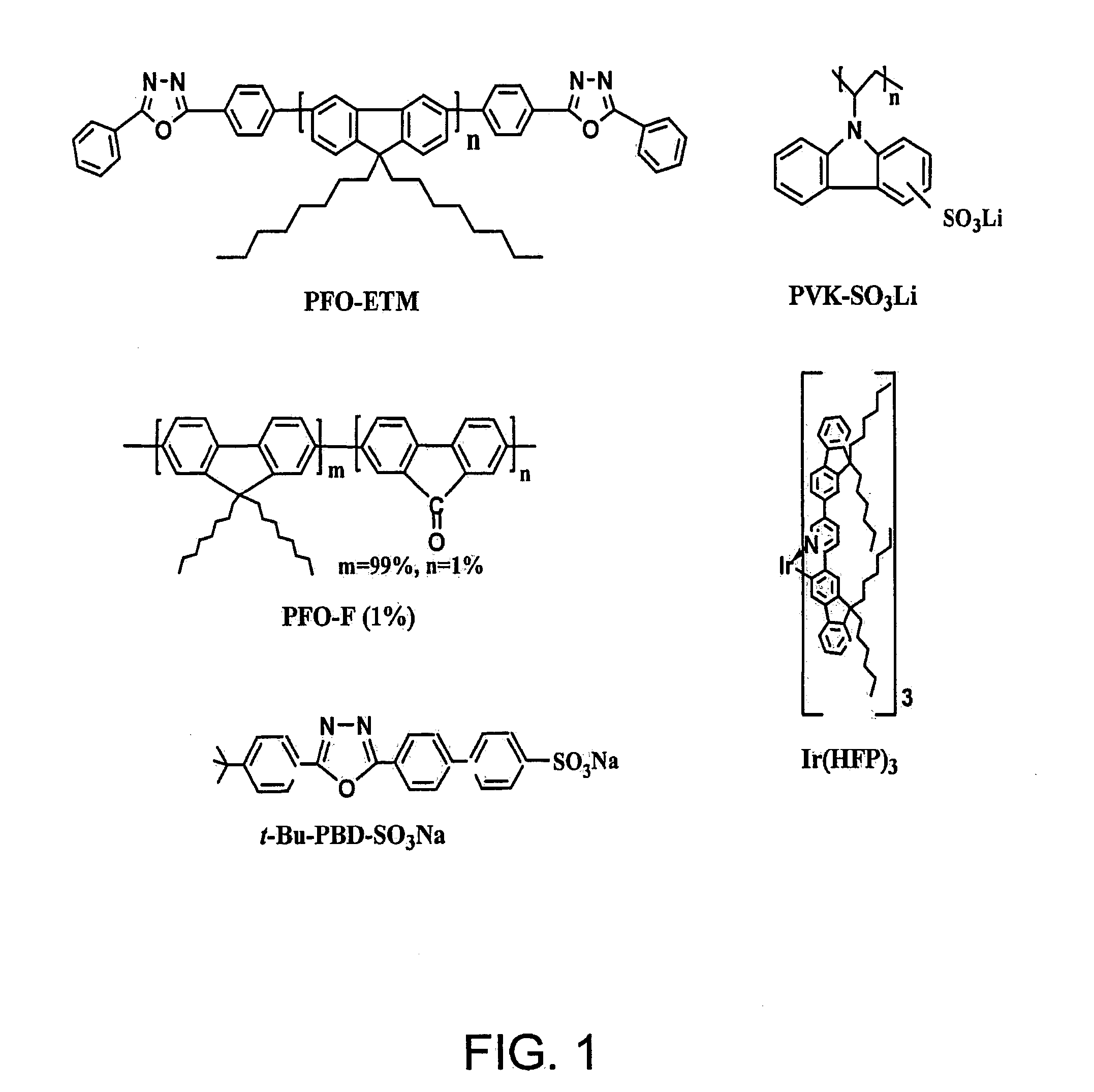
[0102] Synthesis of PVK-SO3Li: The sulfonation of PVK was performed by a procedure described in the literature [S. Wang, Z. Zeng, S. Yang, L.-T. Weng, P. C. L. Wong, K. Ho, Macromolecules, 2000, 33, 3232]. The degree of sulfonation of PVK was about 28%. The sulfonated PVK was dissolved in a minimum amount of hot ethanol, and the resulting solution was cooled down to room temperature. To this solution was added excess EtOLi solution in ethanol and white precipitate was formed. The precipitate was collected by filtration, washed with cooled ethanol and dried under vacuum to obtain the lithium salt PVK-SO3Li.

example 2

[0103] Synthesis of t-Bu-PBD-SO3Na: t-Bu-PBD-SO3H was synthesized by a procedure described in the literature [T. J. Boyd, R. R. Schrock, Macromolecules, 1999, 32, 6608]. A concentrated solution of t-Bu-PBD-SO3H in water / THF(v / v 6:1) was added into a salt brine to afford a white precipitate. The precipitate was extracted into ethanol and the ethanol was removed to obtain the desired sodium salt t-Bu-PBD-SO3Na.

example 3

[0104] Three stock solutions, PFO-ETM, PFO-F (1%) and Ir(HFP)3 were prepared by dissolving 50 mg PFO-ETM, 20 mg PFO-F (1%) and 5 mg Ir(HFP)3 into 1 ml toluene, respectively. The resulting 0.5 wt.-% Ir(HFP)3 solution was diluted to 0.05 wt.-% Ir(HFP)3. The mixtures were stirred overnight at 65° C. and then cooled to room temperature.

[0105] This example demonstrates that the emissive materials used in the practice of this invention are soluble in common nonpolar organic solvents.

the structure of the environmentally friendly knitted fabric provided by the present invention; figure 2 Flow chart of the yarn wrapping machine for environmentally friendly knitted fabrics and storage devices; image 3 Is the parameter map of the yarn covering machine
Login to View More

PUM

PropertyMeasurementUnit
color rendering indexaaaaaaaaaa
luminanceaaaaaaaaaa
CRIaaaaaaaaaa
Login to View More

Abstract

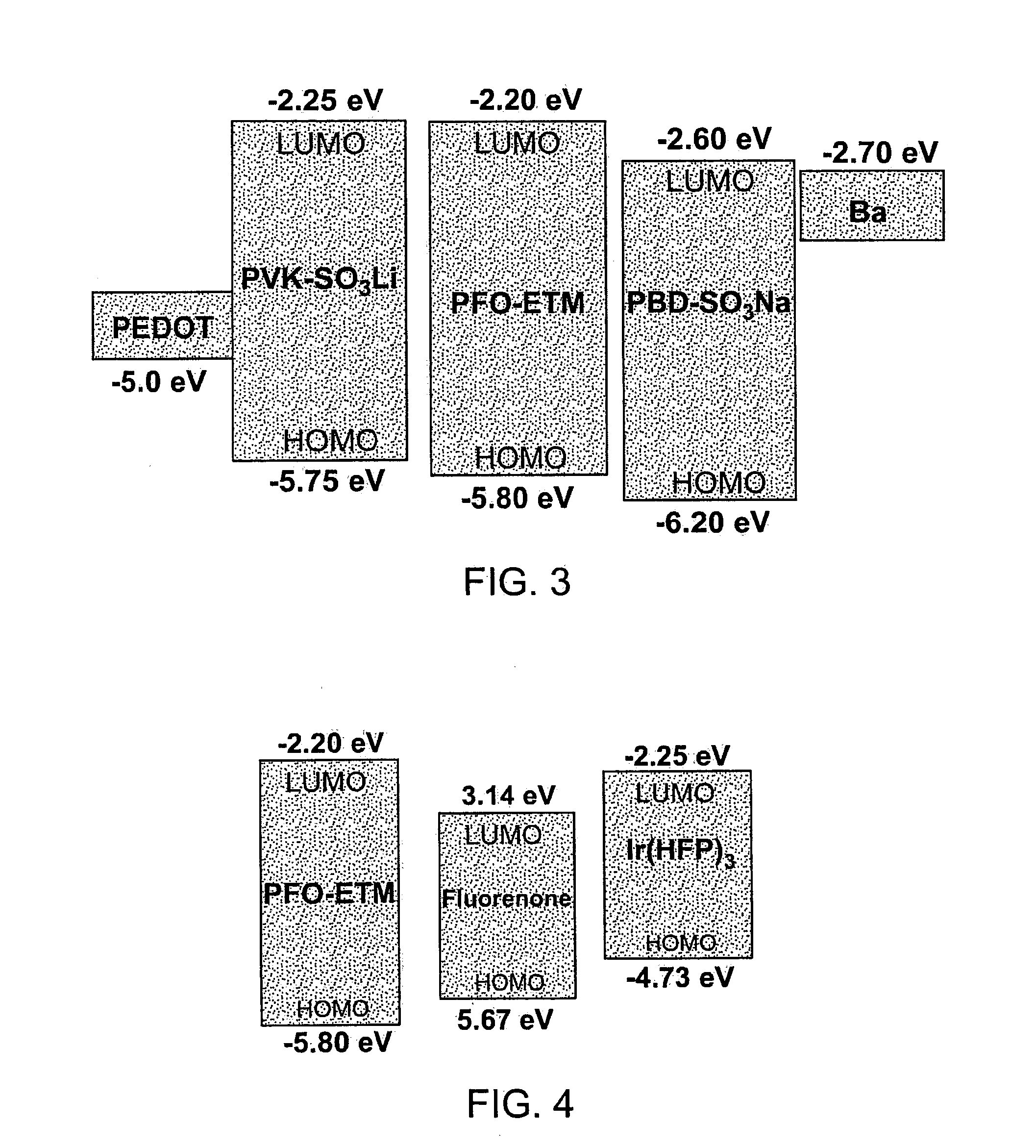
Multilayer polymer light-emitting diodes (PLEDs) are demonstrated using semiconducting polymers blended with organometallic emitters as the emissive layer and one or both of an electron transport layer and a hole transparent layer on the appropriate electron injection and hole injection sides of the emissive layer. The transport layers reduce energy potential gaps between the hole injection electrode and the emissive polymer and between the electron injection electrode and the emissive polymer. A solvent-processing based procedure for preparing these devices is also disclosed It uses nonpolar solvent-based solutions of emissive polymers to form the emissive layer and polar solvent-based solutions to form the transport layers to minimize etching and other undesirable interactions as the multiple layers are being laid down. Illumination quality white light can be obtained with stable Commission Internationale de l'Eclairage coordinates, stable color temperatures, and stable color rendering indices, all close to those of “pure” white light. These multilayer white light-emitting PLEDs are useful as backlights for liquid crystal displays and for solid state lighting applications.

Description

FIELD OF THE INVENTION [0001] This invention is in the field of organic polymer-based light-emitting diodes. More particularly this invention relates to multilayer polymer light-emitting diodes (PLEDs) that, in certain embodiments, emit white light that is useful for solid state lighting applications. This invention also pertains to methods for preparing these diodes. BACKGROUND OF THE INVENTION [0002] Polymer light-emitting diodes (PLEDs) which employ semiconducting polymers as emitting layers have been demonstrated. A wide range of colors of emission can be achieved by varying the materials present in the emitting layers. Blends of emitting polymers alone and together with organometallic emitters can be used to achieve additional color shades of emitted light including white light. [0003] LEDs that emit white light are of interest and potential importance for use as back lights in active matrix displays (with color filters) and because they can be used for solid state lighting [A....

Claims

the structure of the environmentally friendly knitted fabric provided by the present invention; figure 2 Flow chart of the yarn wrapping machine for environmentally friendly knitted fabrics and storage devices; image 3 Is the parameter map of the yarn covering machine
Login to View More

Application Information

Patent Timeline
no application Login to View More
Patent Type & Authority Applications(United States)
IPC IPC(8): H01L51/54H01L51/56
CPCH01L51/0003Y10T428/24942H01L51/0039H01L51/0042H01L51/0043H01L51/007H01L51/0085H01L51/50H01L51/5012H01L51/5016H01L51/5036H01L51/5048H01L51/5088Y10S428/917H01L51/0037H10K71/12H10K85/115H10K85/1135H10K85/146H10K85/151H10K85/6565H10K85/342H10K50/125H10K50/14H10K50/11H10K2101/10H10K50/17H10K50/00
Inventor GONG, XIONGHEEGER, ALAN J.MOSES, DANIELBAZAN, GUILLERMO C.WANG, SHU
Owner RGT UNIV OF CALIFORNIA
Features
  • R&D
  • Intellectual Property
  • Life Sciences
  • Materials
  • Tech Scout
Why Patsnap Eureka
  • Unparalleled Data Quality
  • Higher Quality Content
  • 60% Fewer Hallucinations
Social media
Patsnap Eureka Blog
Learn More