Method and apparatus for encoding or decoding two digital video signals arranged in a single-video signal path

a digital video and signal path technology, applied in the field of methods and apparatuses for encoding or decoding two digital video signals arranged in a singlevideo signal path, can solve the problems of negative influence of each additional meter of cable signal quality, g. the s/n ratio, etc., and achieve the effect of reducing the length of data words

US20070116114A1Inactive Publication Date: 2007-05-24GVBB HLDG R L
5 Cites 6 Cited by

Patent Information

Authority / Receiving Office
US · United States
Current Assignee / Owner
Publication Date
2007-05-24
Estimated Expiration
Not applicable · inactive patent

Smart Images

  • Figure 1
    Figure 1
  • Figure 2
    Figure 2
  • Figure 3
    Figure 3
Patent Text Reader

Abstract

In high-end professional video cameras a triax system is used for transferring various signals back and forth over a single coaxial cable between the camera and a base unit using frequency multiplexing. In current low-cost camera systems several signals are transferred as analogue signals over separate wires or cables. However, the analogue camera CVBS video output signal is replaced by a standard serial SDI signal from the camera to a base unit, achieving a maximum data rate of 270 Mbit / s. According to the invention, a single SDI or HDSDI connection is used for transmitting a digital playback video signal as well as a digital teleprompter video signal from the base unit to the camera. A one-dimensional adaptive dynamic range compression is used to reduce the data word length of the two video signals to be transmitted via the SDI / HDSDI connection. To one of the two video signals a smaller data word length is assigned than to the data word length of the other one.
Need to check novelty before this filing date? Find Prior Art

Description

FIELD OF THE INVENTION

[0001] The invention relates to a method and to an apparatus for encoding or decoding two digital video signals arranged in a single-video signal path, e.g. an SDI or HDSDI format video signal path. BACKGROUND OF THE INVENTION

[0002] In the upper part of the market of professional video cameras a triax system is used for transferring various signals back and forth over a coaxial cable between the camera and a base unit. Transferring multiple signals in different direction over a single cable is feasible because frequency multiplexing is used in which to every type of signal a separate frequency band is assigned.

[0003] In the lower part of the market a multi-core adapter solution is currently being used.

[0004] In earlier systems all signals were transferred as analogue signals over separate wires or cables. Because no frequency multiplex / de-multiplex is required such solution is much cheaper. However, a disadvantage is that the maximum distance between camera...

Examples

Embodiment Construction

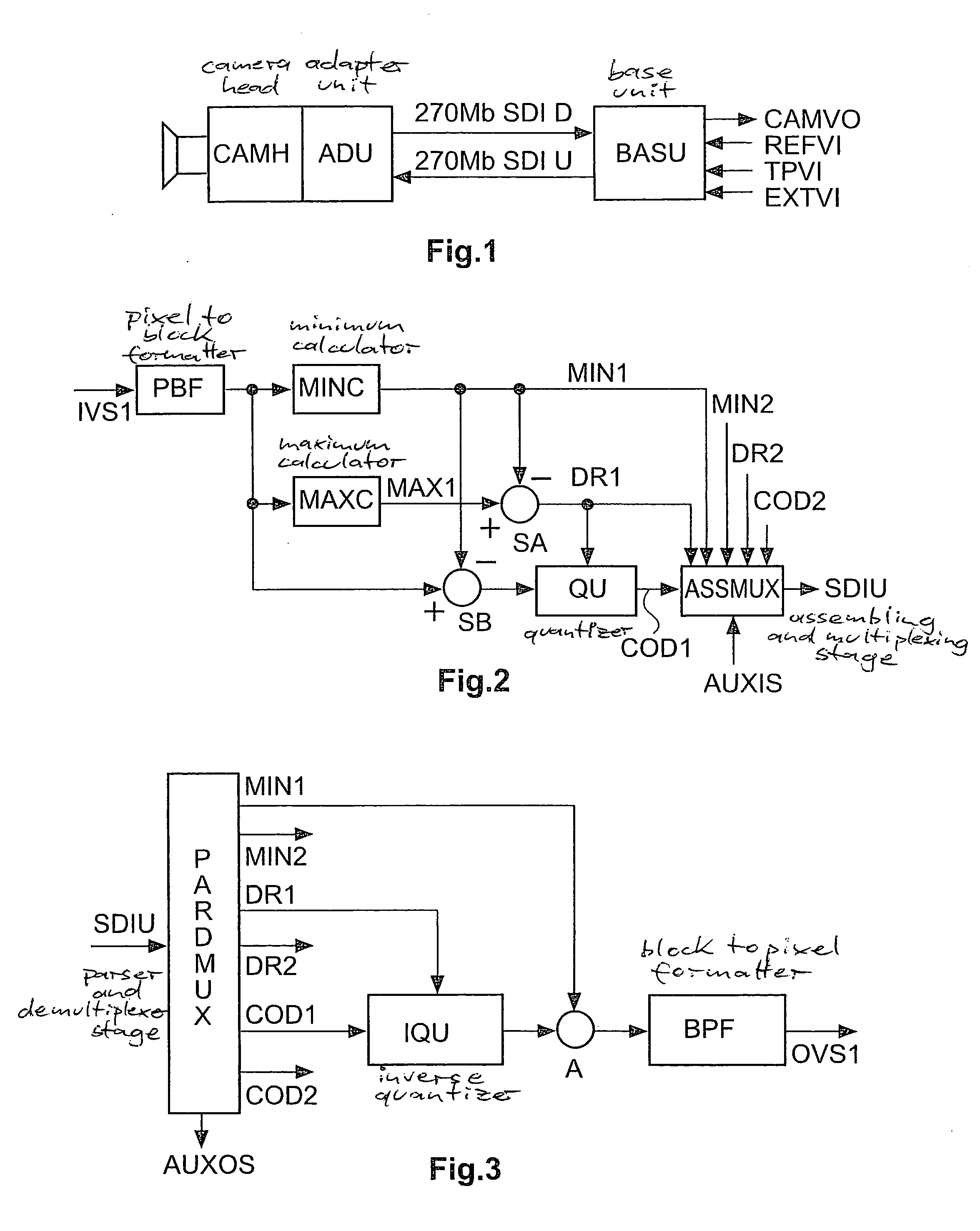
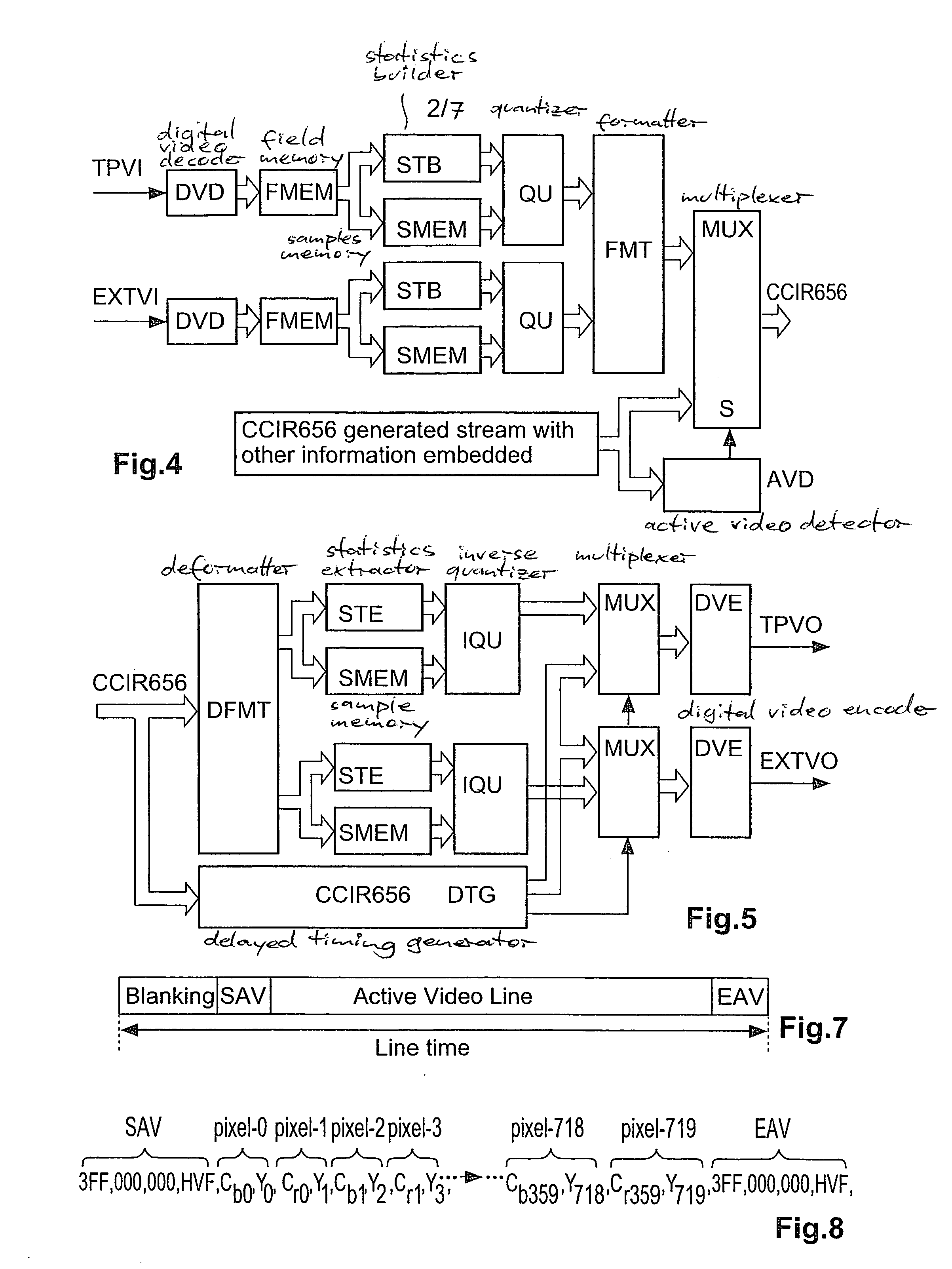
[0057] In FIG. 1 an adapter unit ADU is attached to a camera head CAMH. A base unit BASU receives a reference video input signal REFVI, a teleprompter video input signal TPVI and has an Extern video in terminal EXTVI for entering auxiliary signals. BASU outputs a camera video output signal CAMVO. The base unit sends to the adapter unit the above-described SDI / HDSDI upstream data stream SDIU carrying TP and Play-back, and receives from the adapter unit an SDI / HDSDI down-stream SDID carrying the camera video signal.

[0058] In FIG. 2 the encoder receives a digital video input signal IVS1. In the PAL, SECAM and NTSC TV systems the active video portion of one video line has 720 pixels with 1440 components. These components are arranged in a multiplexed fashion: Cb-Y-Cr-Y-Cb-Y-Cr-Y- etc., wherein Y represents an e.g. 10-bit luminance sample, Cb represents an e.g. 10-bit blue-component chrominance sample and Cr represents a corresponding red-component chrominance sample. The possible ampli...