Bias circuit and control method for bias circuit
- Summary
- Abstract
- Description
- Claims
- Application Information
AI Technical Summary
Benefits of technology
Problems solved by technology
Method used
Image


Examples
Embodiment Construction
[0037]The best mode for carrying out the invention will be described below.
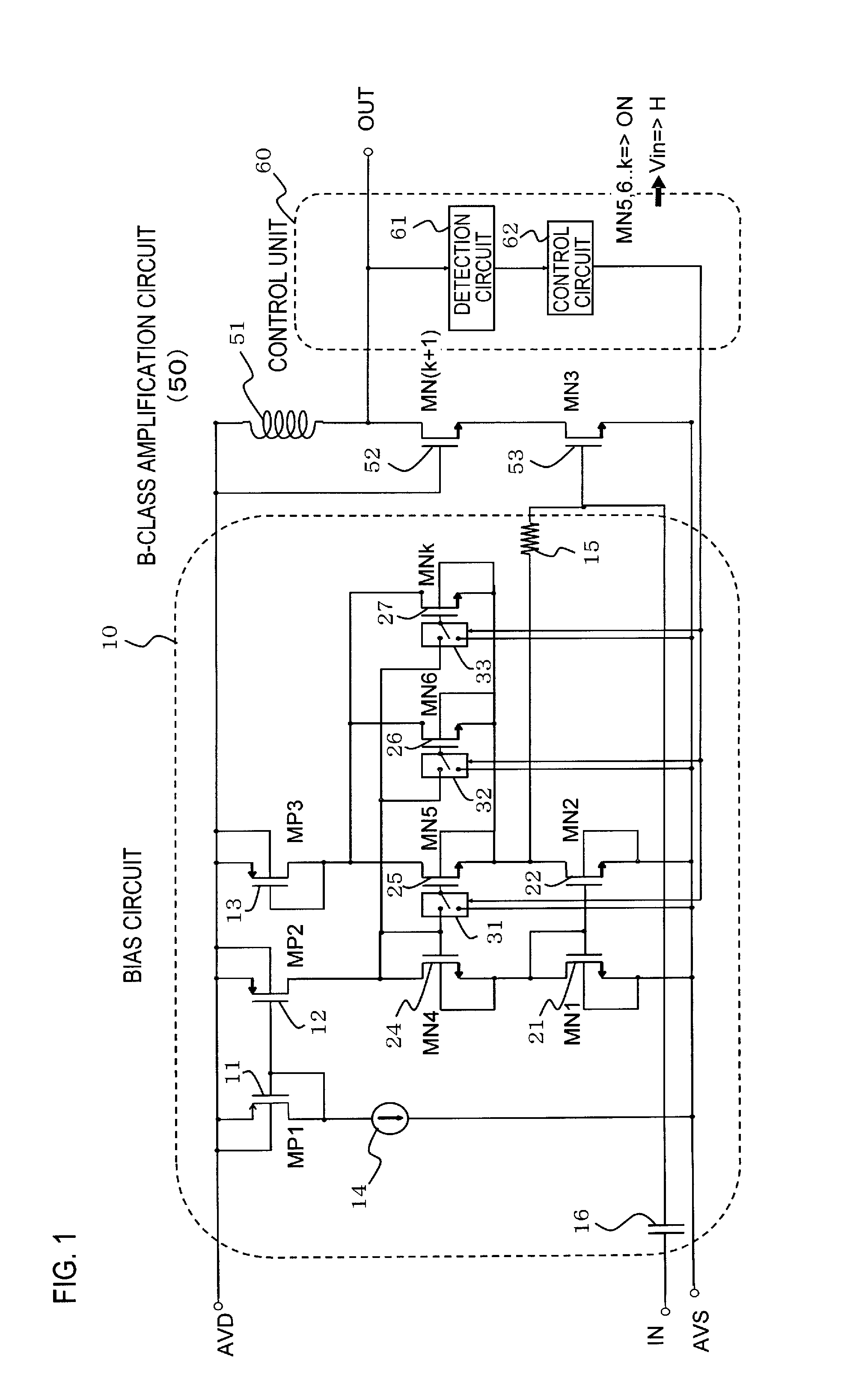
[0038]FIG. 1 illustrates configuration examples of a bias circuit 10, a B-class amplification circuit 50, and a control unit 60.
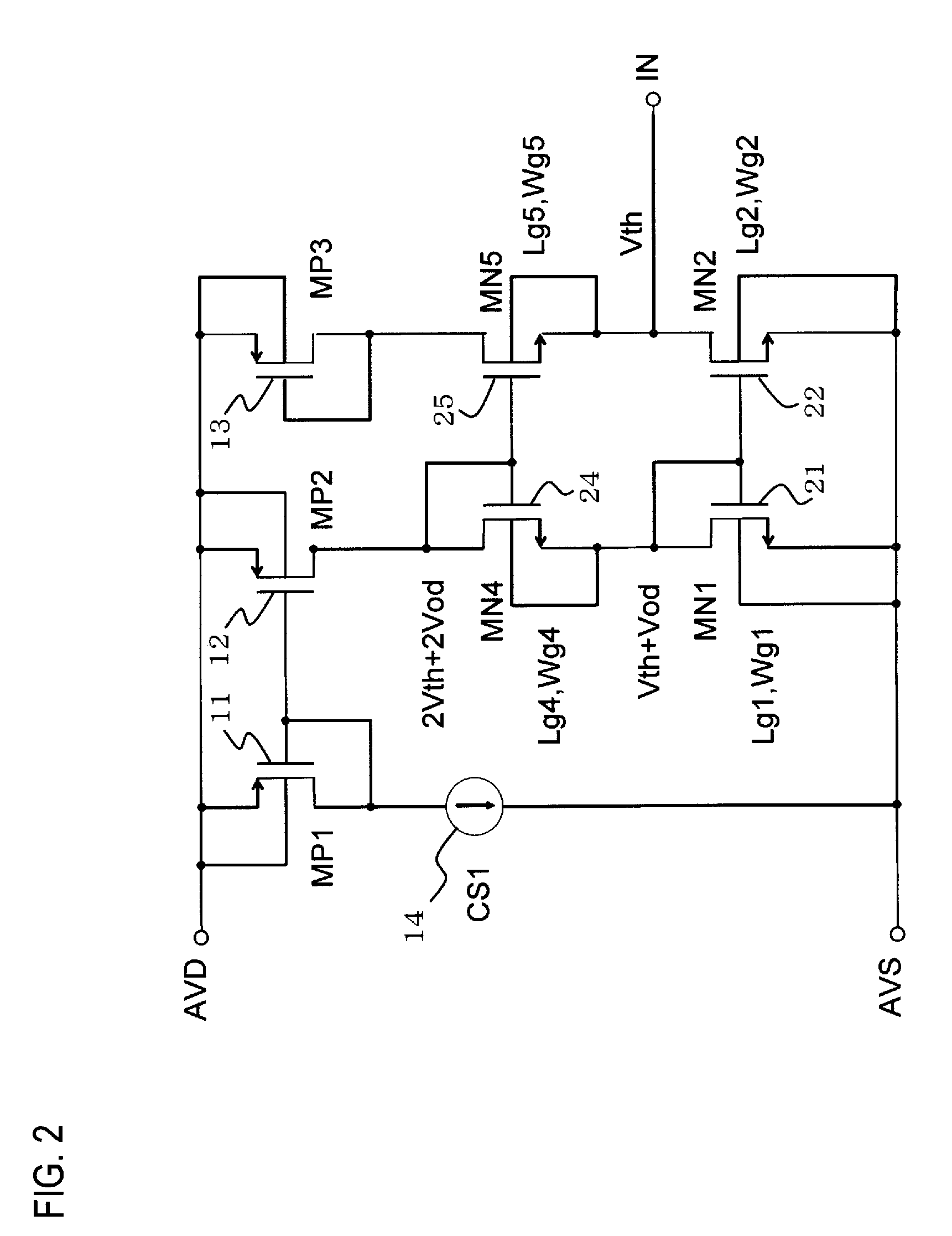
[0039]The bias circuit 10 includes a first to third p-channel transistors (referred to hereinbelow as p-type transistors) (MP1, MP2, MP3) 11, 12, 13, a constant-current source 14, a resistor 15, a capacitor 16, a first and second n-channel transistors (referred to hereinbelow as n-type transistors) (MN1, MN2) 21, 22, and a fourth to k-th n-type transistors (MN4, MN5, . . . , MNk; k is integer equal to or greater than 7) 24, 25, 26, 27. The bias circuit 10 serves to apply a bias voltage to the B-class amplification circuit 50.
[0040]The B-class amplification circuit 50 includes a coil 51, a (k+1)-th n-type transistor (MN(k+1)) 52, and a third n-type transistor (MN3) 53. The B-class amplification circuit 50 is a nonlinear amplification circuit that amplifies only one polarity of inputte...
PUM
 Login to View More
 Abstract
Description
Claims
Application Information
 Login to View More
 - R&D
- Intellectual Property
- Life Sciences
- Materials
- Tech Scout
- Unparalleled Data Quality
- Higher Quality Content
- 60% Fewer Hallucinations
Browse by: Latest US Patents, China's latest patents, Technical Efficacy Thesaurus, Application Domain, Technology Topic, Popular Technical Reports.
© 2025 PatSnap. All rights reserved.Legal|Privacy policy|Modern Slavery Act Transparency Statement|Sitemap|About US| Contact US: help@patsnap.com