Supercharge Your Innovation With Domain-Expert AI Agents!

Method of fabricating an organic light emitting diode using phase separation

a technology of organic light-emitting diodes and phase separation, which is applied in the manufacture of electrode systems, electrical discharge tubes/lamps, electrical apparatus, etc., can solve the problems of low light extraction efficiency, complicated processes, and degraded light extraction efficiency of conventional oleds, and achieves improved light extraction efficiency, low cost, and simple process

Active Publication Date: 2012-06-21
ELECTRONICS & TELECOMM RES INST
View PDF3 Cites 0 Cited by
  • Summary
  • Abstract
  • Description
  • Claims
  • Application Information

AI Technical Summary

Benefits of technology

This approach significantly improves light extraction efficiency while maintaining a simple and cost-effective fabrication process, suitable for large-area devices, by reducing the amount of light guided within the substrate and increasing external emission.

Problems solved by technology

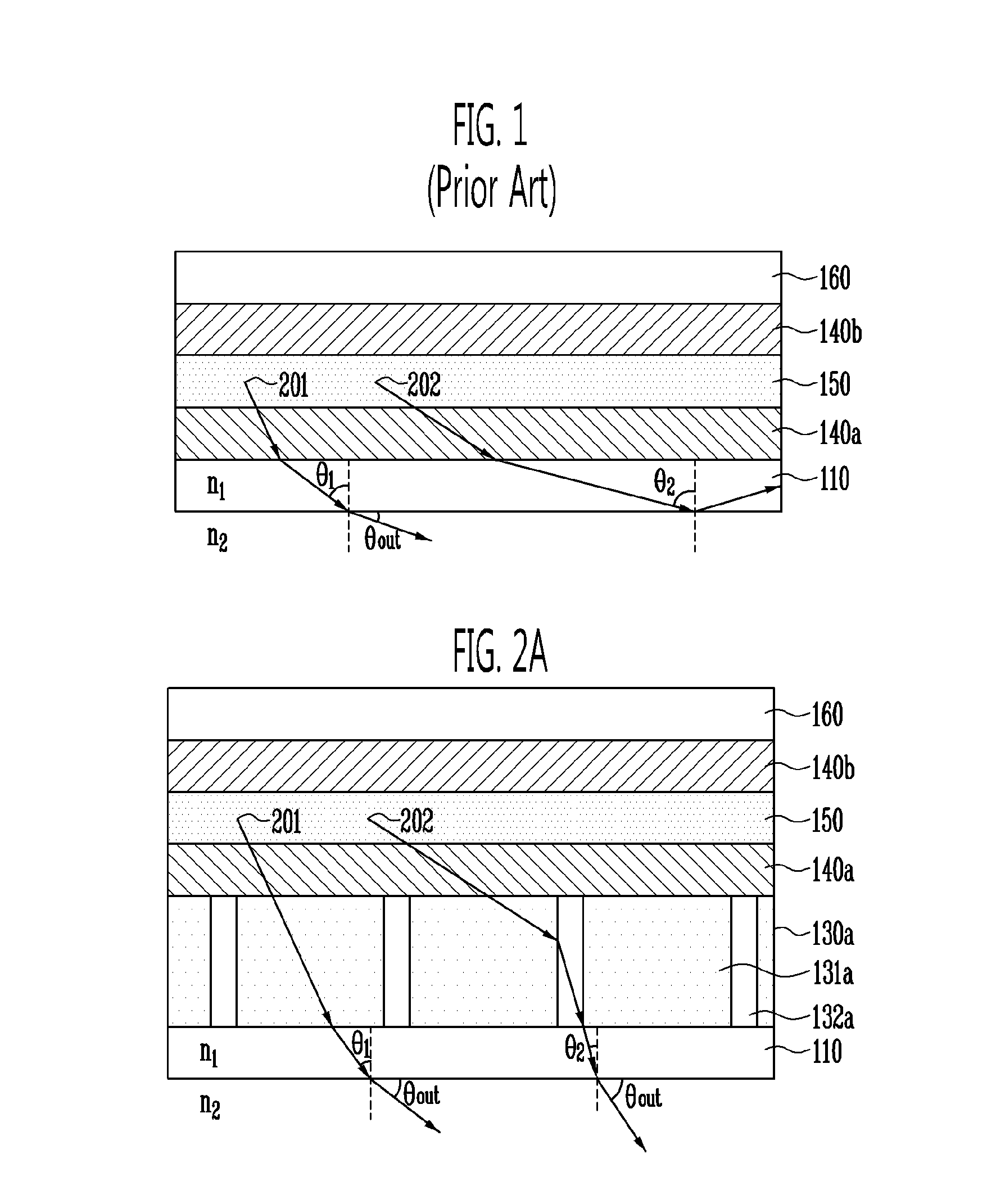
FIG. 1 is a cross-sectional view illustrating a problem caused by total reflection of light in a conventional OLED.
Thus, the light extraction efficiency of a conventional OLED may be degraded due to its total reflection characteristics.
However, the methods may substantially have low light extraction efficiency, involve complicated processes, require high fabrication costs, and shorten the lifetime of an organic EML.

Method used

the structure of the environmentally friendly knitted fabric provided by the present invention; figure 2 Flow chart of the yarn wrapping machine for environmentally friendly knitted fabrics and storage devices; image 3 Is the parameter map of the yarn covering machine
View more

Image

Smart Image Click on the blue labels to locate them in the text.
Viewing Examples
Smart Image
  • Method of fabricating an organic light emitting diode using phase separation
  • Method of fabricating an organic light emitting diode using phase separation
  • Method of fabricating an organic light emitting diode using phase separation

Examples

Experimental program
Comparison scheme
Effect test

Embodiment Construction

[0047]The objects, features, and advantages of the present invention will be apparent from the following detailed description of embodiments of the invention with references to the following drawings. Descriptions of well-known components and processing techniques are omitted so as not to unnecessarily obscure the embodiments of the present invention. The following terms are defined in consideration of functions of the present invention and may be changed according to users or operator's intentions or customs. Thus, the terms shall be defined based on the contents described throughout the specification.

[0048]As described in Background, in a conventional OLED, a considerable amount of light emitted by an organic emission layer (EML) may not be emitted out of the OLED but guided in the OLED.

[0049]In order to solve these problems, the present invention provides an OLED and a method of fabricating the same, in which a light path control layer capable of refracting and scattering light m...

the structure of the environmentally friendly knitted fabric provided by the present invention; figure 2 Flow chart of the yarn wrapping machine for environmentally friendly knitted fabrics and storage devices; image 3 Is the parameter map of the yarn covering machine
Login to View More

PUM

No PUM Login to View More

Abstract

A method of fabricating an organic light emitting diode using phase separation. The method includes preparing a transparent substrate. A first light path control layer is formed on the transparent substrate. The first light path control layer includes a mixture of a first medium and a second medium having a lower refractive index than the first medium using the phase separation. An anode, an organic emission layer, and a cathode are sequentially stacked on the first light path control layer. In this method, an OLED with improved light extraction efficiency can be fabricated using a simple and inexpensive process.

Description

CROSS-REFERENCE TO RELATED APPLICATION[0001]This application is a divisional of co-pending application Ser. No. 12 / 787,134 filed on May 25, 2010, and claims priority to and the benefit of Korean Patent Application No. 10-2009-0111625, filed Nov. 18, 2009, the disclosure of which is incorporated herein by reference in its entirety.BACKGROUND[0002]1. Field of the Invention[0003]The present invention relates to an organic light emitting diode (OLED), and more specifically, to an OLED structured to increase light extraction efficiency.[0004]2. Discussion of Related Art[0005]In a typical organic light emitting diode (OLED), holes emitted from an anode combine with electrons emitted from a cathode in an organic emission layer (EML) formed between the anode and the cathode to generate excitons, and the excitons may recombine to emit light.[0006]An OLED, which is an emissive device, has a wide viewing angle, a fast response speed, and high color reproduction characteristics so that the OLED...

Claims

the structure of the environmentally friendly knitted fabric provided by the present invention; figure 2 Flow chart of the yarn wrapping machine for environmentally friendly knitted fabrics and storage devices; image 3 Is the parameter map of the yarn covering machine
Login to View More

Application Information

Patent Timeline
no application Login to View More
Patent Type & Authority Applications(United States)
IPC IPC(8): H01J9/18
CPCH01L51/5275H10K50/858H10K50/85
Inventor CHO, DOO HEELEE, JEONG IKSHIN, JIN WOOKLEE, JONG HEECHU, HYE YONGLEE, JOO WONHAN, JUN HAN
Owner ELECTRONICS & TELECOMM RES INST
Features
  • R&D
  • Intellectual Property
  • Life Sciences
  • Materials
  • Tech Scout
Why Patsnap Eureka
  • Unparalleled Data Quality
  • Higher Quality Content
  • 60% Fewer Hallucinations
Social media
Patsnap Eureka Blog
Learn More