Check patentability & draft patents in minutes with Patsnap Eureka AI!

Interference reduction for a wireless communications network

a wireless communication network and interference reduction technology, applied in the direction of wireless commuication services, orthogonal multiplexes, electrical equipment, etc., can solve the problems of reducing the quality of service, consuming a large amount of human resources, and a long process of manual network optimization, so as to and reduce interference in interference in cell sites

Inactive Publication Date: 2012-11-22
VIAVI SOLUTIONS INC
View PDF3 Cites 1 Cited by
  • Summary
  • Abstract
  • Description
  • Claims
  • Application Information

AI Technical Summary

Benefits of technology

This approach automates the reduction of interference, maximizing network performance by continuously optimizing transmitter parameters, thereby improving user satisfaction and resource utilization.

Problems solved by technology

However, manual network optimization consumes a large amount of human resources and is a lengthy process that is performed only when needed or periodically.
Therefore, usage of network resource is not maximized, quality of service is degraded and end users or customer satisfaction is reduced.
However, signals received by the MS that are not sent by the transmitters in the active set are considered interference signals.
Existence of interfering transmitters may lead to reduced network performance by reducing the number useful signals received by mobile stations.
Moreover, interfering transmitters may cause pilot pollution, which is a phenomenon that occurs when there are too many potential serving cells to choose from.

Method used

the structure of the environmentally friendly knitted fabric provided by the present invention; figure 2 Flow chart of the yarn wrapping machine for environmentally friendly knitted fabrics and storage devices; image 3 Is the parameter map of the yarn covering machine
View more

Image

Smart Image Click on the blue labels to locate them in the text.
Viewing Examples
Smart Image
  • Interference reduction for a wireless communications network
  • Interference reduction for a wireless communications network
  • Interference reduction for a wireless communications network

Examples

Experimental program
Comparison scheme
Effect test

Embodiment Construction

[0021]In the description that follows, numerous details are set forth in order to provide a thorough understanding of the invention. It will be appreciated by those skilled in the art that variations of these specific details are possible while still achieving the results of the invention. Well-known elements and processing steps are generally not described in detail in order to avoid unnecessarily obscuring the description of the invention.

[0022]In the drawings accompanying the description that follows, often both reference numerals and legends (labels, text descriptions) may be used to identify elements. If legends are provided, they are intended merely as an aid to the reader, and should not in any way be interpreted as limiting.

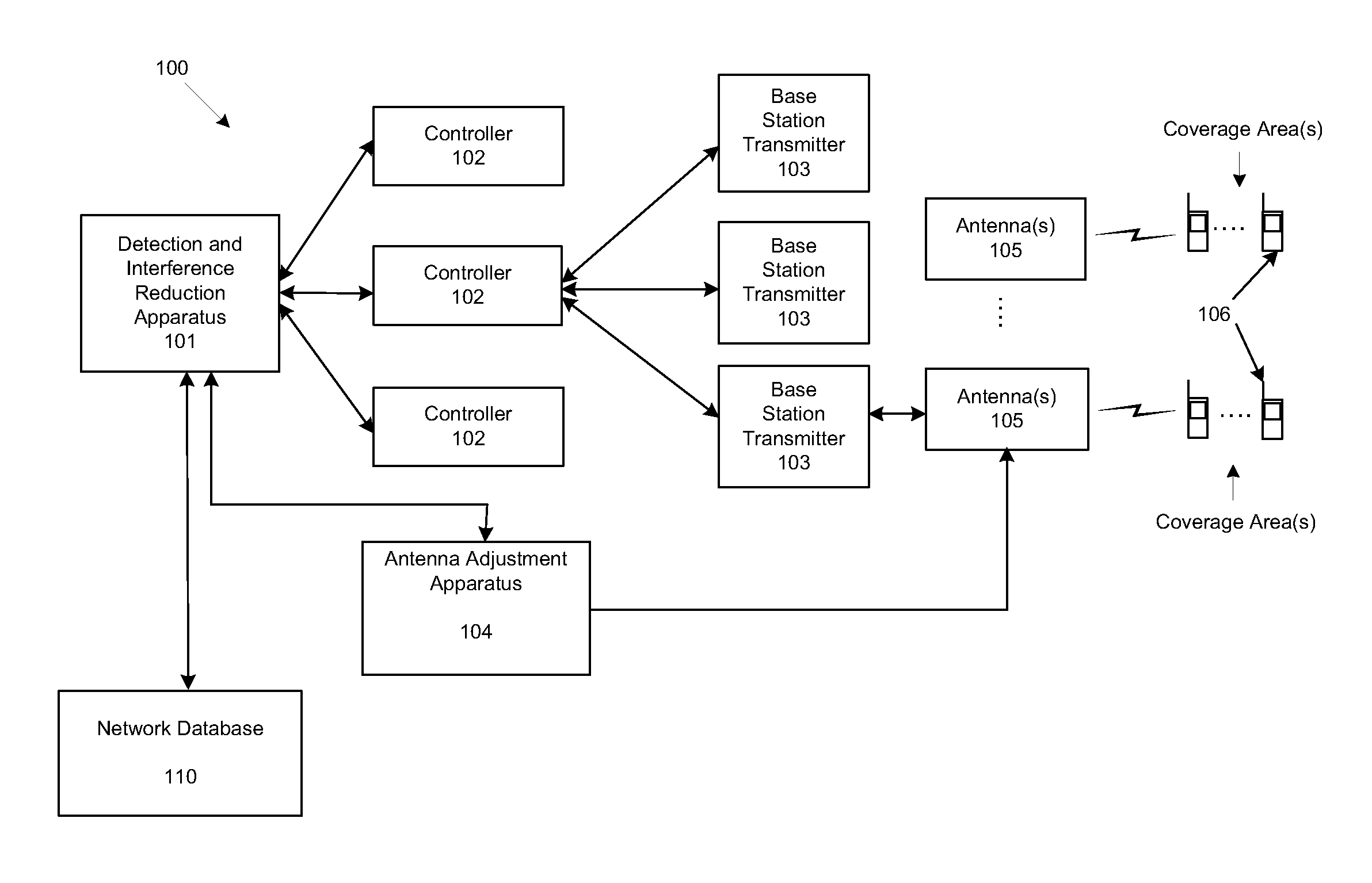
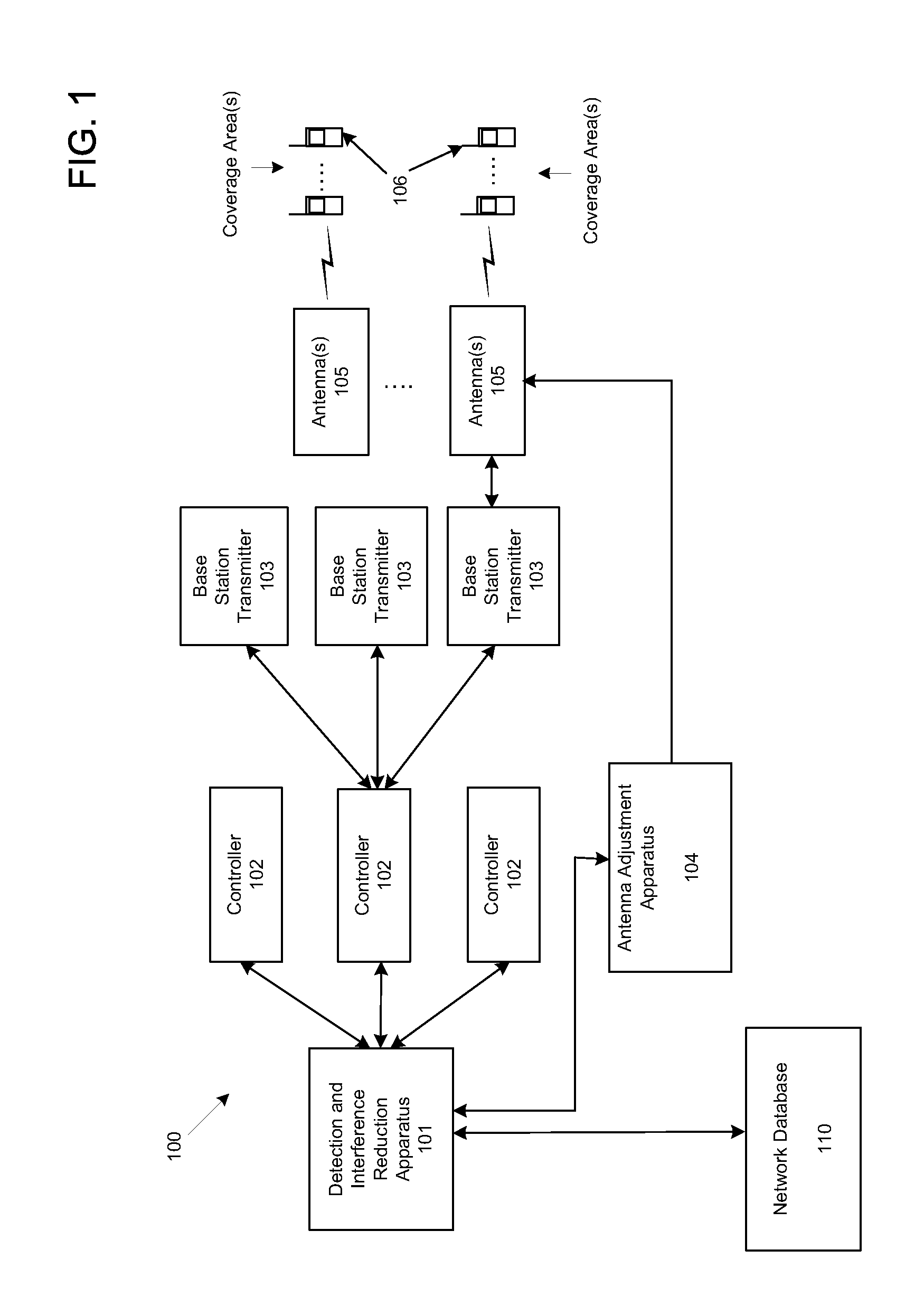
[0023]FIG. 1 is a system for detecting and reducing interference in cell sites of a wireless communications network in accordance with an embodiment of the invention. The wireless network 100 illustrated in FIG. 1 includes a detection and interference app...

the structure of the environmentally friendly knitted fabric provided by the present invention; figure 2 Flow chart of the yarn wrapping machine for environmentally friendly knitted fabrics and storage devices; image 3 Is the parameter map of the yarn covering machine
Login to View More

PUM

No PUM Login to View More

Abstract

An apparatus, method and program reduce interference in interfered cell sites of a wireless communications network. A cell site is a region in which wireless communications are provided to mobile devices, and the interfered cell sites being cell sites where mobile devices are subject to interference signals from at least one interfering transmitter. A transmitter is selected from a list of interfering transmitters in need of adjustment and corresponding antennas. A critical zone is determined with respect to the selected transmitter. Parameters of the selected transmitter and the corresponding antenna are altered and performance of the wireless network in the critical zone around the problem transmitter and interference in the cell sites interfered by the problem transmitter are monitored. Altering of the parameters of the transmitter and the corresponding antenna is performed continuously until a desired interference reduction is achieved in the cell sites interfered by the selected transmitter.

Description

[0001]This is a continuation application of U.S. patent application Ser. No. 13 / 110,205, filed on May 18, 2011.BACKGROUND OF THE INVENTION[0002]1. Field of the Invention[0003]The present invention generally relates to planning and optimization of a universal mobile telecommunication system (UMTS) based network. In particular, the present invention relates to detecting and reducing interference from several transmitters in a UMTS network.[0004]2. Description of the Related Art[0005]Traditional network planning and optimization of a wireless network relies on static methodologies for finding site locations, dimensioning and configuring the radio resources to meet specified traffic demand. Traditional network optimization methods find the best configuration(s) of the wireless network to maximize the performance, which typically starts with an already working wireless network, followed by analysis and calculations done by engineers using software and hardware tools with extensive simula...

Claims

the structure of the environmentally friendly knitted fabric provided by the present invention; figure 2 Flow chart of the yarn wrapping machine for environmentally friendly knitted fabrics and storage devices; image 3 Is the parameter map of the yarn covering machine
Login to View More

Application Information

Patent Timeline
no application Login to View More
Patent Type & Authority Applications(United States)
IPC IPC(8): H04W24/00
CPCH04J11/0056H04B1/7103
Inventor SAHIN, MUSTAFA EMINTARRAF, OSAMA
Owner VIAVI SOLUTIONS INC
Features
  • R&D
  • Intellectual Property
  • Life Sciences
  • Materials
  • Tech Scout
Why Patsnap Eureka
  • Unparalleled Data Quality
  • Higher Quality Content
  • 60% Fewer Hallucinations
Social media
Patsnap Eureka Blog
Learn More