Medium for mammalian somatic cells and additive therefor
a technology which is applied in the field of mammalian somatic cells and additives, can solve the problems of uncompletely elucidated components, heavy patient burden, and contamination of infectious pathogens such as unknown viruses and prions, and achieve the suppression of variation in the growing ability of cells due to variation among the lots of sera to be added
- Summary
- Abstract
- Description
- Claims
- Application Information
AI Technical Summary
Benefits of technology
Problems solved by technology
Method used
Image

Examples
example 1
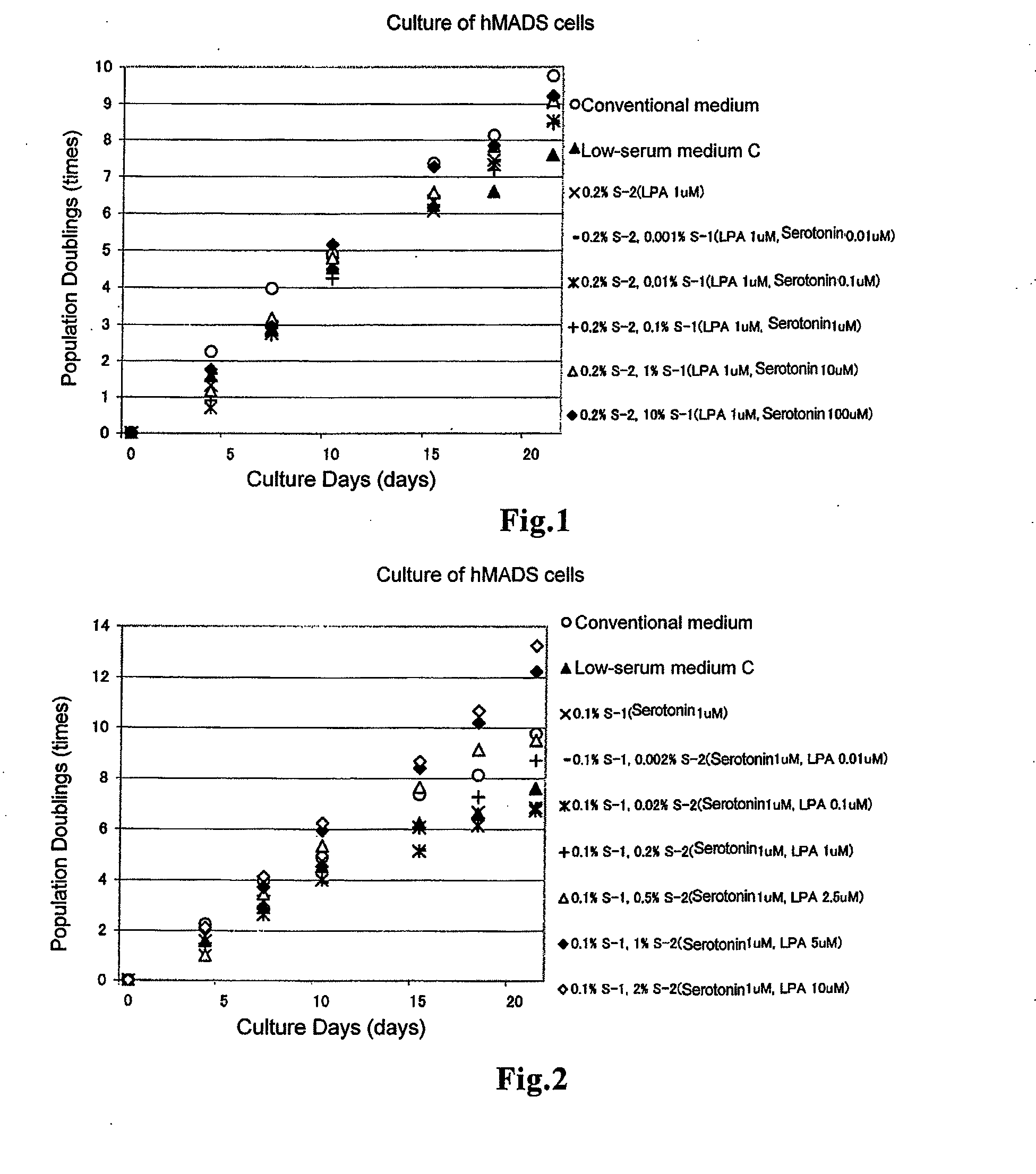
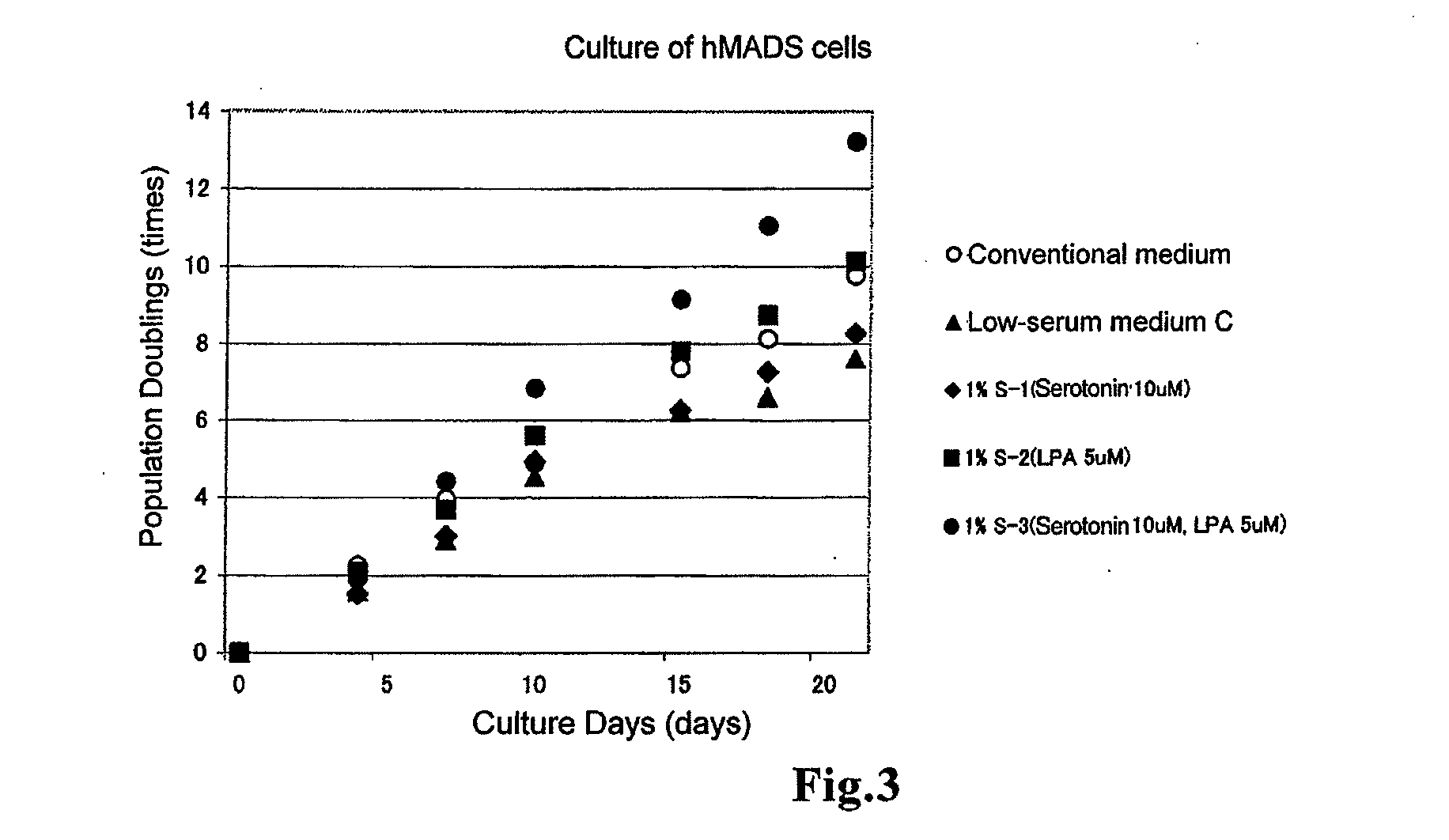
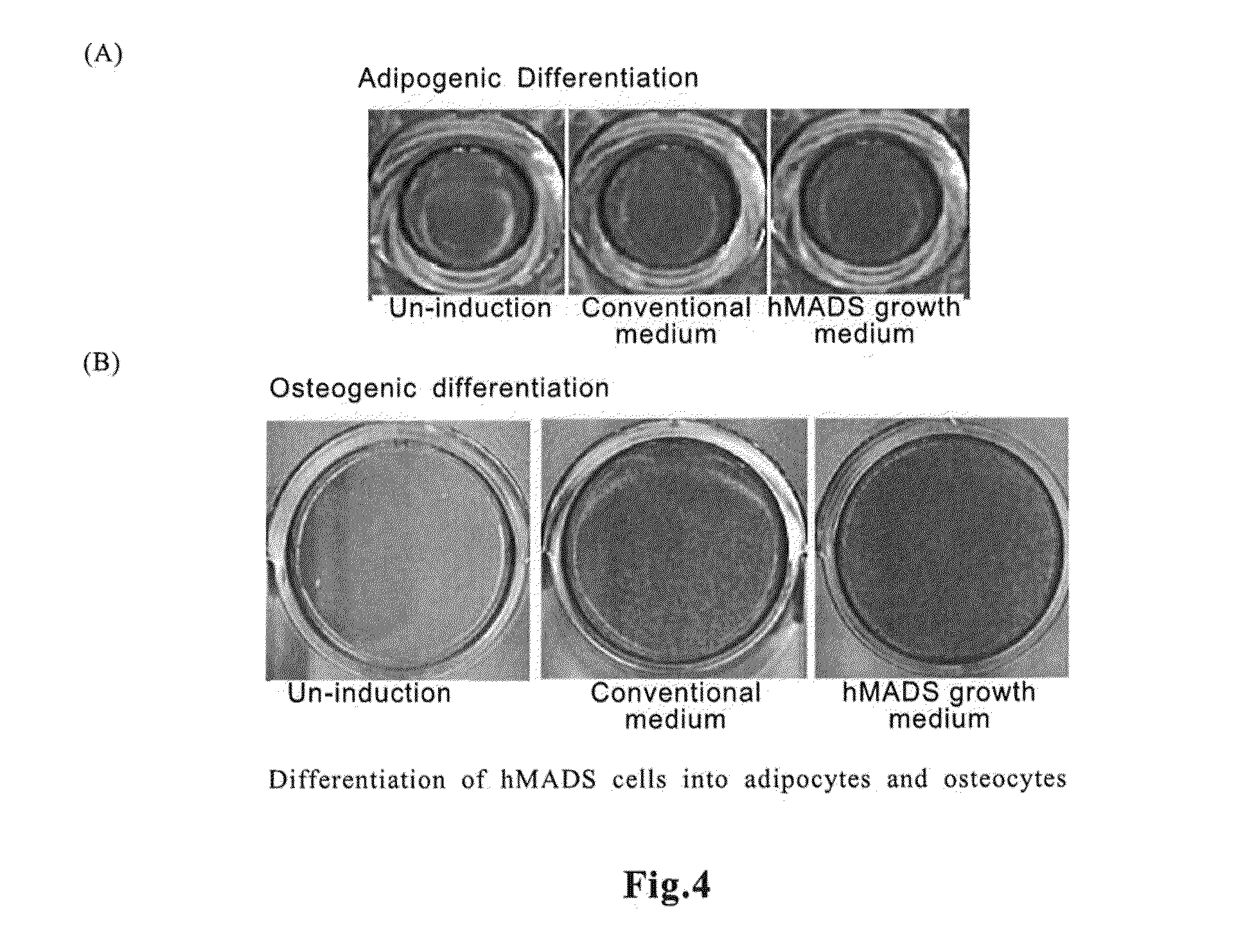
Culturing of Human Multipotent Adipose-Derived Stem (hMADS) Cells
(1-1) Production of Ligands
[0065]As the serotonin ligand, ligand 1 (S-1) was produced by dissolving 2.1 mg of serotonin hydrochloride (manufactured by Sigma) into 10 mL of DMEM (manufactured by LONZA). Further, as the Edg ligand, ligand 2 (S-2) was produced by dissolving 2.3 mg of 1-oleyl lysophosphatidic acid sodium salt (LPA: manufactured by CAYMAN) into 10 mL of PBS. Further, ligand 3 (S-3) was produced by dissolving 2.1 mg of serotonin hydrochloride and 2.3 mg of LPA into 10 mL of PBS.
(1-2) Growth of hMADS Cells
[0066]To a medium containing amino acids (all the amino acids described above), inorganic salts (all the inorganic salts described above), vitamins (all the vitamins described above) and other additives (adenosine 5′-monophosphate, corticosterone, ethanolamine, D-galactose, D-glucose, insulin, reduced glutathione, lipoic acid, hypoxanthine, phenol red, progesterone, putrescine, pyruvic acid, thymidine, triio...
example 2
Culturing of Human Bone Marrow-derived Mesenchymal Stem Cells (hMSCs)
(2-1) Production of Ligands
[0101]As the serotonin ligand, ligand 1 (S-1) was produced by dissolving 2.1 mg of serotonin hydrochloride (manufactured by Sigma) into 10 mL of DMEM (manufactured by LONZA).
[0102]Further, as the Edg ligand, ligand 2 (S-2) was produced by dissolving 2.3 mg of 1-oleyl lysophosphatidic acid sodium salt (LPA: manufactured by CAYMAN) into 10 mL of PBS, and ligand 2 (S-2′) was produced by dissolving 1.9 mg of sphingosine-1-phosphate (S1P: manufactured by CAYMAN) into 10 mL of DMEM.
[0103]Further, ligand 3 (S-3) was produced by dissolving 2.1 mg of serotonin hydrochloride and 2.3 mg of LPA into 10 mL of PBS.
(2-2) Growth of hMSCs
[0104]Low-serum medium C1 was obtained by adding 100 U / mL penicillin / streptomycin (manufactured by GIBCO) and 0.5% FCS to a basal medium which was the same as the basal medium prepared in Example 1 except that it did not contain hypoxanthine and thymidine and a part of th...
example 3
[0144]To a medium containing amino acids (all the amino acids described above), inorganic salts (all the inorganic salts described above), vitamins (all the vitamins described above) and other additives (adenosine 5′-monophosphate, corticosterone, ethanolamine, D-galactose, D-glucose, insulin, reduced glutathione, lipoic acid, hypoxanthine, phenol red, progesterone, putrescine, pyruvic acid, thymidine, triiodothyronine and transferrin), 7×10⁻⁴% 2-Me, 100 U / L penicillin / streptomycin, 0.5% FCS, 2.5 ng / mL bFGF and 1% S-3 produced in (1-1) were added to obtain low-serum medium 3 (1% S-3 LS).
[0145]Further, the serum-free medium 3 (1% S-3 SF) was obtained with the same composition as that of the above-described low-serum medium 3 except that FCS was not contained.
[0146]To DMEM / F12, added were 1 mg / L nonessential amino acids (manufactured by GIBCO), 7×10⁻⁴% 2-ME, 100 U / L penicillin / streptomycin, 10% FCS and 2.5 ng / mL bFGF to obtain a conventional serum-containing medium (conventional mediu...
PUM
| Property | Measurement | Unit |
|---|---|---|
| concentration | aaaaa | aaaaa |
| concentration | aaaaa | aaaaa |
| cell morphologies | aaaaa | aaaaa |
Abstract
Description
Claims
Application Information
 Login to View More
 - R&D
- Intellectual Property
- Life Sciences
- Materials
- Tech Scout
- Unparalleled Data Quality
- Higher Quality Content
- 60% Fewer Hallucinations
Browse by: Latest US Patents, China's latest patents, Technical Efficacy Thesaurus, Application Domain, Technology Topic, Popular Technical Reports.
© 2025 PatSnap. All rights reserved.Legal|Privacy policy|Modern Slavery Act Transparency Statement|Sitemap|About US| Contact US: help@patsnap.com