Check patentability & draft patents in minutes with Patsnap Eureka AI!

COMPOSITION AND METHOD FOR REDUCING SOx and NOx EMISSIONS FROM COMBUSTION OF FUEL

a technology of hydrocarbon fuel and combustion method, which is applied in the direction of fuels, combustion treatment, lighting and heating apparatus, etc., can solve the problems of reducing the efficiency of combustion, affecting plant and animal life, and severely corroding precipitation, etc., and achieves the effect of reducing sox and nox emissions

Inactive Publication Date: 2013-06-13
BRANDT ROBERT E
View PDF5 Cites 0 Cited by
  • Summary
  • Abstract
  • Description
  • Claims
  • Application Information

AI Technical Summary

Benefits of technology

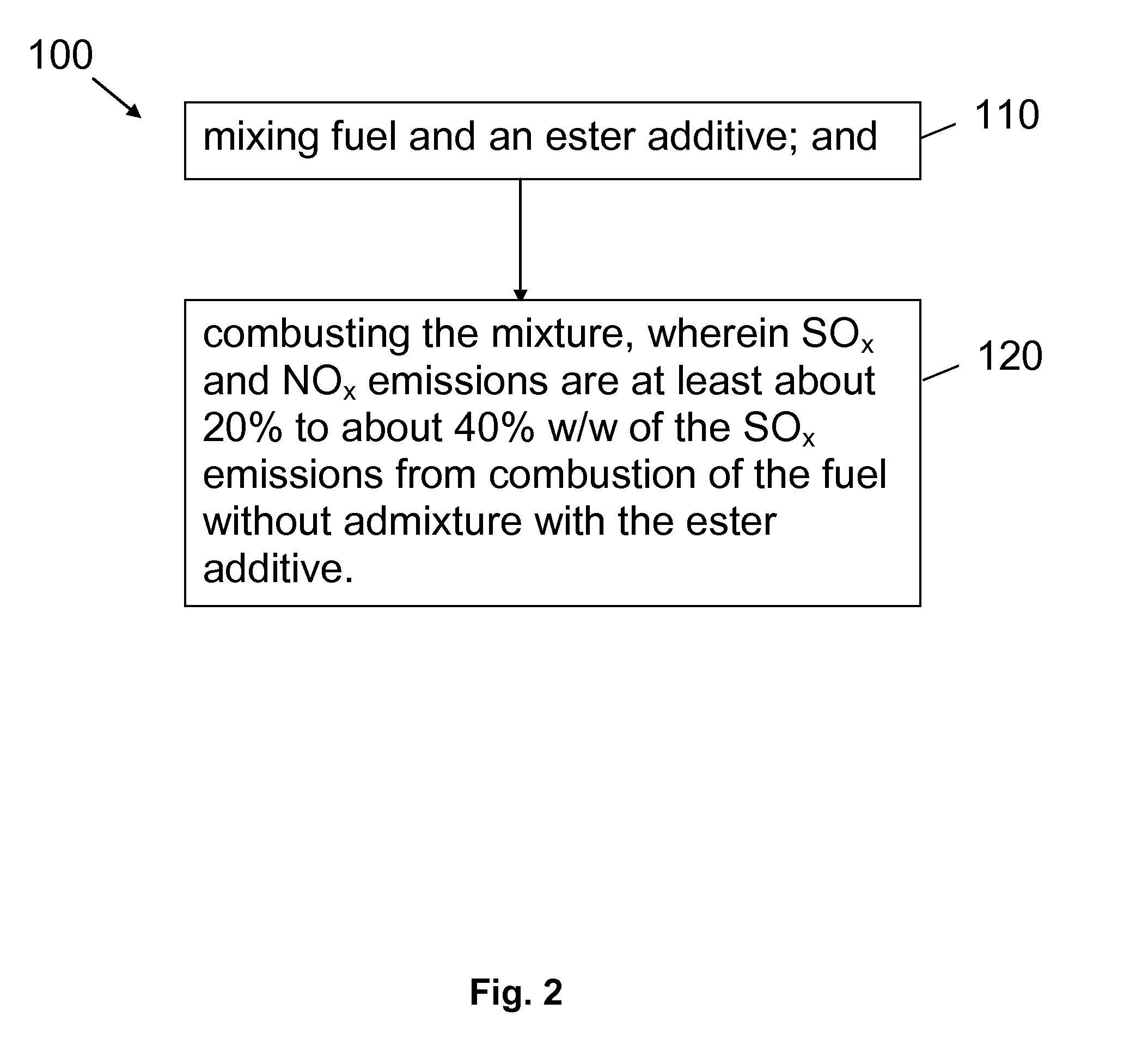
The invention provides a method for reducing emissions of SOx and NOx from burning fuel by adding an ester additive to the fuel before combustion. The addition of the ester additive results in at least a 20% to 40% reduction in emissions compared to combusting the fuel without the additive. The invention also provides a fuel mixture with reduced emissions of SOx and NOx.

Problems solved by technology

During this time, substantial amounts of money and effort have been spent to combat this problem.
Additionally, the governmental agencies, on the federal, state, and local levels have issued environmental regulations which severely limit the amount of pollutants which can be released into the atmosphere, consequently forcing users of these fuels to make the choice of burning the more expensive, “clean-burning”, fuels or, as the supply of such fuels is shrinking, to seek methods to reduce the emissions released by the combustion of the higher-polluting fuels.
When released into the atmosphere, it has been postulated, these compounds can react with atmospheric moisture and oxygen to form nitric and sulfuric acid, which results in “acid rain”, severely corrosive precipitation that is detrimental to plant and animal life.
Such restrictions have made it nearly impossible to utilize high nitrogen and / or sulfur content fuels in standard applications.
Since many of the viscous hydrocarbon fuels discussed, and much of the world's coal reserves, have high nitrogen and / or sulfur content, use of a significant portion of the world's petroleum and coal reserves presents difficult environmental and economic problems.
This method, also known as “scrubbing” is the most common method in use today; however, it suffers from the major drawback of requiring significant capital outlay for the design and construction of the system.
Such solvents are, however, expensive and often will extract significant amounts of combustible fuel components along with the nitrogen and / or sulfur.
For these reasons, this method has proven to be impractical.
However, this process also requires significant capital outlay.

Method used

the structure of the environmentally friendly knitted fabric provided by the present invention; figure 2 Flow chart of the yarn wrapping machine for environmentally friendly knitted fabrics and storage devices; image 3 Is the parameter map of the yarn covering machine
View more

Image

Smart Image Click on the blue labels to locate them in the text.
Viewing Examples
Smart Image
  • COMPOSITION AND METHOD FOR REDUCING SOx and NOx EMISSIONS FROM COMBUSTION OF FUEL
  • COMPOSITION AND METHOD FOR REDUCING SOx and NOx EMISSIONS FROM COMBUSTION OF FUEL
  • COMPOSITION AND METHOD FOR REDUCING SOx and NOx EMISSIONS FROM COMBUSTION OF FUEL

Examples

Experimental program
Comparison scheme
Effect test

example 1

[0048]I was able to arrange a test burn in a pilot kiln to assess the viability. The pilot kiln had been test burning several hazardous waste options for creation of cement products. The refractory in the kiln had been subjected to this burning process for 14 days prior to my test.

[0049]The kiln 10, shown in FIG. 1, was brought up to 1200° C., burning 37 lbs / hr. of High Sulfur coal. The initial baseline for the SOx was 8.0-8.5 ppm measured at the exhaust stack, down-stream from the kiln hood, shown in FIG. 1. Six (6) cc of a mixture containing a blend of Methyl laurate (35.5 wt. %+ / −5%), Methyl myristate (35.5 wt. %+ / −5%), 1,1,1-trimethylolpropane trinonoate (9.3 wt. %+ / −5%), Methyl palmitate (4.3 wt. %+ / −5%) and Dipentaerythritol hexaheptanoate (15.2 wt. %+ / −5%) was introduced into the flame (1800° C.) of the kiln 10 at point A in FIG. 1, while continuing to burn 37 lbs / hr. of High Sulfur coal. This application did not change the baseline of SOx significantly. A second injection of...

example 2

[0050]The kiln 10, shown in FIG. 1, was brought up to 1200° C., burning 37 lbs / hr. of High Sulfur coal. The initial baseline for the SOx was 8.0-8.5 ppm measured at the exhaust stack, down-stream from the kiln hood, shown in FIG. 1. Six (6) cc of an ester mixture containing a blend of Methyl laurate (35.5 wt. %+ / −5%), Methyl myristate (35.5 wt. %+ / −5%), 1,1,1-trimethylolpropane trinonoate (9.3 wt. %+ / −5%), Methyl palmitate (4.3 wt. %+ / −5%) and Dipentaerythritol hexaheptanoate (15.2 wt. %+ / −5%) was then introduced into the hot air stream at point B at the feed end 20 of the kiln 10 in FIG. 1 (1000° C. to 1200° C.). Hereinafter, the “ester mixture”, unless otherwise defined, is an ester mixture containing a blend of Methyl laurate (35.5 wt. %+ / −5%), Methyl myristate (35.5 wt. %+ / −5%), 1,1,1-trimethylolpropane trinonoate (9.3 wt. %+ / −5%), Methyl palmitate (4.3 wt. %+ / −5%) and Dipentaerythritol hexaheptanoate (15.2 wt. %+ / −5%). The SOx concentration dropped to 4 ppm.

[0051]This 20-40% de...

the structure of the environmentally friendly knitted fabric provided by the present invention; figure 2 Flow chart of the yarn wrapping machine for environmentally friendly knitted fabrics and storage devices; image 3 Is the parameter map of the yarn covering machine
Login to View More

PUM

PropertyMeasurementUnit
structuresaaaaaaaaaa
w/waaaaaaaaaa
timeaaaaaaaaaa
Login to View More

Abstract

A fuel mixture characterized by reduced SOx and NOx emissions from combustion of the fuel, comprising: fuel; and an ester additive derived from reaction of i) a C6-C16 aliphatic straight chain or branched chain monocarboxylic acid, wherein aliphatic is defined as of or relating to a major group of organic compounds, structured in open or branched chains, including alkanes, e.g. paraffins, alkenes, e.g. olefins, and alkynes e.g., acetylenes, and either, ii) an aliphatic polyhydric alcohol having three or more primary alcohol groups, or iii) a C1-C16 aliphatic straight or branched chain monohydric alcohol. A method of reducing SOx and NOx emissions from combustion of the fuel, comprising: mixing fuel and an ester additive; and combusting the mixture, wherein SOx and NOx emissions are at least about 20% to about 40% w / w of the SOx and NOx emissions from combustion of the fuel without admixture with the ester additive.

Description

FIELD OF THE INVENTION[0001]The present invention relates generally to mixtures of esters and hydrocarbon fuel, and methods of using thereof. More specifically, the present invention relates to mixtures of esters and hydrocarbon fuel having reduced emissions of nitrogen and sulfur oxides and methods of reducing nitrogen and sulfur oxides from combustion of the mixtures.BACKGROUND[0002]Within the past few years there has been an increasing concern with the immediate and long-term effects of atmospheric pollution produced during the burning of hydrocarbon fuels. During this time, substantial amounts of money and effort have been spent to combat this problem. Additionally, the governmental agencies, on the federal, state, and local levels have issued environmental regulations which severely limit the amount of pollutants which can be released into the atmosphere, consequently forcing users of these fuels to make the choice of burning the more expensive, “clean-burning”, fuels or, as th...

Claims

the structure of the environmentally friendly knitted fabric provided by the present invention; figure 2 Flow chart of the yarn wrapping machine for environmentally friendly knitted fabrics and storage devices; image 3 Is the parameter map of the yarn covering machine
Login to View More

Application Information

Patent Timeline
no application Login to View More
Patent Type & Authority Applications(United States)
IPC IPC(8): C10L10/00B08B5/00F23J15/02
CPCC10L2200/0446F23J15/02C10L1/19C10L1/191C10L10/02C10L10/08C10L2200/0423C10L2200/043C10L2200/0438C10L10/00B08B5/00C10L5/04C10L2300/30C10L2300/20
Inventor BRANDT, ROBERT E.
Owner BRANDT ROBERT E
Features
  • R&D
  • Intellectual Property
  • Life Sciences
  • Materials
  • Tech Scout
Why Patsnap Eureka
  • Unparalleled Data Quality
  • Higher Quality Content
  • 60% Fewer Hallucinations
Social media
Patsnap Eureka Blog
Learn More