Manufacturing method of solid catalyst for propylene polymerization
a technology of propylene polymerization and solid catalyst, which is applied in the direction of physical/chemical process catalysts, bulk chemical production, organic compound/hydride/coordination complex catalysts, etc., can solve the problem of not being able to provide high-regular polymers with high yield, and not being able to disclose an example of dialkylalkylidene succina
- Summary
- Abstract
- Description
- Claims
- Application Information
AI Technical Summary
Problems solved by technology
Method used
Image

Examples
example 1
1. Preparation of Solid Catalyst
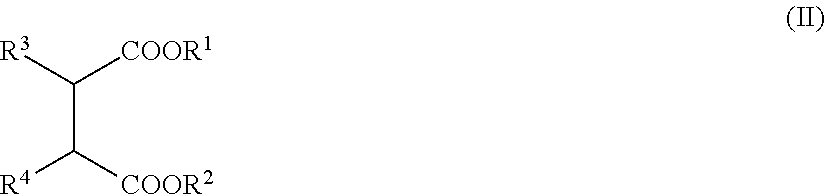
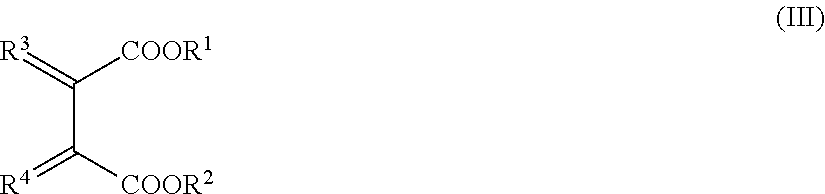
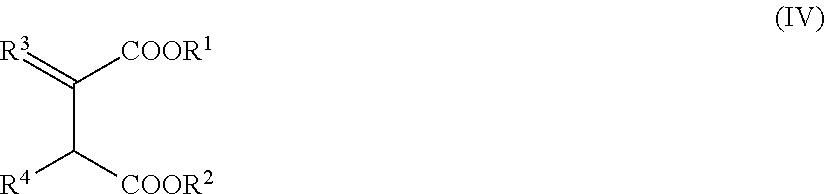
[0032]To a 1 L-volume glass reactor of which atmosphere was sufficiently substituted by nitrogen, equipped with a stirrer, 150 ml of toluene and 20 g of spherical-shaped diethoxymagnesium having an average particle size of 20 μm, particle distribution index of 0.86, bulk density of 0.35 g / cc were added, while maintaining the temperature at 10° C. Then, 40 ml of titanium tetrachloride diluted in 60 ml toluene was added thereto over 1 hour, and then thereto a mixture of diethyl-2,3-diisopropylidene succinate 2.9 g and diethyl-2,3-diisopropylsuccinate 2.9 g was added while increasing the reactor temperature to 110° C. After maintaining the temperature at 110° C. for 2 hours and lowering to 90° C., stirring was halted, the supernatant was removed, and the resultant was washed once with additional 200 ml toluene. Thereto, 150 ml toluene and 50 ml titanium tetrachloride were added, and the temperature was raised up to nor and maintained for 2 hours for agin...
example 2
[0040]A catalyst was prepared according to the method described in Example 1 except that a mixture of diethyl-2,3-diisopropylidenesuccinate 2.3 g and diethyl-2,3-diisopropylsuccinate 3.5 g was used, instead of a mixture of diethyl-2,3-diisopropylidenesuccinate 2.9 g and diethyl-2,3-diisopropylsuccinate 2.9 g in the above item 1. Preparation of solid catalyst. The titanium content of the resulted solid catalyst component was 3.2 wt %. Next, propylene polymerization was carried out by the same method as in Example 1, and the result was represented in Table 1.
example 3
[0041]A catalyst was prepared according to the method described in Example 1 except that a mixture of diethyl-2,3-diisopropylidenesuccinate 1.4 g and diethyl-2,3-diisopropylsuccinate 4.3 g was used, instead of a mixture of diethyl-2,3-diisopropylidenesuccinate 2.9 g and diethyl-2,3-diisopropylsuccinate 2.9 g in the above item 1. Preparation of solid catalyst. The titanium content of the resulted solid catalyst component was 3.1 wt %. Next, propylene polymerization was carried out by the same method as in Example 1, and the result was represented in Table 1.
PUM
| Property | Measurement | Unit |
|---|---|---|
| temperature | aaaaa | aaaaa |
| particle diameter | aaaaa | aaaaa |
| particle size | aaaaa | aaaaa |
Abstract
Description
Claims
Application Information
 Login to View More
 - R&D
- Intellectual Property
- Life Sciences
- Materials
- Tech Scout
- Unparalleled Data Quality
- Higher Quality Content
- 60% Fewer Hallucinations
Browse by: Latest US Patents, China's latest patents, Technical Efficacy Thesaurus, Application Domain, Technology Topic, Popular Technical Reports.
© 2025 PatSnap. All rights reserved.Legal|Privacy policy|Modern Slavery Act Transparency Statement|Sitemap|About US| Contact US: help@patsnap.com