[0007]The object of the present invention is therefore to provide an improved device for supporting the user in charge of treating the patient.
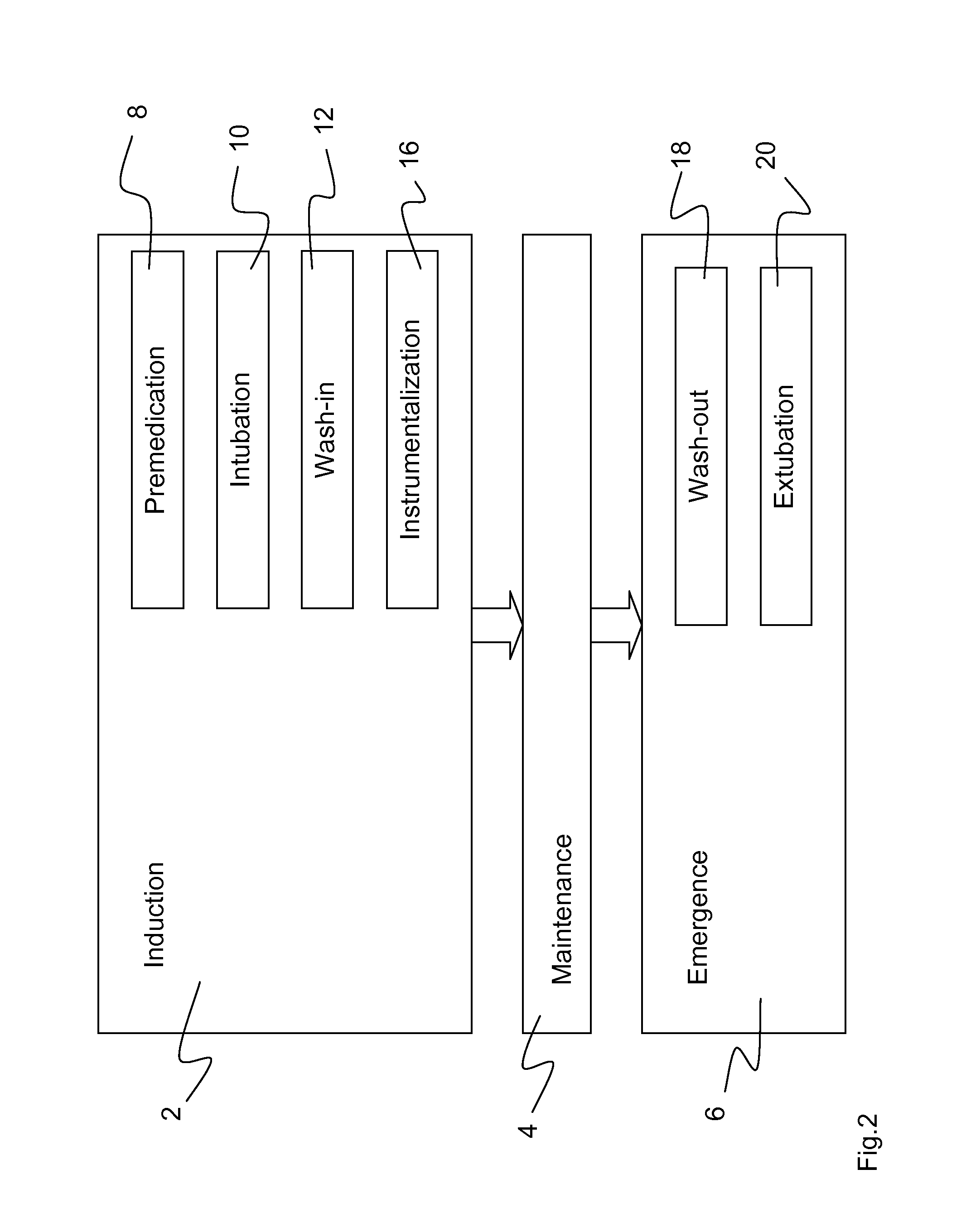
[0013]Thus, a device with a display means for displaying the phase of treatment in which the patient is at a defined point in time is proposed in a preferred embodiment. This point in time may already be in the past, or it may pertain to the current point in time of polling or to a point in time in the future. The history of the treatment as well as expected treatment events such as phase transitions can thus be displayed by means of the display means. The knowledge of the treatment phase in which the patient is at the given point in time (displayed, for example, by the display means) makes it possible for the treating person to make a comparatively simple classification or rating of parameter values. Thus, a defined parameter value may be unusual for a first phase of treatment but usual for a second phase of treatment. If the phase of treatment of the patient during which the parameter had a defined parameter value is displayed to the treating person, deviations of the parameter can be determined more easily and countermeasures can possibly be initiated sooner.
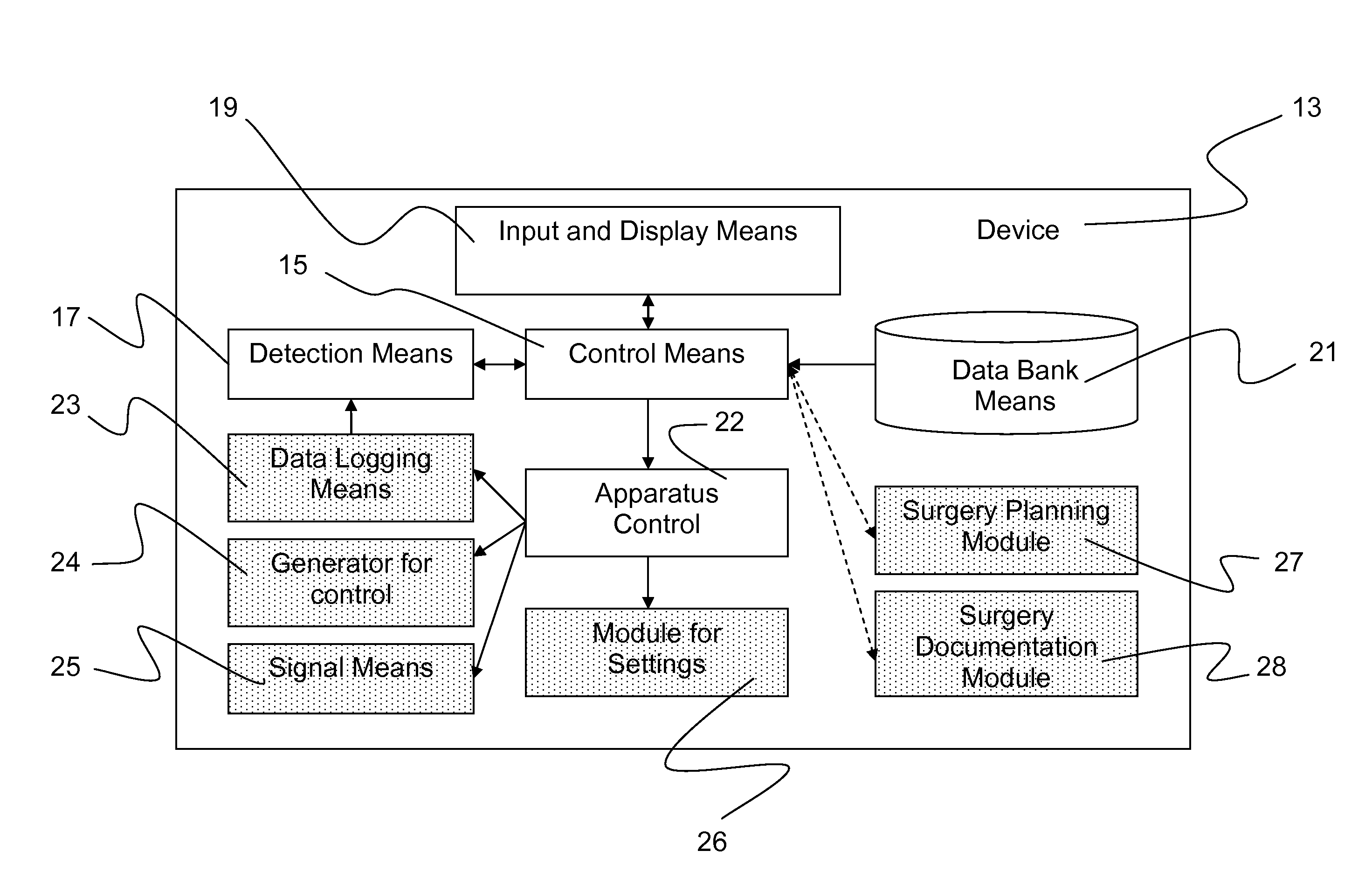
[0017]In yet another preferred embodiment according to the present invention, the device has a data bank means for storing work flows, e.g., SOPs (Standard Operating Procedures) in a comprehensive manner. All the possibly parametrized actions and SOPs, which are carried out at the time of a phase transition or a transition from one state to another, can be defined in such a work flow data bank. For example, all ECG (electrocardiogram) alarms can be switched off or suspended following activation of the heart-lung machine. The data bank may contain meaningful presettings provided by the manufacturer, which can counteract erroneous setting and contribute to increased safety. The data bank may be designed such that it can be adjusted by the user to any desired standards, including local ones (SOPs) and norms with suitable tools. Whether or not a confirmation by the user is necessary before the action is carried out may possibly also be stored in the data bank. For example, it would be possible to specify that a message is sent to the operating room cleaning team without checking at the time of transition into the phase of emergence from an anesthesia. Besides the definition of a standard setting, the data bank may also have sets of settings, which are specific of certain interventions.
[0019]The advantages that can be obtained according to the present invention comprise, among other things, optimal support of the person treating the patient and a general improvement in operating convenience.
[0020]Furthermore, the patient's safety is markedly increased compared to the extent hitherto common in practice. Improved safety of the patient and checking by the user, among other things, by the acknowledgment mechanism described, can thus be guaranteed. The number of human interactions necessary during a phase transition can be limited to a minimum. Operating convenience is increased while the probability of operating errors is minimized at the same time.
[0021]Furthermore, a positive effect on quality and efficiency can be achieved due to more standardized procedures (SOPs—Standard Operating Procedures) by means of the technical support of the treating person by the device according to the present invention. The present invention advantageously contributes, furthermore, to documentation, for example, in connection with surgical procedures, because phase transitions are already detected by the device and their occurrence only needs to be stored. This also applies to the processes brought about by the signal sent or to transmitted information. Furthermore, SOPs can be technically supported. Standardization and hence quality assurance of anesthesia can likewise be promoted. Higher-level work flows of the hospital can be triggered or supported by connecting external IT systems. A work flow data bank that can be freely configured offers the needed flexibility to add, adjust or update standards. The workstation documentation and especially the anesthesia documentation can be automatically complemented with information on the phase identification.


 Login to View More
  Login to View More