Microwave heating apparatus
a heating apparatus and microwave technology, applied in microwave heating, electrical apparatus, electric/magnetic/electromagnetic heating, etc., can solve the problems of over-the-counter technologies that do not take into account and objects may be accidentally deformed or broken, so as to achieve the effect of effectively preventing the generation of sparks
- Summary
- Abstract
- Description
- Claims
- Application Information
AI Technical Summary
Benefits of technology
Problems solved by technology
Method used
Image


Examples
example 1
[0071]A polyimide film, Kapton (registered trademark) 150EN (film thickness: 37.5 μm), manufactured by Du Pont-Toray Co., Ltd., was used for the substrate. Silver (Ag) paste (DOTITE (registered trademark) FA-353N, Ag content: 69% by mass, manufactured by Fujikura Kasei Co., Ltd.) was coated on a surface of the substrate. The silver paste was coated by printing a 2 cm square pattern on the substrate by screen printing. The printed pattern (silver paste layer) after being dried for one day at a room temperature, had a thickness of 6 μm (3-point average value). The thickness of the pattern was measured by a digital micrometer manufactured by Mitutoyo Corporation. The change in thickness before and after the pattern formation was measured.
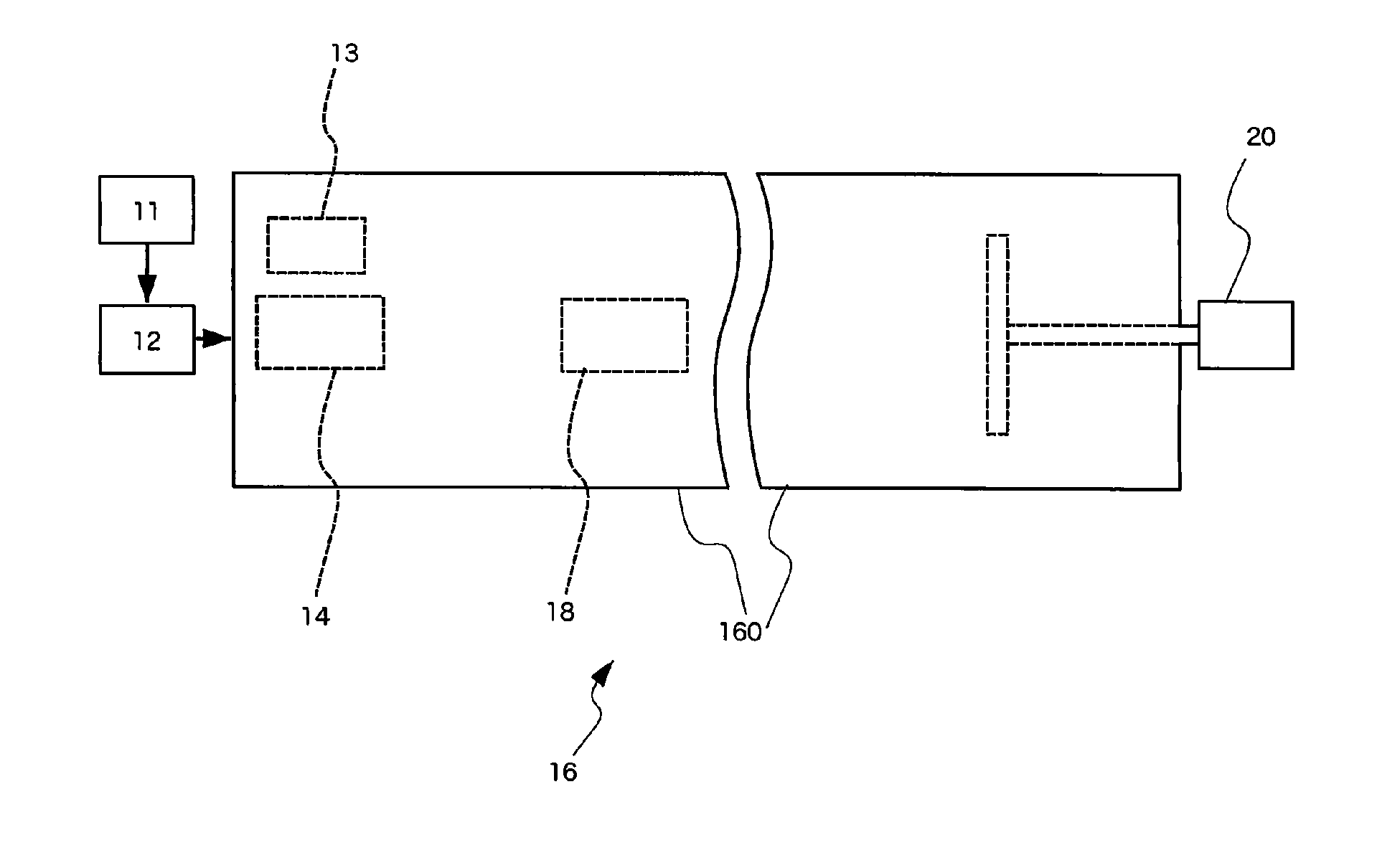
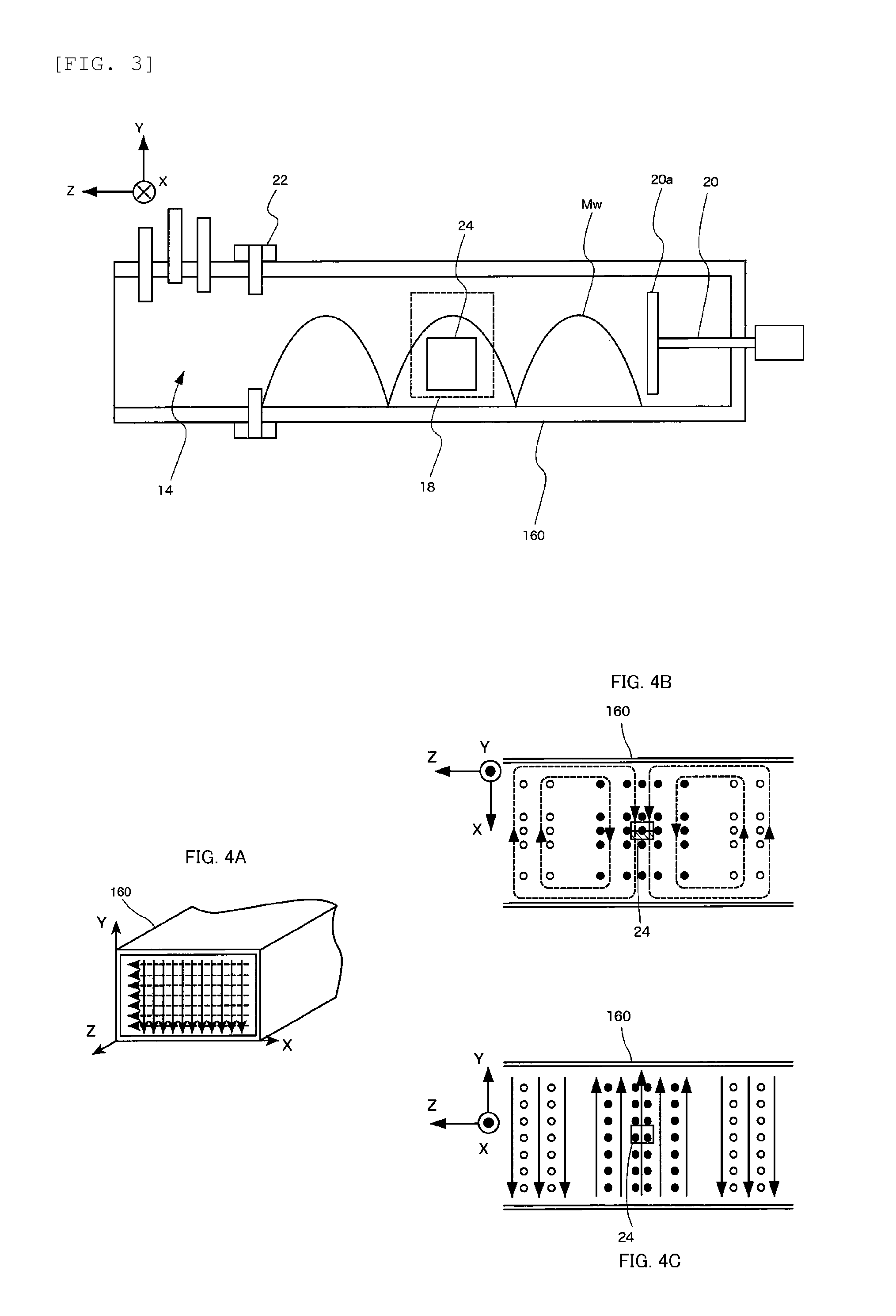
[0072]The substrate provided with the silver paste layer formed thereon by coating the silver paste as above, was adhered on a quartz glass (25 mm×100 mm×1 mmt) using Kapton (registered trademark) tape, and arranged in the apparatus shown in FIG. 1, so...
example 2
[0078]A polyimide film, Kapton (registered trademark) 150EN (film thickness: 37.5 μm), manufactured by Du Pont-Toray Co., Ltd., was used for the substrate. A copper oxide (40 to 60% by mass) paste containing a reducing agent (ethylene glycol, 5 to 15% by mass) (Metalon ICI-020, manufactured by NovaCentrix) was coated on a surface of the substrate. The copper oxide paste was coated by printing a 2 cm square pattern on the substrate by screen printing. The printed pattern (copper oxide paste layer) after being dried for one day at a room temperature, had a thickness of 8 μm (3-point average value), when the thickness was measured in the same way as in Example 1.
[0079]The microwave used in Example 2 had a frequency of 2.457 GHz, output power of 60 W, a pulse cycle of 50 kHz, and a duty ratio (the ratio of microwave irradiation time “ti” to pulse cycle time “to”: ti / (ti+to)) of 30%. At this time, the maximum point of the electric field (minimum point of the magnetic field) is, theoretic...
example 3
[0081]In place of the silver (Ag) paste (DOTITE (registered trademark) FA-353N, Ag content: 69% by mass, manufactured by Fujikura Kasei Co., Ltd.), 7 g of silver (Ag) paste (DOTITE (registered trademark) FA-353N, manufactured by Fujikura Kasei Co., Ltd.) was added with 0.14 g of ultra fine artificial graphite powder (UF-G10, median particle diameter: 4.5 μm, manufactured by Showa Denko K.K.) and 0.4 g of terpineol, and mixed well, and the resulting mixed paste was used. Other conditions were the same as those of Example 1, and the mixed paste was coated on the substrate. The microwave heating was performed in the same way as in Example 1. As a result, no sparks were generated during the microwave heating, and a silver film could be formed on the surface of the substrate while the substrate could be prevented from being broken. The obtained silver film had a thickness of 14 μm and a volume resistivity of 8.9×10⁻⁵ Ω·cm.
PUM
| Property | Measurement | Unit |
|---|---|---|
| thickness | aaaaa | aaaaa |
| thickness | aaaaa | aaaaa |
| frequency | aaaaa | aaaaa |
Abstract
Description
Claims
Application Information
 Login to View More
 - R&D
- Intellectual Property
- Life Sciences
- Materials
- Tech Scout
- Unparalleled Data Quality
- Higher Quality Content
- 60% Fewer Hallucinations
Browse by: Latest US Patents, China's latest patents, Technical Efficacy Thesaurus, Application Domain, Technology Topic, Popular Technical Reports.
© 2025 PatSnap. All rights reserved.Legal|Privacy policy|Modern Slavery Act Transparency Statement|Sitemap|About US| Contact US: help@patsnap.com