Check patentability & draft patents in minutes with Patsnap Eureka AI!

Top-k search using selected pairwise comparisons

a pairwise comparison and top-k search technology, applied in the field of recommendation and voting system, can solve the problem that each user can make mistakes, and achieve the effect of reducing the total number of comparison questions for each user

Inactive Publication Date: 2016-01-07
THOMSON LICENSING SA
View PDF8 Cites 9 Cited by
  • Summary
  • Abstract
  • Description
  • Claims
  • Application Information

AI Technical Summary

Benefits of technology

The present invention is a method and apparatus for recommending movies to users based on their preferences. The invention adaptively decides which specific movies to compare against so that the best films can be determined while asking only a few comparison questions. The invention uses a graph structure created from a set of unranked items and a random selection of pairwise comparisons to find the top ranked items. The method and apparatus can be used to recommend movies to a large number of users with minimal errors and can handle user preferences and errors in a statistically efficient way.

Problems solved by technology

Of course, each user can make mistakes, either through the interface (clicking the wrong item), or by having preferences outside the mainstream of most users.

Method used

the structure of the environmentally friendly knitted fabric provided by the present invention; figure 2 Flow chart of the yarn wrapping machine for environmentally friendly knitted fabrics and storage devices; image 3 Is the parameter map of the yarn covering machine
View more

Image

Smart Image Click on the blue labels to locate them in the text.
Viewing Examples
Smart Image
  • Top-k search using selected pairwise comparisons
  • Top-k search using selected pairwise comparisons
  • Top-k search using selected pairwise comparisons

Examples

Experimental program
Comparison scheme
Effect test

Embodiment Construction

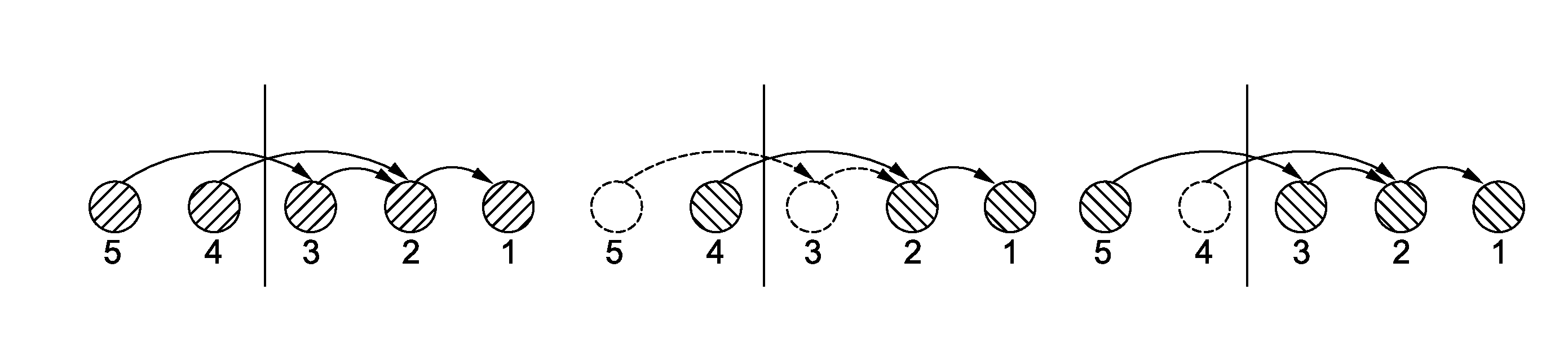
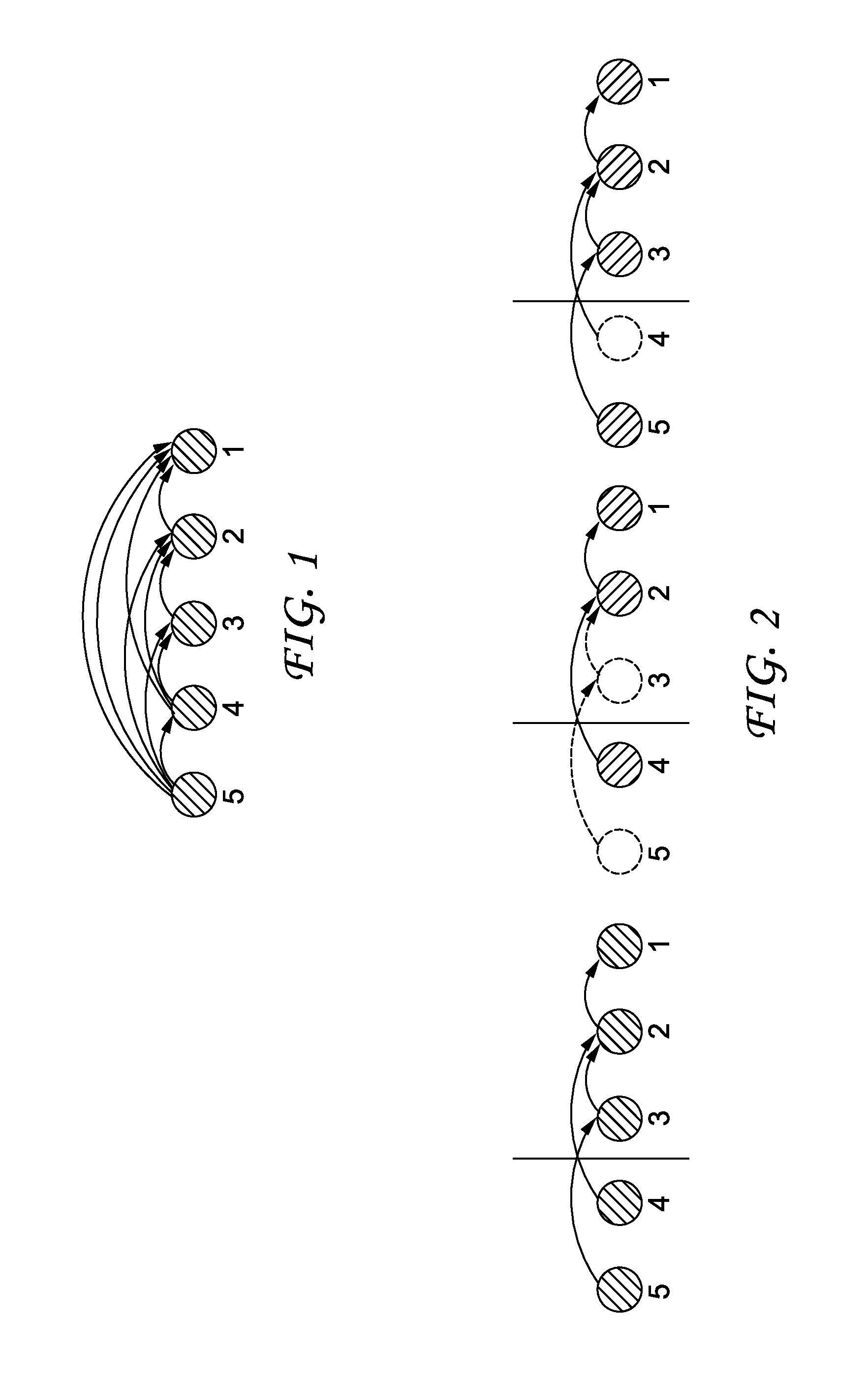
[0022]Given a collection of N items with some unknown underlying ranking, how to use pair-wise comparisons to determine the top ranked items in the set is examined. Resolving the top items from pairwise comparisons has application in diverse fields. Techniques are introduced herein to resolve the top ranked items using significantly less than all the possible pairwise comparisons and using both random and adaptive sampling methodologies. Using randomly-chosen comparisons, a graph-based technique is shown to efficiently resolve the top O(log N) items when there are no comparison errors. In terms of adaptively-chosen comparisons, it is shown how the top O(log N) items can be found, even in the presence of corrupted observations, using a voting methodology that only requires O(N log2N) pairwise comparisons.

[0023]Consider the “learning to rank problem”, where a set of N items, X{32 1, 2, . . . , N}, has unknown underlying ranking defined by the mapping π:{1, 2, . . . , N}→{1, 2, . . . ,...

the structure of the environmentally friendly knitted fabric provided by the present invention; figure 2 Flow chart of the yarn wrapping machine for environmentally friendly knitted fabrics and storage devices; image 3 Is the parameter map of the yarn covering machine
Login to View More

PUM

No PUM Login to View More

Abstract

A method and apparatus for determining a pre-determined number of top ranked items is described including accepting a probability of the method failing, iteratively performing the following steps, accepting the set of unranked items and the probability of erroneous pairwise comparisons, randomly selecting a pre-determined number of items from the set of unranked items, querying multiple observed pairwise comparisons, determining items of the set of unranked items that are in a top portion and in a bottom portion of the set of unranked items based on the query, reducing the set of unranked items by removing the items in the bottom portion and the top portion of the set of unranked items responsive to the determining step, querying the multiple observed pairwise comparisons, reducing the set of unranked items by removing items in the bottom portion of the set of unranked items responsive to the second querying step and returning the reduced set of unranked items.

Description

[0001]This application claims priority to U.S. Provisional Application No. 61 / 773,970 entitled “Top-K Search Using Selected Pairwise Comparisons”, filed on Mar. 7, 2013, which is hereby incorporated by reference in its entirety.FIELD OF THE INVENTION[0002]The present invention relates to recommendation and voting systems.BACKGROUND OF THE INVENTION[0003]Naïve solutions to the top-k item problem require all N*(N-1) / 2 pairwise comparisons to be observed. Often, there is significant cost to obtain each comparison. For example, in the recommender systems problem, each comparison query is the result of a user being asked to compare two items (e.g., movies, music, etc.), where each user will maintain engagement only for a small number of comparisons. When N is very large, obtaining all of the pairwise comparisons is prohibitively expensive.[0004]A geometric approach to learning the rank of a set of items was attempted by K. Jamieson and R. Nowak in “Active Ranking using Pairwise Compariso...

Claims

the structure of the environmentally friendly knitted fabric provided by the present invention; figure 2 Flow chart of the yarn wrapping machine for environmentally friendly knitted fabrics and storage devices; image 3 Is the parameter map of the yarn covering machine
Login to View More

Application Information

Patent Timeline
no application Login to View More
Patent Type & Authority Applications(United States)
IPC IPC(8): G06F17/30
CPCG06F17/30477G06F17/30395G06F16/435G06F16/2425G06F16/2455
Inventor ERIKSSON, BRIAN, CHARLES
Owner THOMSON LICENSING SA
Features
  • R&D
  • Intellectual Property
  • Life Sciences
  • Materials
  • Tech Scout
Why Patsnap Eureka
  • Unparalleled Data Quality
  • Higher Quality Content
  • 60% Fewer Hallucinations
Social media
Patsnap Eureka Blog
Learn More