Check patentability & draft patents in minutes with Patsnap Eureka AI!

Plant and method for the stabilization and inertization of slag deriving from steel production processes in steelworks and blast furnaces

a technology of inertization and stabilization, which is applied in the direction of mixing methods, lavatory sanitory, solid waste management, etc., to achieve the effect of effective slag exploitation and effective slag exploitation

Active Publication Date: 2016-05-05
FMP SRL
View PDF0 Cites 0 Cited by
  • Summary
  • Abstract
  • Description
  • Claims
  • Application Information

AI Technical Summary

Benefits of technology

The present invention offers a creative solution for effective exploitation of slags from steel production processes or ferrous mineral treatment processes, resulting in an inert product suitable for multiple uses. This reduces disposal costs and storage. The use of inert products obtained from the present invention provides high compressive strength and resistance to chemical etching or aggressive agents in difficult environments. Additionally, it helps to resolve the problem of heavy metal ions release in the environment.

Problems solved by technology

The treatment of slags today is often a considerable problem.
Such types of slags are considered often a refuse, a discard of the metallurgic production with consequent high costs due to their disposal or anyway to their storing.
In building field the use of the slags is considered unattractive and there are important prejudices on the effectiveness of their use because of the characteristics of the slags that influence their applicability in this field and because of the disadvantages attributed to their use and that are mainly:1) presence of a structure with pits which involves an anomalous water use during the mixture of the concrete and that makes the use of the slags hardly manageable in yard;2) presence of heavy metals that are potentially polluting if their release in the environment occurs;3) high weight of the slag inert products with respect to the inert products from quarry that penalizes the transport of the concrete in the concrete mixer; in fact the inert products deriving from slag can weigh also about 30% more with respect to the inert product from quarry, with the consequence that also the concrete obtained will be heavier, though this disadvantage is inherent only with the maximum volume that can be carried for example by the a concrete mixer because with an equal heavy weight transportable by the concrete mixer, the volume of the transported product will be lower due to the greater specific weight of the product;4) resistance in the course of time of the manufactured product made with concretes containing slags because of the excessive need of water in the concrete constituting the same product.
With particular reference to the applications in building field, the prior art techniques often find big limitations to the use of the slags deriving from the steel production processes in steelworks or ferrous mineral treatment processes in blast furnaces because of anomalous and hardly predictable and quantifiable phenomena of water absorption.
Replacing the inert product from quarry with the one from slag of analogous size a problem during the amalgam phase can be soon noticed.
In fact the porous structure of the slag causes an uncontrollable and high absorption of water which is anomalous and discontinuous, with respect to the absorption that occurs in the case of resorting to the usual inert products from quarry.
The evaporation causes the formation of minuscule free spaces which successively cause a withdrawal of the product or of the concrete with consequent formation of cracks and breakings at the structural level and drawbacks at physical and visual level that do not allow to have a homogenous concrete or anyway suitable for the specific requirements for example in the case of visible faces, industrial pavements, etc.
Further disadvantage of this excessive and anomalous evaporation of water is the possible occurrence of phenomena of “efflorescence” caused from the coming to surface of some physical elements present in the cement.
Notwithstanding the grinding of the slag in various sizes, also very fine ones, the above described problem remains and therefore the use in building field is very limited with respect to the one which it could actually be.
However such solutions are more expensive.
Though some prior art techniques describe the use of a certain quantity of slags in the preparation of cement products, namely the patent WO 2011 / 101386, they do not explain how the treatment of the slags themselves for the purpose of making them suitable to be incorporated within the cement mixture must occur, that is the prior art techniques do not explain how an effective inertization of the slags should be performed in order to obtain an inert product successively suitable to be used for example in the preparation of a cement product.
Furthermore in the prior art techniques, namely the patent WO 2011 / 101386, it is foreseen that the possible present slags are reduced to very fine granulometries, of the order of about 0.1-300 micron, which means that the slags must be treated by means of expensive processes and fittings to obtain particularly fine sizes, which increases the application costs of the described technique and also cause that the operators are exposed to the very thin powders obtained by slags deriving from steel production processes in steelworks or working of ferrous mineral treatment processes in blast furnaces, this exposition happening before the slags are effectively treated to be inertized.
Furthermore the inertization that we can obtain from the incorporation of finely crushed slags within cement products is not effective as the cement is not able to inertize effectively the single grains but is limited to incorporate them in the mixture with the risk that in any case the detachment of fine powders from the manufactured product with dispersion of heavy metals in the environment may occur.
For example the solutions described in U.S. Pat. No. 5,037,286; GB2327669; FR1357032; FR2742431 in practice provide that the particles of slags are incorporated or anyway completely coated by the cement, with considerable material waste of material and uncertainty in the effective inertization of the product.

Method used

the structure of the environmentally friendly knitted fabric provided by the present invention; figure 2 Flow chart of the yarn wrapping machine for environmentally friendly knitted fabrics and storage devices; image 3 Is the parameter map of the yarn covering machine
View more

Image

Smart Image Click on the blue labels to locate them in the text.
Viewing Examples
Smart Image
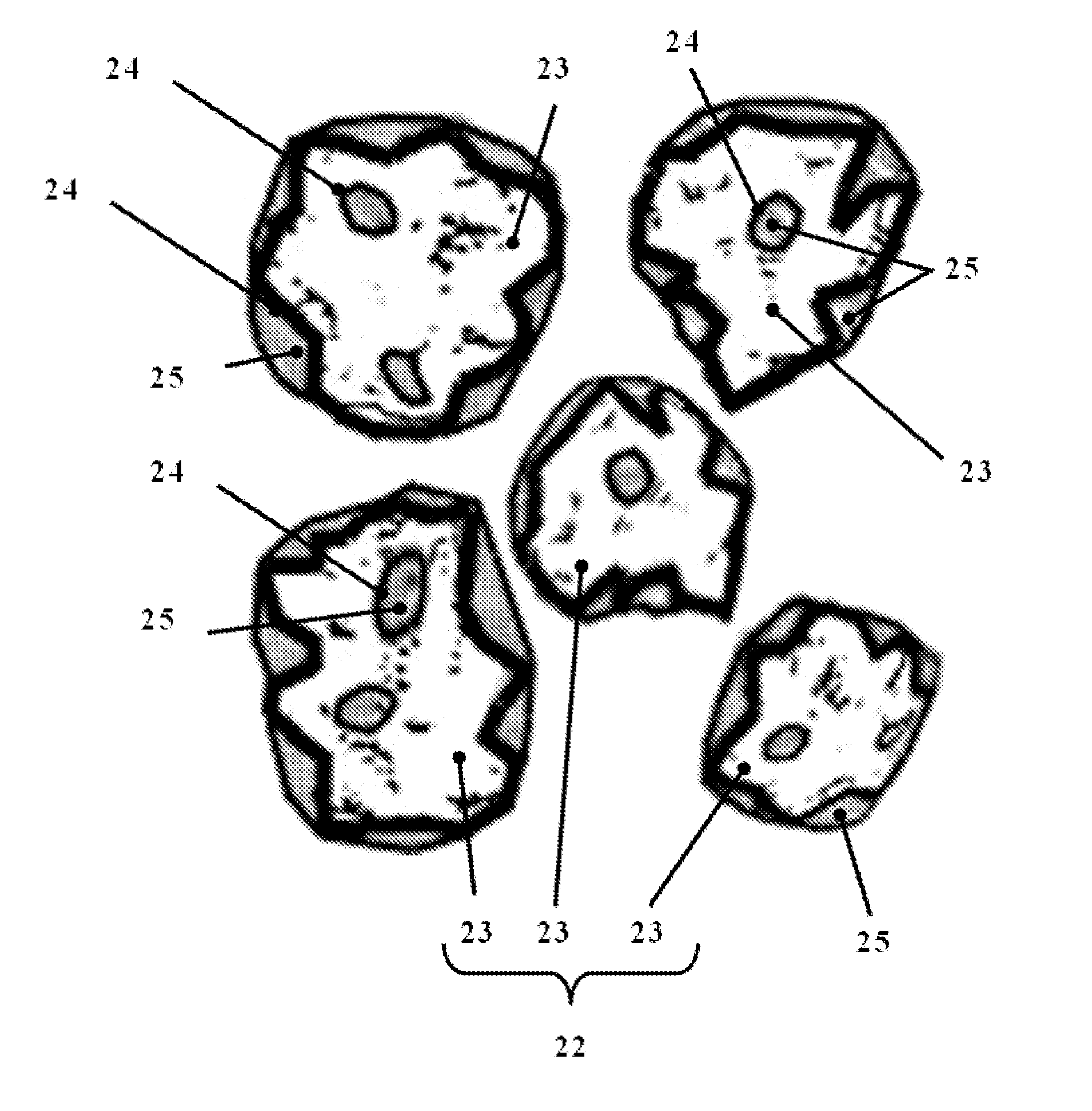
  • Plant and method for the stabilization and inertization of slag deriving from steel production processes in steelworks and blast furnaces
  • Plant and method for the stabilization and inertization of slag deriving from steel production processes in steelworks and blast furnaces
  • Plant and method for the stabilization and inertization of slag deriving from steel production processes in steelworks and blast furnaces

Examples

Experimental program
Comparison scheme
Effect test

example 1

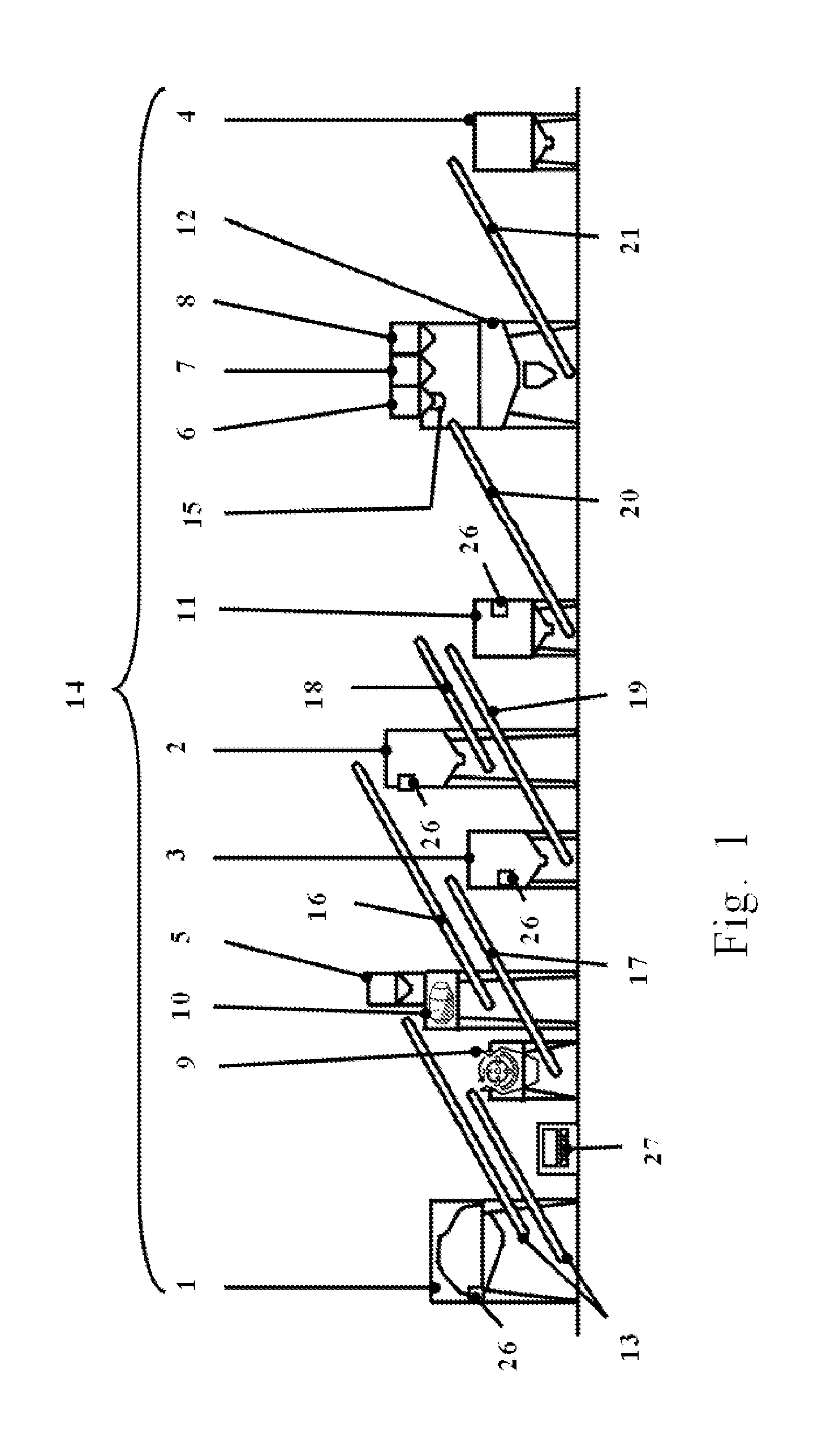
[0104]The grinding of a slag deriving from steel production processes in steelworks or ferrous mineral treatment processes in blast furnaces is carried out in quantity equal to about 2200 kilograms within a ball grinding mill (10) with obtainment of crushed slag in particulate having crushed particles size between 0.1 and 4 mm. Successively the mixing means of a planetary mixer (12) are activated and within the mixing chamber of the planetary mixer (12) a first water quantity equal to about 20 litres is added. After a first time T1 of about 10 seconds the introduction of the crushed slag in quantity of about 2200 kilograms within the mixing chamber of the planetary mixer (12), maintaining activated the mixing means is carried out. After second time T2 of about 30 seconds the introduction of the hydraulic binder in quantity of about 150 kilograms within the mixing chamber of the planetary mixer (12), maintaining activated the mixing means is carried out. After a third time T3 of abou...

example 2

[0105]The grinding of slag deriving from steel production processes in steelworks or ferrous mineral treatment processes in blast furnaces is made in quantity equal to about 1800 kilograms within a hammer crusher (9) with crushed slag obtainment in particulate having crushed particles size between 0.1 and 4 mm. Successively the mixing means of a planetary mixer (12) are activated and within the mixing chamber of the planetary mixer (12) a first water quantity equal to about 12 litres is added. After a first time T1 of about 5 seconds the introduction of the crushed slag is made in quantity of about 1800 kilograms within the mixing chamber of the planetary mixer (12), maintaining activated the mixing means. After second time T2 of about 20 seconds the introduction of the hydraulic binder in quantity of about 80 kilograms within the mixing chamber of the planetary mixer (12) is made, maintaining the mixing means activated. After a third time T3 of about 20 seconds the introduction of ...

example 3

[0106]The grinding of slag deriving from steel production processes in steelworks or ferrous mineral treatment processes in blast furnaces in a quantity equal to about 1300 kilograms is made within a hammer crusher (9) with obtainment of crushed slag in particulate having crushed particles size between 0.1 and 4 mm and the grinding of slag deriving from steel production processes in steelworks or ferrous mineral treatment processes in blast furnaces is made in quantity equal to about 1300 kilograms within a ball grinding mill (10) with obtainment of crushed slag in particulate having crushed particles size between 0.1 and 4 mm. Successively the mixing means of a planetary mixer (12) are activated and within the mixing chamber of the planetary mixer (12) a first water quantity equal to about 26 litres is added. After a first time T1 of about 15 seconds the introduction of the crushed slag in a quantity of about 2600 kilograms within the mixing chamber of the planetary mixer (12), mai...

the structure of the environmentally friendly knitted fabric provided by the present invention; figure 2 Flow chart of the yarn wrapping machine for environmentally friendly knitted fabrics and storage devices; image 3 Is the parameter map of the yarn covering machine
Login to View More

PUM

PropertyMeasurementUnit
sizesaaaaaaaaaa
sizesaaaaaaaaaa
sizesaaaaaaaaaa
Login to View More

Abstract

Method and plant for the stabilization and inertization of slag which is intended to obtain an inert and matured product based on slag deriving from steel production processes in steelworks or ferrous mineral treatment processes in blast furnaces.

Description

CROSS-REFERENCE TO RELATED U.S. APPLICATIONS[0001]Not applicable.STATEMENT REGARDING FEDERALLY SPONSORED RESEARCH OR DEVELOPMENT[0002]Not applicable.NAMES OF PARTIES TO A JOINT RESEARCH AGREEMENT[0003]Not applicable.REFERENCE TO AN APPENDIX SUBMITTED ON COMPACT DISC[0004]Not applicable.BACKGROUND OF THE INVENTION[0005]1. Field of the Invention[0006]The present invention relates to a treatment method of slags deriving from steel production processes in steelworks and blast furnaces according to the characteristics of the pre-characterizing part of claim 1.[0007]The present invention also relates to a plant for the stabilization and inertization of slag which is intended to obtain an inert and matured product based on slag deriving from steel-production processes in steelworks or ferrous mineral treatment processes in blast furnaces according to the characteristics of the pre-characterizing part of claim 15.[0008]The present invention also relates to an inert and matured product based...

Claims

the structure of the environmentally friendly knitted fabric provided by the present invention; figure 2 Flow chart of the yarn wrapping machine for environmentally friendly knitted fabrics and storage devices; image 3 Is the parameter map of the yarn covering machine
Login to View More

Application Information

Patent Timeline
no application Login to View More
Patent Type & Authority Applications(United States)
IPC IPC(8): C04B5/00C04B18/14B01F3/20C04B18/06C04B28/02C04B40/00B01F23/70
CPCC04B5/00C04B28/02C04B18/142B01F3/2071C04B18/067C04B40/0028Y02W30/91C04B20/1077B01F23/71
Inventor FEDON, MARCOMICHIELETTO, PIERPAOLOPILOTTO, RENATO
Owner FMP SRL
Features
  • R&D
  • Intellectual Property
  • Life Sciences
  • Materials
  • Tech Scout
Why Patsnap Eureka
  • Unparalleled Data Quality
  • Higher Quality Content
  • 60% Fewer Hallucinations
Social media
Patsnap Eureka Blog
Learn More