Unlock instant, AI-driven research and patent intelligence for your innovation.

Genetic Copy Number Determination Using High Throughput Multiplex Sequencing Of Smashed Nucleotides

a technology of multiplex sequencing and gene, applied in the field of gene copy number determination using high throughput multiplex sequencing of smashed nucleotides, can solve the problem that the length of sequence reads does not improve the resolution of copy number analysis, and achieve the effect of increasing the read length

Active Publication Date: 2019-11-28
COLD SPRING HARBOR LAB INC
View PDF1 Cites 0 Cited by
  • Summary
  • Abstract
  • Description
  • Claims
  • Application Information

AI Technical Summary

Benefits of technology

SMASH achieves comparable quality to whole genome sequencing in copy number analysis while significantly reducing costs, enabling more efficient detection of CNVs and providing genomic copy number information for diagnostic and therapeutic applications.

Problems solved by technology

Because the accuracy of copy number determination methods is driven by the quantity of independent reads, increased length of sequence reads does not improve the resolution of copy number analysis.

Method used

the structure of the environmentally friendly knitted fabric provided by the present invention; figure 2 Flow chart of the yarn wrapping machine for environmentally friendly knitted fabrics and storage devices; image 3 Is the parameter map of the yarn covering machine
View more

Image

Smart Image Click on the blue labels to locate them in the text.
Viewing Examples
Smart Image
  • Genetic Copy Number Determination Using High Throughput Multiplex Sequencing Of Smashed Nucleotides
  • Genetic Copy Number Determination Using High Throughput Multiplex Sequencing Of Smashed Nucleotides
  • Genetic Copy Number Determination Using High Throughput Multiplex Sequencing Of Smashed Nucleotides

Examples

Experimental program
Comparison scheme
Effect test

example 1

of SMASH

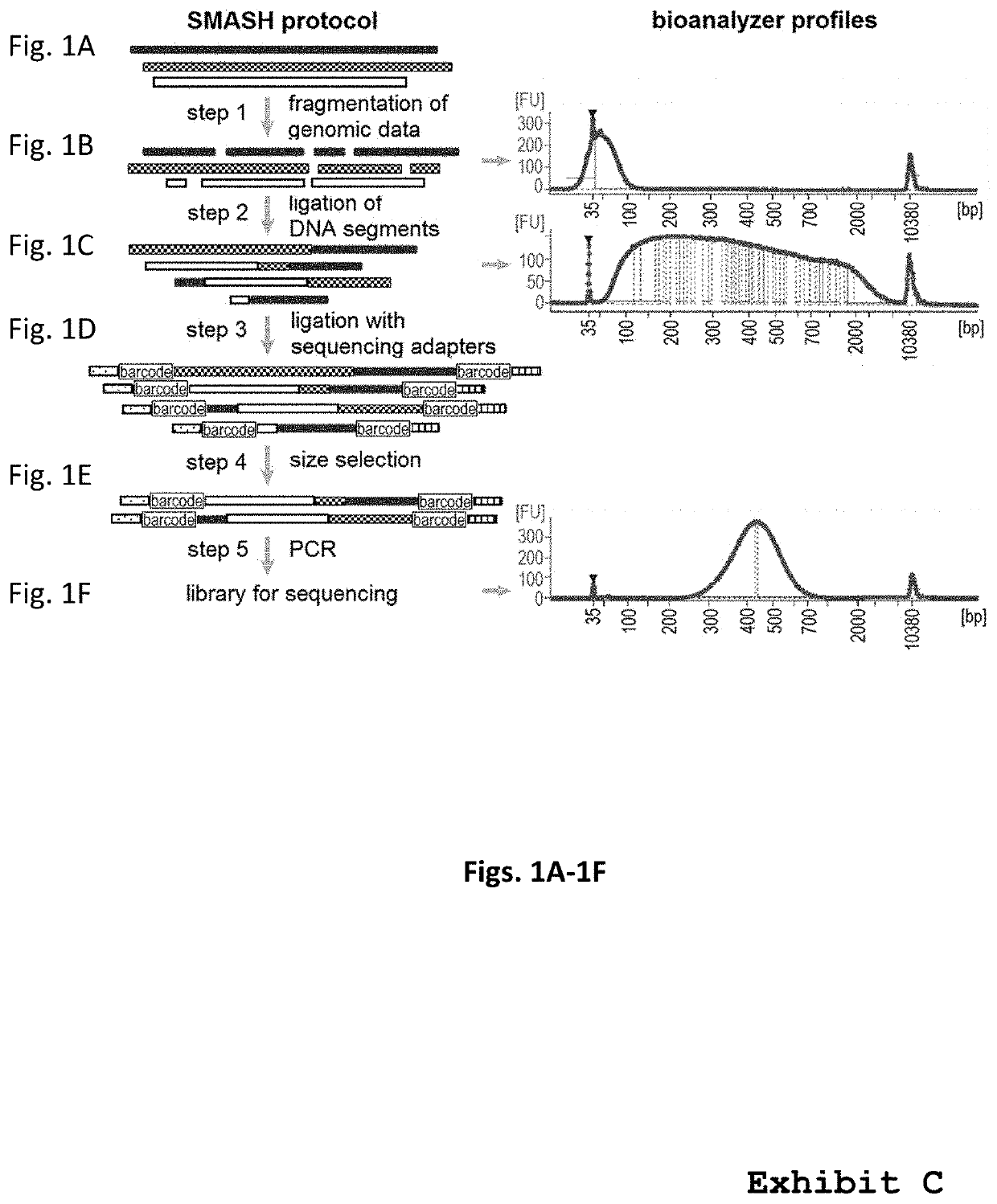
[0138]The protocol for SMASH (see also “Methods—Smash protocol,” above) is illustrated in FIG. 1. To obtain SMASH tags, first genomic DNA was mechanically sheared by sonication, then cut with two restriction endonucleases. The ideal size fraction is obtained using bead purification (see also “Methods—Smash protocol,” above) to enrich for the target size range of 40 bp (FIG. 1). To generate the long chimeric DNAs, the SMASH tags were end-repaired and then ligated. A second fragmentation step may optionally be performed to eliminate long (>1 kb) chimeric molecules, and DNA fragments in the proper size range (300-700 bp) are purified. Barcoded sequencing adaptors are then attached to the molecules, creating libraries that can be multiplexed on a single sequencing lane. Alternatively, long chimeric DNAs can be formed by ligation of end-repaired SMASH segments, followed by attachment of barcoded sequencing adaptors to the fragments and finally selection of DNA fragments in the op...

example 2

g Pipeline Parameters

[0143]To measure performance precisely and choose parameters for pipeline processing, the signal in bins was compared on the X chromosome to those on autosomes in male subjects. Also calculated are 1) the median average deviation (MAD) of bins to measure the magnitude of the noise, and 2) the autocorrelation as a measure of trendiness in the data, an important risk factor for segmentation error. Signal to noise (“S / N”) was calculated as the difference in the medians of the autosome and X-chromosome, divided by the square root of the sum of the squares of the MADs. These statistics were used to evaluate reference normalization and mapping algorithms, and then to compare WGS to SMASH (Table 1).

[0144]First, the utility of applying reference normalization (“ref norm,” Table 1) was considered. Dividing the GC-adjusted bin ratios by a standard sample bin ratio greatly improved performance for both WGS and SMASH (rows 1 through 4). Namely, reference normalization decre...

example 3

WGS to SMASH Profiles Under Optimized Pipeline Parameters

[0147]The performance of WGS and SMASH was compared using autosomes and X-chromosomes as described above. Different total numbers of bins (from 50,000 to 500,000), different mean numbers of maps per bin (20, 50 and 100), collecting statistics for signal-to-noise and autocorrelation were considered, among other factors. The two methods have very similar performance characteristics (Table 2). WGS, map for map, slightly outperforms SMASH. When bin boundaries were chosen such that the reference sample has the same number of maps in each bin, the signal-to-noise ratio improves for both SMASH and WGS, and the difference between them narrows substantially (Supplementary Table

TABLE 2maps autosome X- X- signal # of per auto- autosome chrom autosome chrom to type bins bin correlation median median MAD MAD noisesmash 50000 20 −0.002 2.032 1.111 0.297 0.218 2.497 wgs 50000 20 0.000 2.031 1.072 0.295 0.208 2.659 smash 50000 50 0.006 2.009 ...

the structure of the environmentally friendly knitted fabric provided by the present invention; figure 2 Flow chart of the yarn wrapping machine for environmentally friendly knitted fabrics and storage devices; image 3 Is the parameter map of the yarn covering machine
Login to View More

PUM

PropertyMeasurementUnit
final volumeaaaaaaaaaa
volumeaaaaaaaaaa
Login to View More

Abstract

The present invention, SMASH (Short Multiply Aggregated Sequence Homologies), is a technique designed to pack multiple independent mappings into every read. Specifically, the invention relates to a composition comprising a first mixture of different chimeric genomic nucleic acid fragments, wherein each different fragment in the mixture comprises randomly ligated DNA segments, wherein each DNA segment in the fragment is a nucleic acid molecule at least 27 base pairs in length resulting from random fragmentation of a single genome. The invention also relates to methods for generating said composition and use of said composition to obtain genomic information, for example, copy number variation.

Description

[0001]This application is a divisional of U.S. Ser. No. 15 / 419,878, filed Jan. 30, 2018, a continuation of PCT / US2016 / 050750, filed Sep. 8, 2016, which claims the benefit of U.S. Provisional Application Nos. 62 / 292,151, filed Feb. 5, 2016, 62 / 250,405, filed Nov. 3, 2015 and 62 / 215,540, filed Sep. 8, 2015, the contents of which are hereby incorporated by reference.[0002]This application incorporates-by-reference nucleotide and / or amino acid sequences which are present in the file named “20190207_87857_Z_PCT_US_Sequence_Listing_ADR.txt”, which is 2.20 kilobytes in size, and which was created Feb. 7, 2019 in the IBM-PC machine format, having an operating system compatibility with MS-Windows, which is contained in the text file filed Feb. 7, 2019 as part of this application.[0003]Throughout this application, various publications are referenced, including referenced in parenthesis. Full citations for publications referenced in parenthesis may be found listed at the end of the specificati...

Claims

the structure of the environmentally friendly knitted fabric provided by the present invention; figure 2 Flow chart of the yarn wrapping machine for environmentally friendly knitted fabrics and storage devices; image 3 Is the parameter map of the yarn covering machine
Login to View More

Application Information

Patent Timeline
no application Login to View More
Patent Type & Authority Applications(United States)
IPC IPC(8): C12Q1/6809G16B30/00C12Q1/6855C12Q1/68C12N15/10C12Q1/6806G16B30/10
CPCC12N15/1093C12Q1/6855G16B30/00C12N15/1065C12Q1/6806C12Q1/6809C12Q1/68G16B30/10C12Q2525/191C12Q2535/122C12Q2563/185C40B40/06
Inventor WIGLER, MICHAEL H.LEVY, DANWANG, ZIHUA
Owner COLD SPRING HARBOR LAB INC