Check patentability & draft patents in minutes with Patsnap Eureka AI!

Imaging lens

a technology of imaging lens and aperture, applied in the field of imaging lens, can solve the problems of insufficient size reduction and difficult cost reduction, and achieve the effect of facilitating aberration correction, facilitating aberration correction, and facilitating aberration correction

Pending Publication Date: 2021-01-14
TOKYO VISIONARY OPTICS CO LTD
View PDF0 Cites 0 Cited by
  • Summary
  • Abstract
  • Description
  • Claims
  • Application Information

AI Technical Summary

Benefits of technology

The proposed lens configuration achieves a compact, bright, and high-resolution imaging lens with improved manufacturing ease and reduced costs by using single lenses with optimized refractive powers and surface shapes, effectively correcting aberrations and maintaining low profileness.

Problems solved by technology

Regarding the imaging lens having a seven-lens configuration disclosed in the above-described Patent Document 1, F-number is relatively small and the aberrations are properly corrected, however, sufficient reduction in size is not achieved.
Furthermore, the configuration including a glass lens or a cemented lens has difficulty in manufacturing process, and reduction in cost is also difficult.

Method used

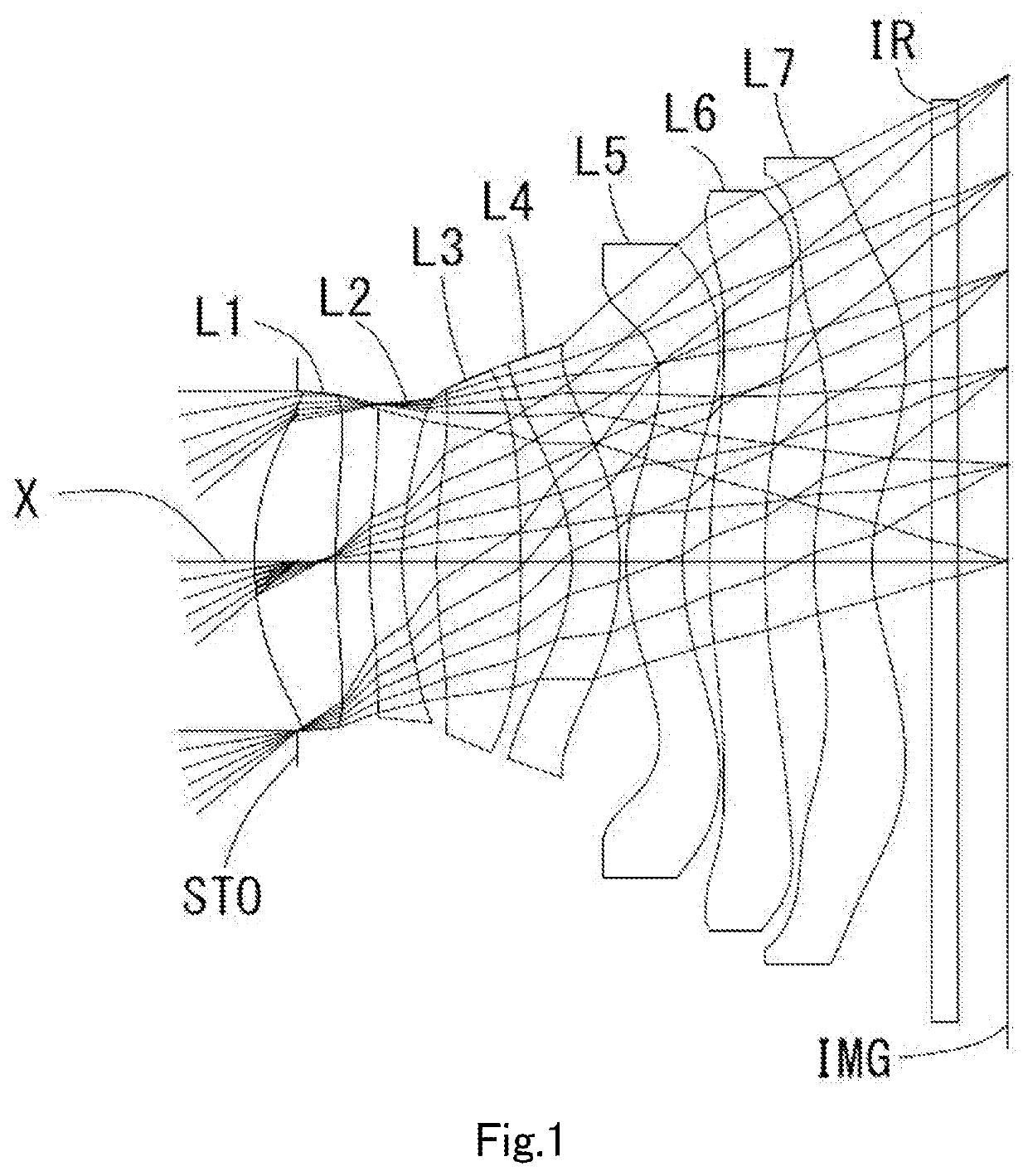
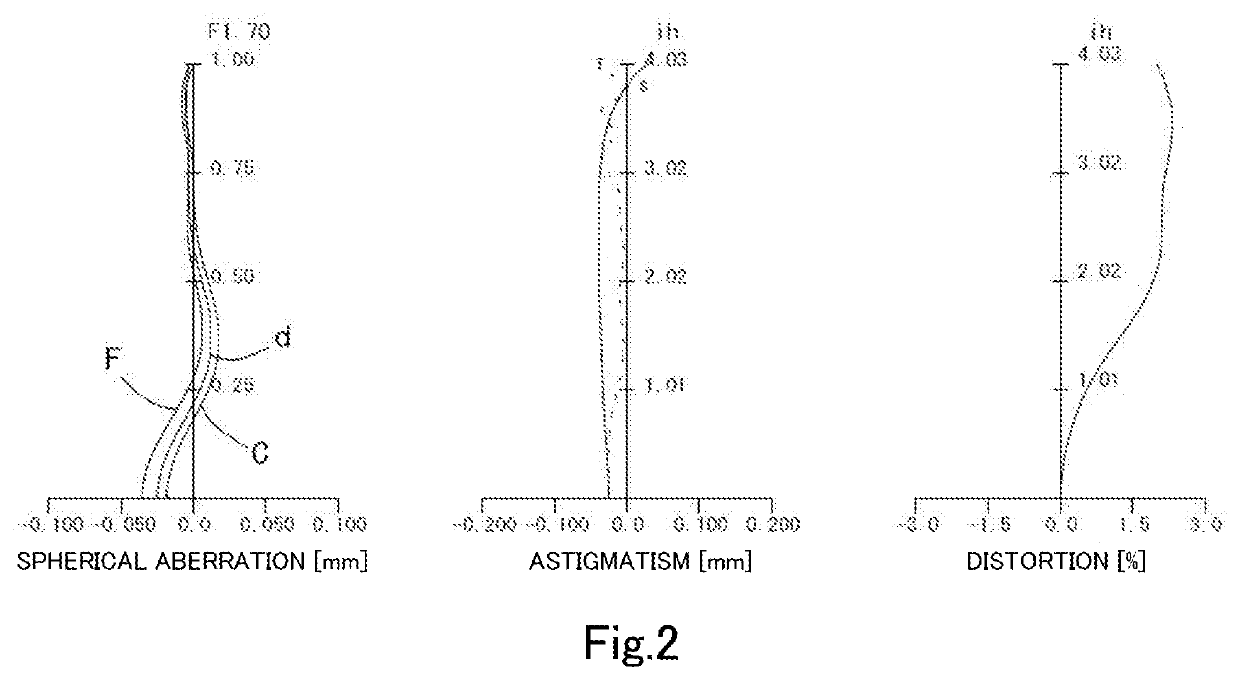
the structure of the environmentally friendly knitted fabric provided by the present invention; figure 2 Flow chart of the yarn wrapping machine for environmentally friendly knitted fabrics and storage devices; image 3 Is the parameter map of the yarn covering machine
View more

Image

Smart Image Click on the blue labels to locate them in the text.
Viewing Examples
Smart Image
  • Imaging lens
  • Imaging lens
  • Imaging lens

Examples

Experimental program
Comparison scheme
Effect test

example 1

[0085]The basic lens data is shown below in Table 1.

TABLE 1Unit mmf =4.79ih =4.03Fno =1.70TTL =6.20ω(°) =39.5Surface DataSurfaceCurvatureSurfaceRefractiveAbbeNumber iRadius rDistance dIndex NdNumber vdFocal Length(Object)InfinityInfinity1 (Stop)Infinity−0.3625 2*2.3112(r1)0.6767(d1)1.5445(Nd1)55.98(vd1)6.62(=f1) 3*5.7779(r2)02821(t1) 4*3.4809(r3)0.2720(d2)1.6612(Nd2)20.37(vd2)−14.46(=f2) 5*2.4726(r4)0.2866(t2) 6*5.1708(r5)0.7032(d3)1.5445(Nd3)55.98(vd3)6.15(=f3) 7*−9.0345(r6)0.4197(t3) 8*−1.4464(r7)0.4000(d4)1.6397(Nd4)23.53(vd4)−8.00(=f4) 9*−2.2335(r8)0.0550(t4)10*1.9035(r9)0.4700(d5)1.5445(Nd5)55.98(vd5)9.01(=f5)11*2.8398(r10)0.2231(t5)12*7.0077(r11)0.4600(d6)1.5445(Nd6)55.98(vd6)126.06(=f6)13*7.6239(r12)0.4079(t6)14*2.4638(r13)0.4850(d7)1.5348(Nd7)55.66(vd7)−11.02(=f7)15*1.6183(r14)0.278816 Infinity0.21001.563051.3017 Infinity0.6462(ImageInfinityPlane)Lens group dataComposite Focal LengthEnhance Pupil Diameter1st lens-2nd lens10.14(=f12)2.810(=EPD)2nd lens-3rd lens10.68(=f23)3rd ...

example 2

[0088]The basic lens data is shown below in Table 2.

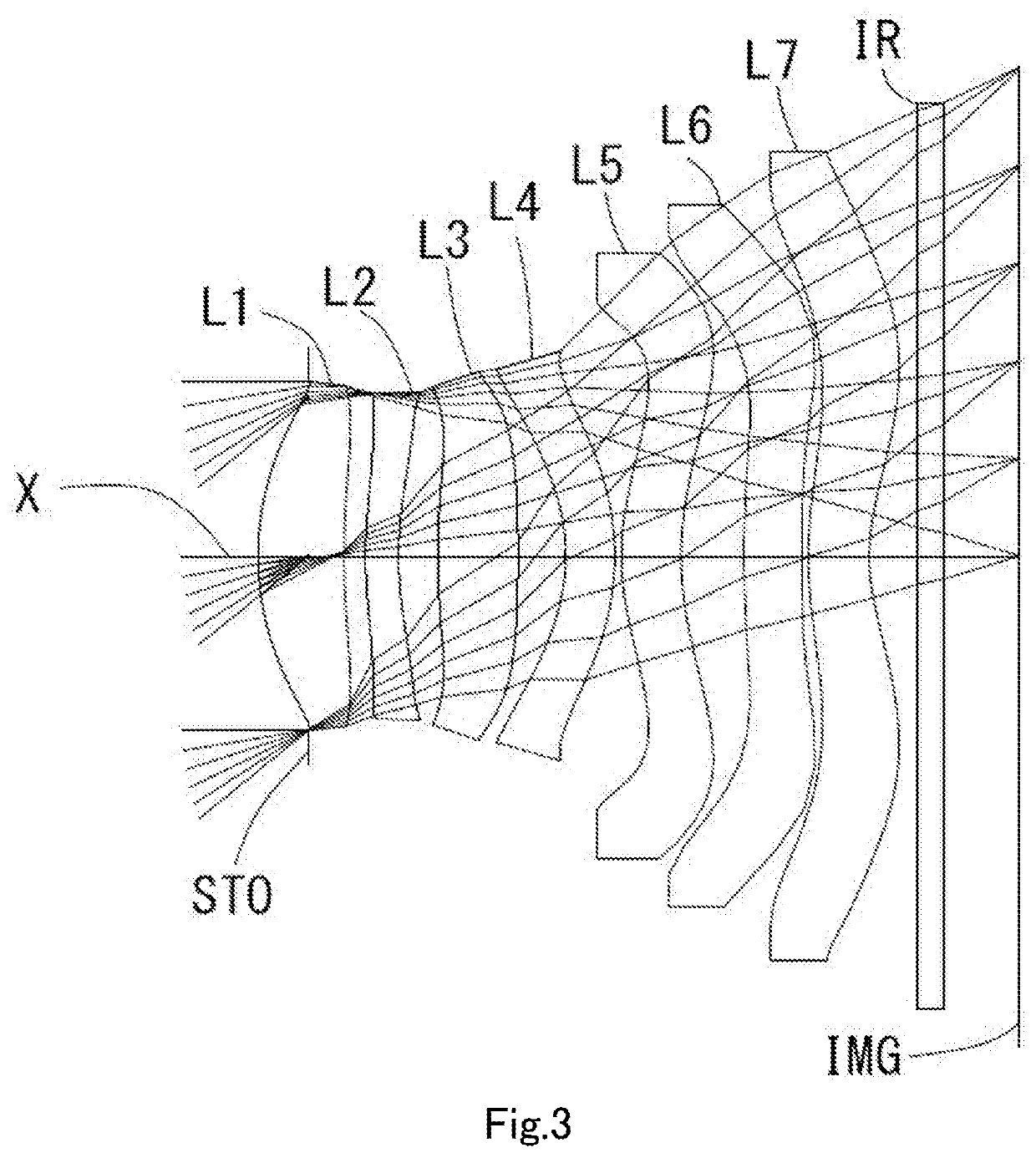
TABLE 2Unit mmf =4.88ih =4.03Fno =1.70TTL =6.20ω(°) =39.1Surface DataSurfaceCurvatureSurfaceRefractiveAbbeNumber iRadius rDistance dIndex NdNumber vdFocal Length(Object)InfinityInfinity1 (Stop)Infinity−0.4150 2*2.3033(r1)0.7070(d1)1.5445(Nd1)55.98(vd1)8.86(=f1) 3*5.3516(r2)0.1782(t1) 4*3.3985(r3)0.2721(d2)1.6709(Nd2)19.48(vd2)−24.87(=f2) 5*2.7326(r4)0.3239(t2) 6*5.8363(r5)0.6605(d3)1.5445(Nd3)55.98(vd3)7.16(=f3) 7*−11.2520(r6)0.3962(t3) 8*−1.5256(r7)0.4000(d4)1.6512(Nd4)20.37(vd4)−8.93(=f4) 9*−2.2715(r8)0.0550(t4)10*1.9695(r9)0.4933(d5)1.5445(Nd5)55.98(vd5)11.75(=f5)11*2.5938(r10)0.5193(t5)12*10.3411(r11)0.4800(d6)1.5348(Nd6)55.66(vd6)11.82(=f6)13*−16.0000(r12)0.0500(t6)14*3.4484(r13)0.5009(d7)1.5348(Nd7)55.66(vd7)−6.14(=f7)15*1.5973(r14)0.248816 Infinity0.21001.563051.3017 Infinity0.7766(ImageInfinityPlane)Lens group dataComposite Focal LengthEnhance Pupil Diameter1st lens-2nd lens8.57(=f12)2.865(=EPD)2nd lens-3rd lens10.24(=f23)3...

example 3

[0091]The basic lens data is shown below in Table 3.

TABLE 3Unit mmf =4.90ih =4.03Fno =1.70TTL =6.20ω(°) =38.9Surface DataSurfaceCurvatureSurfaceRefractiveAbbeNumber iRadius rDistance dIndex NdNumber vdFocal Length(Object)InfinityInfinity1 (Stop)Infinity−0.4350 2*2.2617(r1)0.7274(d1)1.5445(Nd1)55.98(vd1)6.62(=f1) 3*5.3795(r2)0.1796(t1) 4*3.6532(r3)0.2720(d2)1.6709(Nd2)19.48(vd2)−22.85(=f2) 5*2.8619(r4)0.3243(t2) 6*5.6975(r5)0.6303(d3)1.5445(Nd3)55.98(vd3)7.35(=f3) 7*−12.9039(r6)0.3866(t3) 8*−1.4840(r7)0.4000(d4)1.6612(Nd4)20.37(vd4)−8.62(=f4) 9*−2.2216(r8)0.0559(t4)10*1.9158(r9)0.4706(d5)1.5445(Nd5)55.98(vd5)11.19(=f5)11*2.5525(r10)0.5688(t5)12*9.1813(r11)0.4800(d6)1.5348(Nd6)55.66(vd6)11.32(=f6)13*−17.4581(r12)0.0599(t6)14*3.8367(r13)0.4926(d7)1.5348(Nd7)55.66(vd7)−6.06(=f7)15*1.6781(r14)0.237116 lnflntiv0.21001.563051.3017 InMy0.7757(ImageInfinityPlane)Lens group dataComposite Focal LengthEnhance Pupil Diameter1st lens-2nd lens8.39(=f12)2.880(=EPD)2nd lens-3rd lens10.99(=f23)3rd le...

the structure of the environmentally friendly knitted fabric provided by the present invention; figure 2 Flow chart of the yarn wrapping machine for environmentally friendly knitted fabrics and storage devices; image 3 Is the parameter map of the yarn covering machine
Login to View More

PUM

No PUM Login to View More

Abstract

There is provided a compact and high-resolution imaging lens at a low cost. The imaging lens comprises in order from an object side to an image side, a first lens having positive refractive power and a convex surface facing the object side near an optical axis, a second lens having negative refractive power and a meniscus shape having the convex surface facing the object side near the optical axis, a third lens having the positive or the negative refractive power, a fourth lens having the convex surface facing the image side near the optical axis, a fifth lens having the positive refractive power, a sixth lens having the positive refractive power, and a seventh lens having the negative refractive power and a concave surface facing the image side near the optical axis, the image side surface of said seventh lens is formed as an aspheric surface which changes to the convex surface at a peripheral area, the object-side surface of said fifth lens has the convex surface facing the object side near the optical axis, all lenses are single lenses arranged with an interval between lenses adjacent to each other, and below conditional expressions (1), (2) and (3) are satisfied:(1) 1.50<Nd1<1.60(2) −8.0<f2 / f<−2.0(3) 0.3<t2 / t3<3.3whereNd1: refractive index at d-ray of the first lens,f: focal length of the overall optical system,f2: focal length of the second lens,t2: distance along the optical axis from the image-side surface of the second lens to the object-side surface of the third lens, andt3: distance along the optical axis from the image-side surface of the third lens to the object-side surface of the fourth lens.

Description

[0001]The present application is based on and claims priority of a Japanese patent application No. 2017-196848 filed on Oct. 10, 2017, the entire contents of which are hereby incorporated by reference.BACKGROUND OF THE INVENTIONField of the Invention[0002]The present invention relates to an imaging lens which forms an image of an object on a solid-state image sensor such as a CCD sensor or a C-MOS sensor used in a compact imaging device.Description of the Related Art[0003]In recent years, it becomes common that camera function is mounted in many information terminal equipment. It is expected that development of various products with the camera function pursuing convenience and satisfaction of customers will continue accordingly.[0004]The imaging lens used in such equipment is required to be compact and to have high-resolution performance, and spread of the imaging lens and reduction in cost are also required.[0005]For Example, as a conventional imaging lens aiming the high-resolutio...

Claims

the structure of the environmentally friendly knitted fabric provided by the present invention; figure 2 Flow chart of the yarn wrapping machine for environmentally friendly knitted fabrics and storage devices; image 3 Is the parameter map of the yarn covering machine
Login to View More

Application Information

Patent Timeline
no application Login to View More
Patent Type & Authority Applications(United States)
IPC IPC(8): G02B13/00G02B9/64
CPCG02B13/0045G02B9/64G02B13/18
Inventor SEKINE, YUKIO
Owner TOKYO VISIONARY OPTICS CO LTD
Features
  • R&D
  • Intellectual Property
  • Life Sciences
  • Materials
  • Tech Scout
Why Patsnap Eureka
  • Unparalleled Data Quality
  • Higher Quality Content
  • 60% Fewer Hallucinations
Social media
Patsnap Eureka Blog
Learn More