Check patentability & draft patents in minutes with Patsnap Eureka AI!

Programming method for controlling memory threshold voltage distribution

a programming method and threshold voltage technology, applied in static storage, digital storage, instruments, etc., can solve the problems of difficult control of the threshold voltage distribution of the nrom cell, difficulty in achieving narrow threshold voltage distribution,

Active Publication Date: 2006-08-01
MACRONIX INT CO LTD
View PDF2 Cites 11 Cited by
  • Summary
  • Abstract
  • Description
  • Claims
  • Application Information

AI Technical Summary

Benefits of technology

This approach results in more accurate and narrower threshold voltage distributions, reducing the total distribution width to less than 200 mV, enhancing control over memory cell states and improving read margin windows.

Problems solved by technology

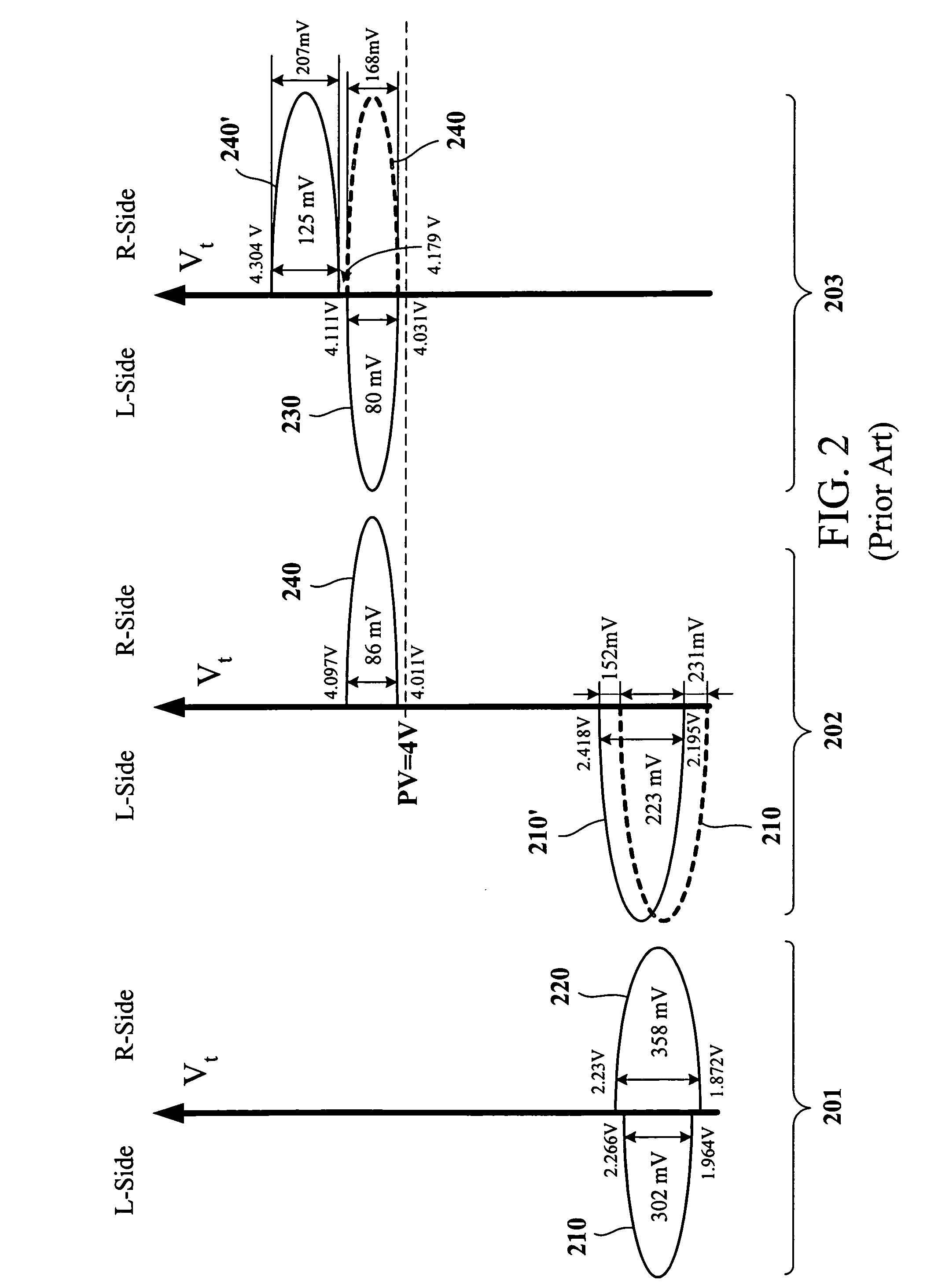
Secondly, the array effect will affect the threshold voltage distributions for a memory cell in a memory array, i.e., the threshold voltage of a selected memory cell will be affected by the leakage current to neighboring memory cells that share the same word line with the selected memory cell, thus resulting in difficulties to achieve narrow threshold voltage distributions.
The deviations and the increased widths of the threshold voltage distributions make the threshold voltage distributions of the NROM cells difficult to control.

Method used

the structure of the environmentally friendly knitted fabric provided by the present invention; figure 2 Flow chart of the yarn wrapping machine for environmentally friendly knitted fabrics and storage devices; image 3 Is the parameter map of the yarn covering machine
View more

Image

Smart Image Click on the blue labels to locate them in the text.
Viewing Examples
Smart Image
  • Programming method for controlling memory threshold voltage distribution
  • Programming method for controlling memory threshold voltage distribution
  • Programming method for controlling memory threshold voltage distribution

Examples

Experimental program
Comparison scheme
Effect test

Embodiment Construction

[0025]Reference is made in detail to embodiments of the invention. While the invention is described in conjunction with the embodiments, the invention is not intended to be limited by these embodiments. On the contrary, the invention is intended to cover alternatives, modifications and equivalents, which may be included within the spirit and scope of the invention as defined by the appended claims. Furthermore, in the following detailed description of the invention, numerous specific details are set forth in order to provide a thorough understanding of the invention. However, as is obvious to one ordinarily skilled in the art, the invention may be practiced without these specific details. In other instances, well-known methods, procedures, components, and circuits have not been described in detail so that aspects of the invention will not be obscured.

[0026]FIG. 3 is a flow chart 300 illustrating an exemplary programming method for a memory batch in accordance with one embodiment of ...

the structure of the environmentally friendly knitted fabric provided by the present invention; figure 2 Flow chart of the yarn wrapping machine for environmentally friendly knitted fabrics and storage devices; image 3 Is the parameter map of the yarn covering machine
Login to View More

PUM

No PUM Login to View More

Abstract

A method for programming one or more memory cells is disclosed. The one or more memory cells need to be two sides operated. After verifying both sides of each memory cell to identify the sides of the memory cells to be programmed, a programming voltage pulse is given to the first sides of the memory cells identified to be programmed. Another verification process is performed for both sides of each memory cell to identify the sides of the memory cells to be programmed. Next, a programming voltage pulse is given to the second sides of the memory cells identified to be programmed. The verifying both sides, programming the first sides, verifying both sides, and programming the second sides will continue until the both sides of each memory cell are programmed to a target programming voltage. The target programming voltage might have multiple voltage levels.

Description

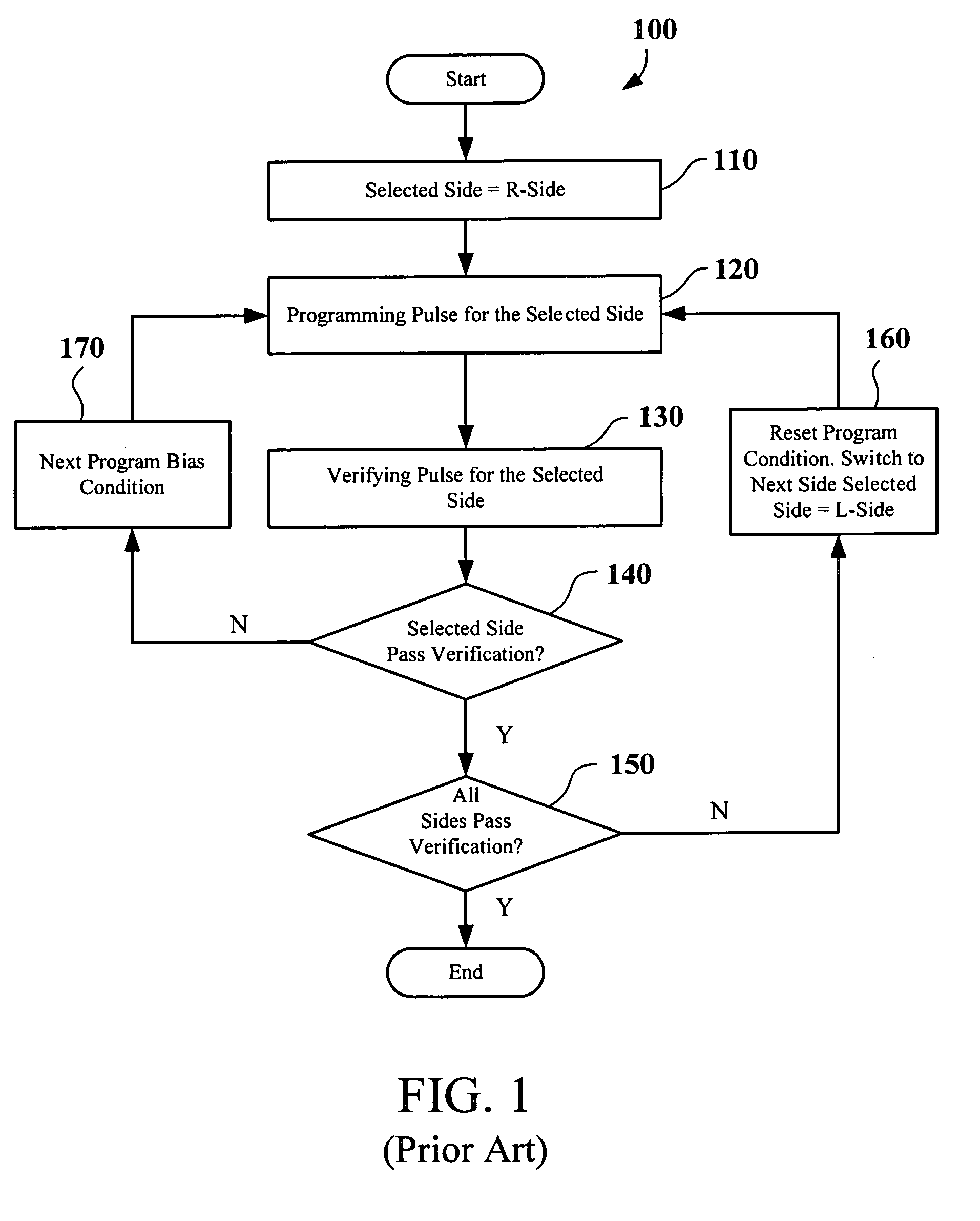
BACKGROUND OF THE INVENTION[0001]1. Field of the Invention[0002]The present invention relates generally to methods for programming semiconductor memory cells, and more particularly, to a programming method for controlling memory threshold voltage distributions for one or more double-sided semiconductor memory cells.[0003]2. Description of the Related Art[0004]A semiconductor memory cell, or a memory cell, such as a nitride read only memory (NROM) cell, is typically programmed by applying a programming pulse thereto, thus causing charges to become trapped in a retention layer of the memory cell. The trapped charges in the retention layer of a memory cell induce the increase of the threshold voltage for the memory cell.[0005]In order to verify whether the increased threshold voltage of the programmed memory cell has reached its target programming voltage, a verifying pulse, following the programming pulse, is applied to the programmed memory cell. If the verifying pulse reveals that t...

Claims

the structure of the environmentally friendly knitted fabric provided by the present invention; figure 2 Flow chart of the yarn wrapping machine for environmentally friendly knitted fabrics and storage devices; image 3 Is the parameter map of the yarn covering machine
Login to View More

Application Information

Patent Timeline
no application Login to View More
Patent Type & Authority Patents(United States)
IPC IPC(8): G11C16/34
CPCG11C11/5671G11C16/0475G11C16/3481G11C16/3459G11C16/12
Inventor LEE, MING-HSIUWU, CHAO-IHSU, TZU-HSUAN
Owner MACRONIX INT CO LTD
Features
  • R&D
  • Intellectual Property
  • Life Sciences
  • Materials
  • Tech Scout
Why Patsnap Eureka
  • Unparalleled Data Quality
  • Higher Quality Content
  • 60% Fewer Hallucinations
Social media
Patsnap Eureka Blog
Learn More