Stitched write head with staircase P2 defined throat height
a writing head and staircase technology, applied in the direction of magnetic recording heads, magnetic recording instruments, magnetic recording, etc., can solve the problems of narrow write efficiency, narrow write gap and track width, and difficulty in fabricating a precise track width during the photo/trim patterning process, and achieve narrow well-defined track width
- Summary
- Abstract
- Description
- Claims
- Application Information
AI Technical Summary
Benefits of technology
Problems solved by technology
Method used
Image


Examples
first embodiment
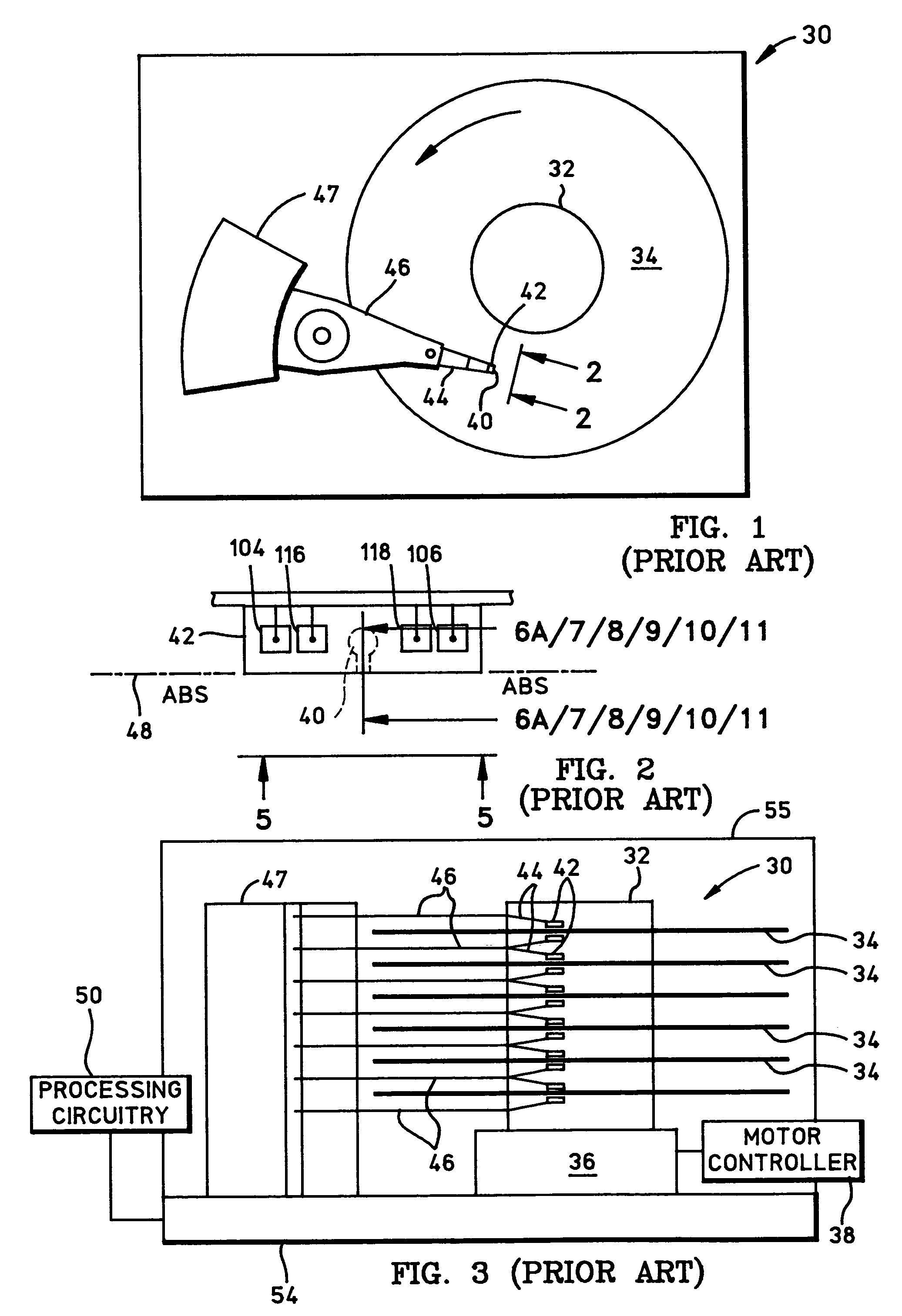
[0028]FIG. 6A is a side cross-sectional elevation view of a magnetic head assembly 200, which includes a write head portion and a read head portion and is the magnetic head assembly 40 in FIG. 2. In the read head a sensor 202 is sandwiched between nonmagnetic electrically insulative first and second read gap layers 204 and 206, and the read gap layers are sandwiched between ferromagnetic first and second shield layers 208 and 210. In response to external magnetic fields, the resistance of the sensor 202 changes. A sense current Is (not shown) conducted through the sensor causes these resistance changes to be manifested as potential changes. These potential changes are then processed as readback signals by the processing circuitry 50 shown in FIG. 3.
[0029]The write head portion includes first and second pole pieces wherein the first pole piece may also include the second shield layer 210 and a first pole piece pedestal 212. When the layer 210 serves as both a second shield layer for ...
embodiment 200
[0033]Another embodiment 300 of the magnetic head assembly is illustrated in FIG. 7 which is the same as the embodiment 200 in FIG. 6A except the second insulation stack 244 with the write coil in FIG. 6A has been eliminated and a third component 302 of the second pole piece is a flat layer instead of an arched layer 230 as shown in FIG. 6A.
[0034]FIG. 8 illustrates a third embodiment 400 of the magnetic head assembly which differs from the embodiment 200 in FIG. 6A in that there is no third component of the second pole piece, the insulation stack 244 with the write coil therein is omitted and the second component 402 of the second pole piece is fabricated somewhat differently. The second component 402 is fabricated with a track width portion 404 which flares out at 236 to form a widened portion 406. The track width portion 404 is employed as a mask for ion milling the first component 226 with the desired track width or may be further ion milled to define the same track width in the ...
fourth embodiment
[0035]FIG. 9 illustrates the magnetic head assembly which differs from the embodiment shown in FIG. 6A in that the pedestal 502 is not milled to form a cap. Instead a first pole piece cap 504 is formed on the pedestal 502, a write gap layer 506 is formed on the cap 504 and the first component 508 of the second pole piece is formed on the write gap 506 with these layers being flush at 232 to define the throat height. The second component 228 of the second pole piece along with other writer layers are constructed similarly as the embodiment shown in FIG. 6A–6C.
PUM
| Property | Measurement | Unit |
|---|---|---|
| width | aaaaa | aaaaa |
| height | aaaaa | aaaaa |
| thickness | aaaaa | aaaaa |
Abstract
Description
Claims
Application Information
 Login to View More
 - R&D
- Intellectual Property
- Life Sciences
- Materials
- Tech Scout
- Unparalleled Data Quality
- Higher Quality Content
- 60% Fewer Hallucinations
Browse by: Latest US Patents, China's latest patents, Technical Efficacy Thesaurus, Application Domain, Technology Topic, Popular Technical Reports.
© 2025 PatSnap. All rights reserved.Legal|Privacy policy|Modern Slavery Act Transparency Statement|Sitemap|About US| Contact US: help@patsnap.com