Supercharge Your Innovation With Domain-Expert AI Agents!

Viscosity modifier for plastisol composition, plastisol composition, and product and molded article each obtained therefrom

a viscosity modifier and plastisol technology, applied in antimony organic compounds, group 5/15 element organic compounds, coatings, etc., can solve the problems of high viscosity, high viscosity, and the possibility of generating harmful hydrogen chloride gas and dioxin, so as to prevent volatilization of organic matter, reduce the possibility of oxidation, and reduce the effect of viscosity

Inactive Publication Date: 2008-11-18
MITSUBISHI CHEM CORP
View PDF22 Cites 4 Cited by
  • Summary
  • Abstract
  • Description
  • Claims
  • Application Information

AI Technical Summary

Benefits of technology

The proposed solution achieves a significant viscosity reduction in plastisol compositions, ensuring low production costs, maintaining mechanical strength, and preventing organic matter volatilization, while being compatible with various plasticizers, thus enhancing the industrial applicability and environmental sustainability of the products.

Problems solved by technology

In recent years, it has been pointed out that vinyl chloride polymers commonly used in plastisol have possibility to generate harmful hydrogen chloride gas and dioxin depending upon a disposal and incineration method.
However, they still have a problem in that their viscosity is higher than that of vinyl chloride sol.
However, a cured plastisol product containing a higher amount of a plasticizer may cause more bleeding out of the plasticizer, and the mechanical strength may decline.
Further, a diluent used for decreasing the viscosity of plastisol is unfavorable from the viewpoint that organic matters vaporize during molding.

Method used

the structure of the environmentally friendly knitted fabric provided by the present invention; figure 2 Flow chart of the yarn wrapping machine for environmentally friendly knitted fabrics and storage devices; image 3 Is the parameter map of the yarn covering machine
View more

Image

Smart Image Click on the blue labels to locate them in the text.
Viewing Examples
Smart Image
  • Viscosity modifier for plastisol composition, plastisol composition, and product and molded article each obtained therefrom
  • Viscosity modifier for plastisol composition, plastisol composition, and product and molded article each obtained therefrom
  • Viscosity modifier for plastisol composition, plastisol composition, and product and molded article each obtained therefrom

Examples

Experimental program
Comparison scheme
Effect test

example 1

[0123]As Table 5 shows, 100 parts of polymer particles (P1), as a polymer; 2 parts of a primary amine (Lion Corporation, brand name: Armeen 8D), as a compound (B); and 80 parts of diisononyl phthalate (DINP) as a plasticizer were measured. After these were mixed under an atmospheric pressure (0.1 MPa) for 10 seconds using a vacuum mixer (manufactured by Thinky Corporation, product name: ARV-200), and then mixed for 50 seconds under a reduced pressure of 2.7 kPa to obtain a plastisol composition. The obtained plastisol composition had a viscosity of 4800 mPa-s.

concerning examples 7 to 10

[0129]Examples 7 to 10 shown in Table 6 show a viscosity variation of a plastisol composition when varying an amount of addition of an amine compound. By comparing these Examples with Comparative Examples 1, an excellent viscosity decreasing effect is confirmed in each Example.

concerning examples 11 to 12

and COMPARATIVE EXAMPLES 3 to 4

[0130]Examples 11 to 12 shown in Table 7 are examples wherein the kind of the plasticizer was changed.

[0131]Comparisons of Example 11 with Comparative Example 3 and Example 12 with Comparative Example 4 confirmed development of a viscosity decreasing effect regardless of a plasticizer in each Example.

the structure of the environmentally friendly knitted fabric provided by the present invention; figure 2 Flow chart of the yarn wrapping machine for environmentally friendly knitted fabrics and storage devices; image 3 Is the parameter map of the yarn covering machine
Login to View More

PUM

PropertyMeasurementUnit
carbon numberaaaaaaaaaa
volume average particle diameteraaaaaaaaaa
Login to View More

Abstract

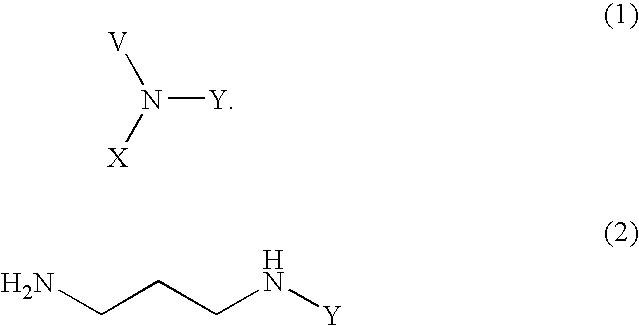
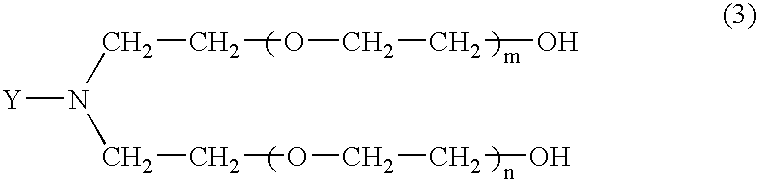
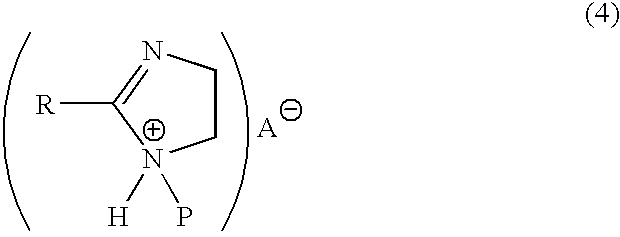
A viscosity modifier for plastisol compositions which contains at least one selected from the group consisting of: (A) a compound having at least one of a carboxy group or a salt thereof, an alkoxy group, and a glycidyl group; (B) amine compounds; and (C) metal chelate compounds. A plastisol composition containing the viscosity modifier and a polymer. A product having a coating layer obtained from the composition. A molded product obtained by using the composition. This viscosity modifier has an excellent effect of decreasing viscosity of a plastisol composition, thus enabling acquisition of a plastisol composition which allows an excellent cured product to be obtained at a low cost.

Description

TECHNICAL FIELD[0001]The present invention relates to a plastisol composition used for forming a film or a molded product, and also relates to a viscosity modifier for adjusting the viscosity of a plastisol composition. Further, the present invention relates to a product or a molded product having a covering layer obtainable from a plastisol composition.BACKGROUND ART[0002]Plastisol having polymer particles dispersed in a plasticizer as a medium is used in a wide range of industries, and its industrial value is remarkable. Plastisol using the most common vinyl chloride polymer is known as vinyl chloride sol, and it is used in a broad range of fields, such as vehicle undercoats, vehicle body sealers, carpet backing materials, wallpaper, floorings, paints, and disposable gloves, due to its excellent physical properties.[0003]A variety of performances are required for plastisol, and one of them is low viscosity. When plastisol has low viscosity, the speed of passing through processes c...

Claims

the structure of the environmentally friendly knitted fabric provided by the present invention; figure 2 Flow chart of the yarn wrapping machine for environmentally friendly knitted fabrics and storage devices; image 3 Is the parameter map of the yarn covering machine
Login to View More

Application Information

Patent Timeline
no application Login to View More
Patent Type & Authority Patents(United States)
IPC IPC(8): C08K5/09C08K5/00C08K5/04C08K5/17C08L33/12C08L51/00
CPCC08K5/0091C08K5/04C08K5/17C08L27/06C08L33/12C08L51/00C08L2666/48
Inventor MAE, SATOSHIYONEKURA, KATSUMIKASAI, TOSHIHIROSAIKI, SHINJI
Owner MITSUBISHI CHEM CORP
Features
  • R&D
  • Intellectual Property
  • Life Sciences
  • Materials
  • Tech Scout
Why Patsnap Eureka
  • Unparalleled Data Quality
  • Higher Quality Content
  • 60% Fewer Hallucinations
Social media
Patsnap Eureka Blog
Learn More