Supercharge Your Innovation With Domain-Expert AI Agents!

Method for reducing pillar structure dimensions of a semiconductor device

a technology of semiconductor devices and pillar structures, which is applied in the direction of semiconductor devices, electrical appliances, photosensitive material processing, etc., can solve the problems of affecting the resolution capability of 193 nanometer immersion tools with negative resists, reaching their limits, and unable to create such small devices

Inactive Publication Date: 2010-03-23
SANDISK TECH LLC
View PDF9 Cites 5 Cited by
  • Summary
  • Abstract
  • Description
  • Claims
  • Application Information

AI Technical Summary

Benefits of technology

Enables the formation of dense pillar structures with improved dimensional control and reliability, overcoming the limitations of existing tools by achieving smaller feature sizes with enhanced precision and strength.

Problems solved by technology

As the dimensions for structures formed on a semiconductor wafer diminish, tools currently available to create these devices reach their limits.
By way of example, for a 32 nanometer patterning of a pillar structure, the currently available 193 nanometer immersion tools will fail to create such small devices.
The resolution capability of the 193 nanometer immersion tools with a negative resist lacks predictability and reliability.

Method used

the structure of the environmentally friendly knitted fabric provided by the present invention; figure 2 Flow chart of the yarn wrapping machine for environmentally friendly knitted fabrics and storage devices; image 3 Is the parameter map of the yarn covering machine
View more

Image

Smart Image Click on the blue labels to locate them in the text.
Viewing Examples
Smart Image
  • Method for reducing pillar structure dimensions of a semiconductor device
  • Method for reducing pillar structure dimensions of a semiconductor device
  • Method for reducing pillar structure dimensions of a semiconductor device

Examples

Experimental program
Comparison scheme
Effect test

Embodiment Construction

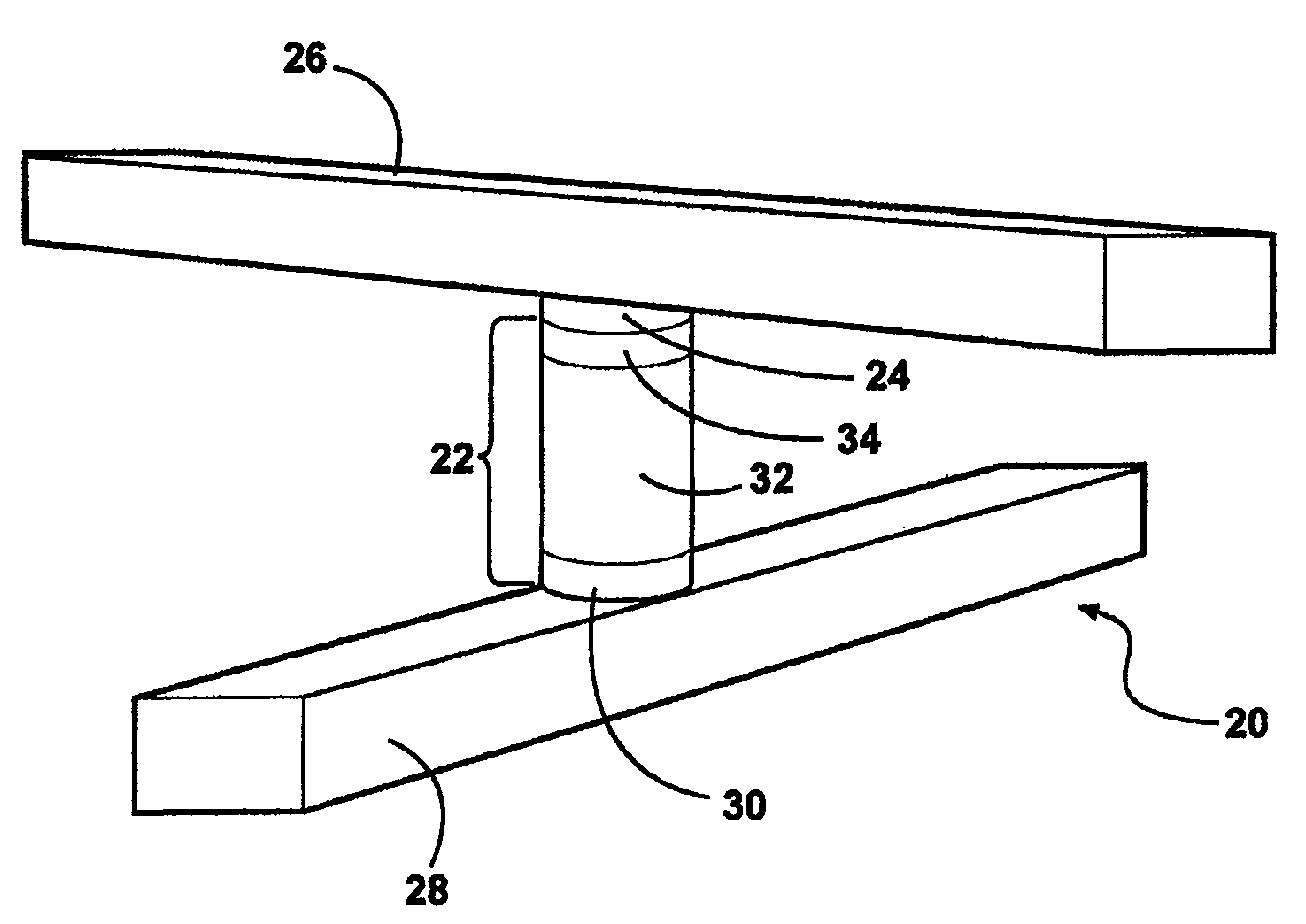
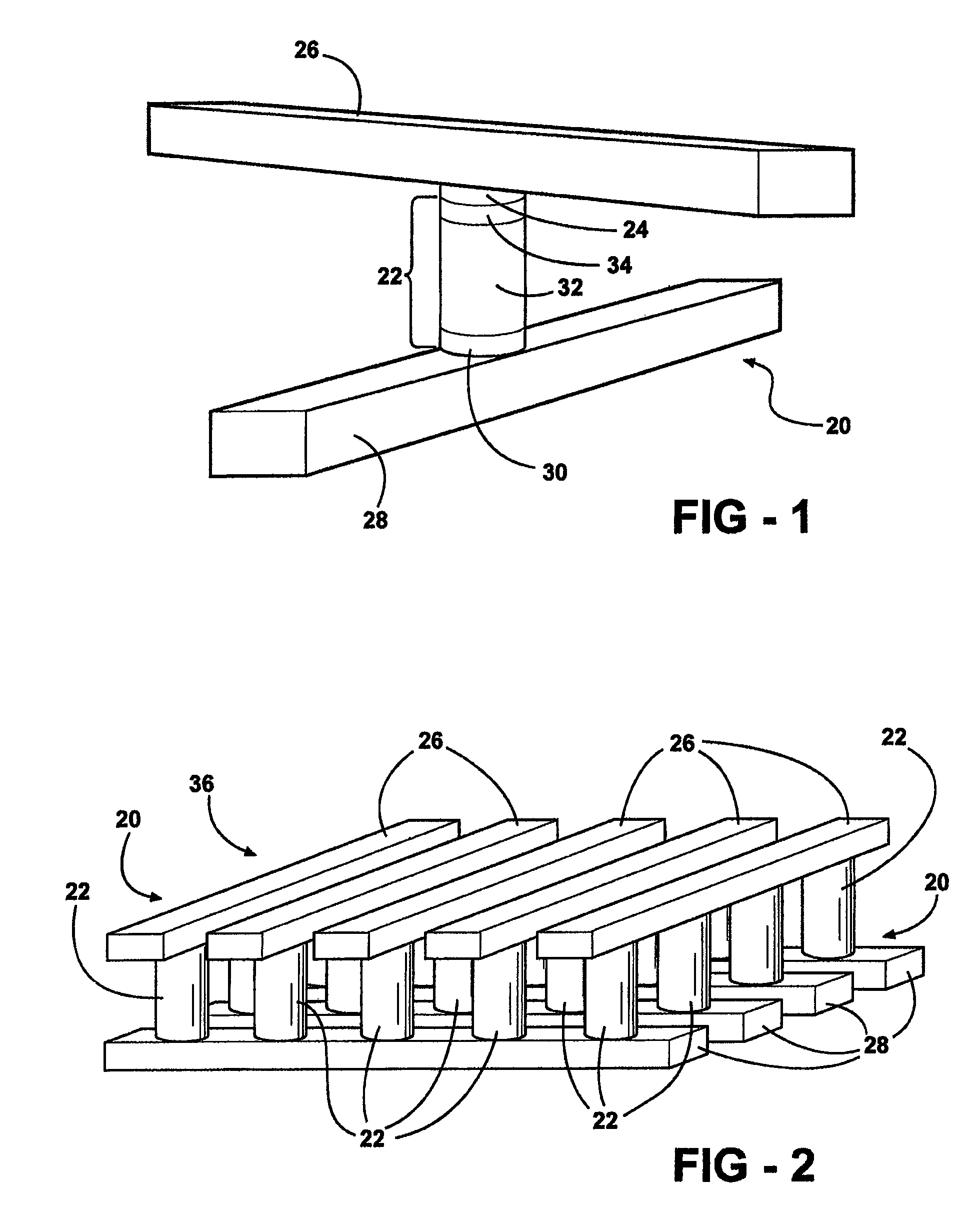
[0022]Referring to FIG. 1, U.S. Pat. No. 6,952,030, issued to Herner et al. and entitled “High-Density Three-Dimensional Memory Cell,” hereinafter the “'030 patent” and hereby incorporated by reference, discloses a nonvolatile memory cell, generally indicated at 20, including a vertically oriented junction diode 22 and a dielectric rupture antifuse 24 interposed between top 26 and bottom 28 conductors. The vertically oriented junction diode 22 includes a heavily doped semiconductor layer 30 of a first conductivity type, an intermediate layer 32 which is undoped semiconductor material or lightly doped semiconductor material, and a heavily doped semiconductor layer 34 of the second conductivity type. The semiconductor material of the junction diode 22 is generally silicon, germanium, or an alloy of silicon and / or germanium. The junction diode 22 and the dielectric rupture antifuse 24 are arranged in series between the bottom conductor 28 and the top conductor 26, which may be formed o...

the structure of the environmentally friendly knitted fabric provided by the present invention; figure 2 Flow chart of the yarn wrapping machine for environmentally friendly knitted fabrics and storage devices; image 3 Is the parameter map of the yarn covering machine
Login to View More

PUM

No PUM Login to View More

Abstract

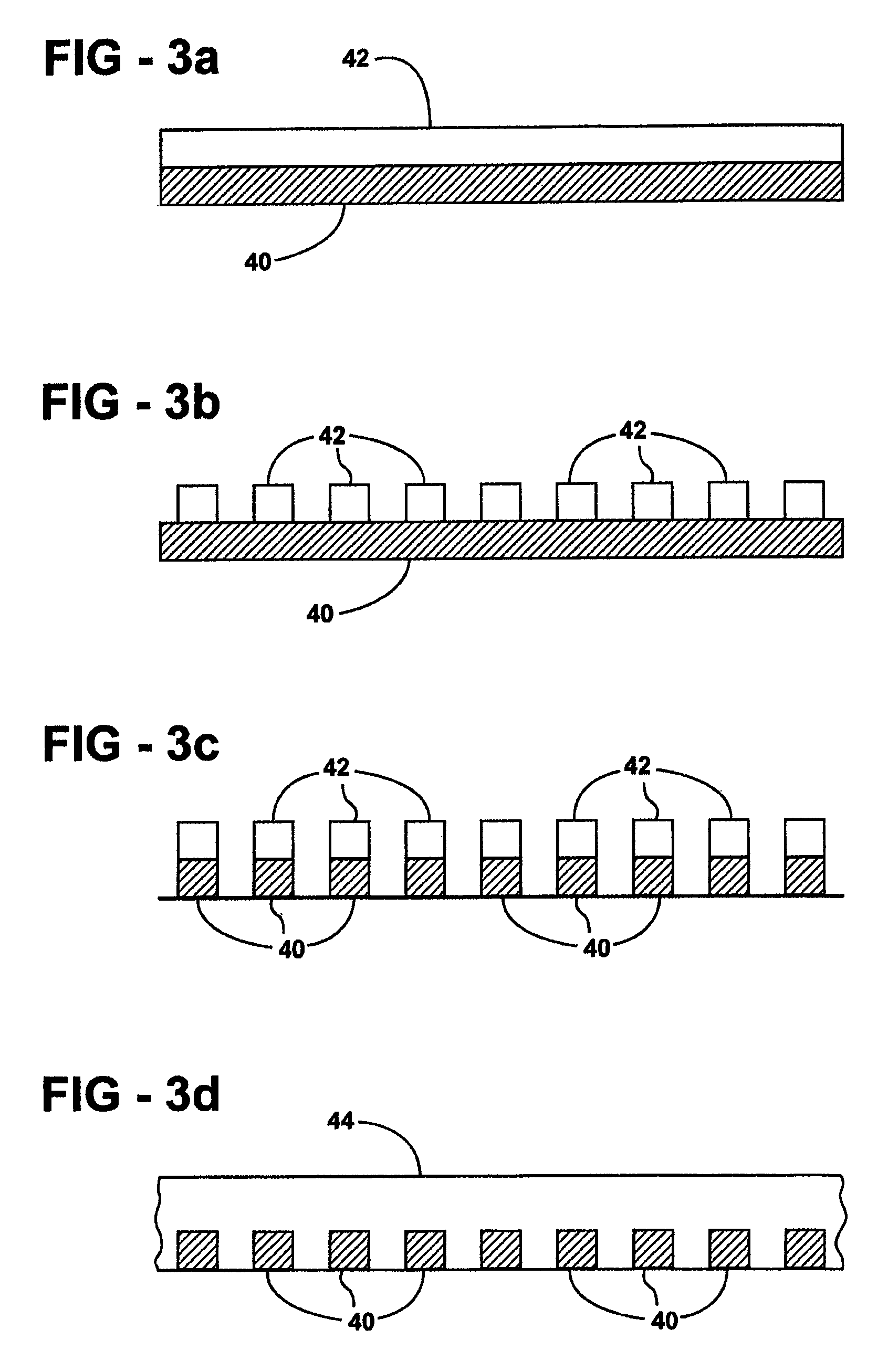
A method creates pillar structures on a semiconductor wafer and includes the steps of providing a layer of semiconductor. A layer of photoresist is applied over the layer of semiconductor. The layer of photoresist is exposed with an initial pattern of light to effect the layer of photoresist. The photoresist layer is then etched away to provide a photoresist pattern to create the pillar structures. The photoresist pattern is processed in the layer of photoresist after the step of exposing the layer of photoresist and prior to the step of etching to reduce the dimensions of the photoresist pattern in the layer of photoresist.

Description

BACKGROUND ART[0001]The invention generally relates to a method used to increase the density of devices formed on a semiconductor wafer. More particularly, the invention relates to a method used to reduce the dimensions of devices formed on a semiconductor wafer.[0002]Devices made from semiconductor materials are used to create memory circuits in electrical components and systems. Memory circuits are the backbone of such devices as data and instruction sets are stored therein. Minimizing the amount of natural resources and space consumed by memory circuits is a primary motivation in the designing of such circuits. As the design of memory circuits has moved from two-dimensional designs to three-dimensional designs, more emphasis is being made to minimize the space required to build structures, while maintain the integrity and strength of same, which becomes more important as more elements are incorporated into a space, the greater the cost in having to replace that component should o...

Claims

the structure of the environmentally friendly knitted fabric provided by the present invention; figure 2 Flow chart of the yarn wrapping machine for environmentally friendly knitted fabrics and storage devices; image 3 Is the parameter map of the yarn covering machine
Login to View More

Application Information

Patent Timeline
no application Login to View More
Patent Type & Authority Patents(United States)
IPC IPC(8): H01L21/20H01L21/36
CPCG03F7/40H01L21/0274
Inventor CHEN, YUNG-TINCHAN, MICHAELPOON, PAULRADIGAN, STEVEN J.
Owner SANDISK TECH LLC
Features
  • R&D
  • Intellectual Property
  • Life Sciences
  • Materials
  • Tech Scout
Why Patsnap Eureka
  • Unparalleled Data Quality
  • Higher Quality Content
  • 60% Fewer Hallucinations
Social media
Patsnap Eureka Blog
Learn More