Apparatus, method and computer program for spectroscopic measurements and analysis
a computer program and spectroscopic measurement technology, applied in the field of apparatus, method and computer program for spectroscopic measurement and analysis, can solve the problems of not providing accurate and reliable methods for obtaining time-resolved information with a parallel read-out of triplet states, and other information relating to the above described methods and technologies
- Summary
- Abstract
- Description
- Claims
- Application Information
AI Technical Summary
Benefits of technology
Problems solved by technology
Method used
Image

Examples
first embodiment
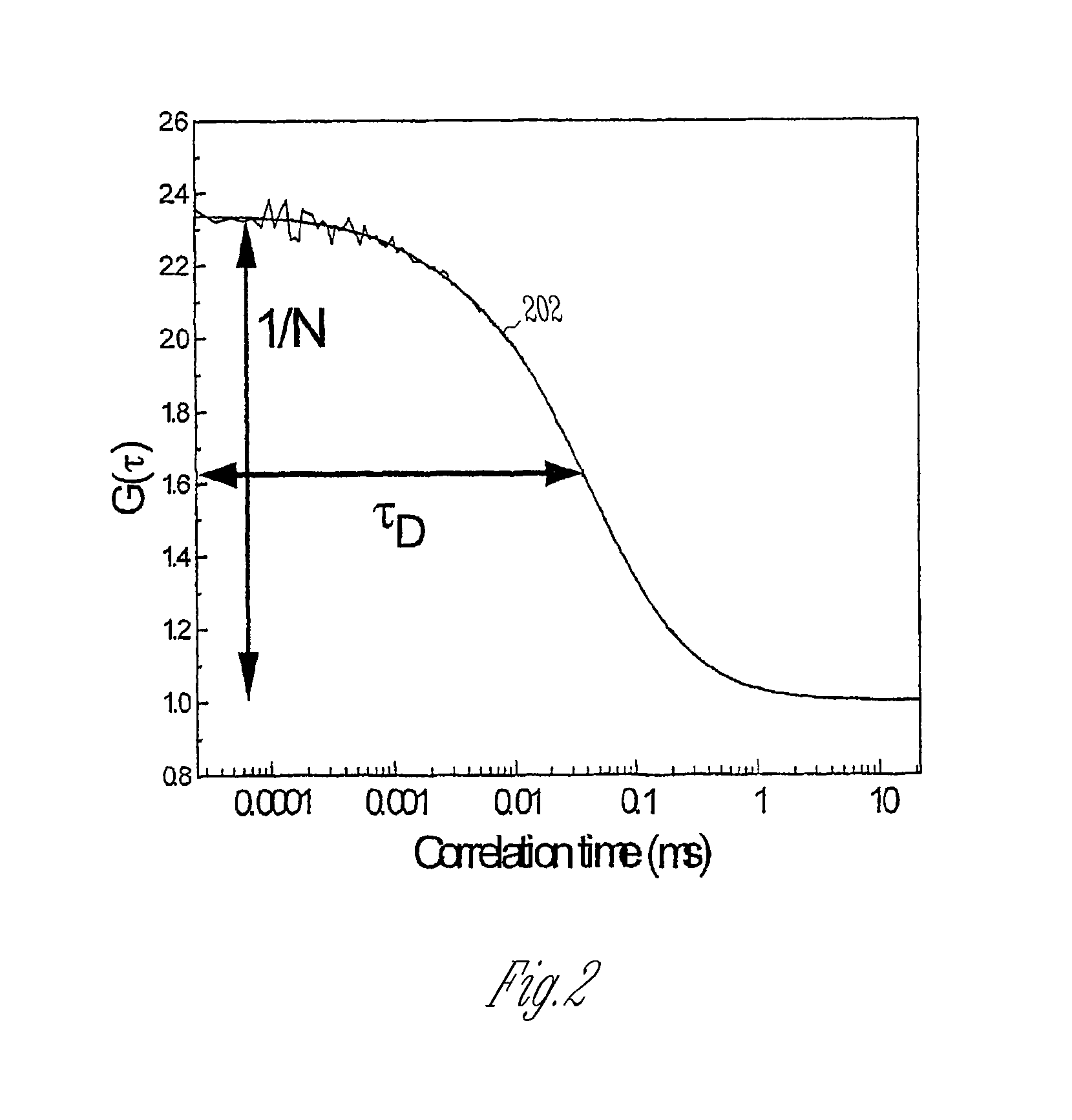
[0051]In a first embodiment according to the present invention, control, manipulation, and monitoring of Texc is done by periodic excitation with different pulse durations and excitation intensities. As previously mentioned, an FCS curve reflects the probability of detecting a fluorescence photon from the molecule under investigation, given that a fluorescence photon was emitted from it at correlation time, τ=0. Looking at FIG. 4, the fluorophore must be in the singlet entity at τ=0 (since it then emitted a photon). The first relaxation process in the FCS curve reflects the transit of the fluorophore from the singlet entity (S0 or S1) into a steady state, where it has a probability of T to be in the triplet state (thus the lower amplitude=probability to emit a photon). In other words, at τ=0, the probability to find the fluorophore in a singlet state (available for fluorescence) is S0+S1=100%, and the fluorophore is fully fluorescent. At τ>>τT the fluorophore has relaxed into a stea...
second embodiment
[0057]In accordance with the present invention, a solution for how to more reliably probe the extent of triplet state quenching is proposed (see FIG. 10). The triplet state population can be strongly enhanced by addition of quenchers, which by the so called heavy-atom effect enhance the rate of intersystem crossing, kISC. This can be very clearly seen in FCS measurements as a prominent increase in the triplet population. However, we have observed that for some fluorophore / quencher combinations, the triplet decay rate, kT, is far more enhanced than the intersystem crossing. Depending on if kISC or kT is most strongly increased, the triplet population will either markedly increase or decrease upon addition of a quencher, if the excitation intensity is high enough to produce a steady-state triplet population in the first place (see FIG. 10). This is hereafter referred to as differential quenching. Consequently, using two different fluorophores emitting in different wavelength regions, ...
third embodiment
[0058]In accordance with the present invention, FRET is proposed in combination with application of differential quenching. As can be seen in equations 2 and 3 above, both T and τT depend on the excitation rate k12. This dependence remains, no matter the mode of excitation Consequently, if the excitation takes place via FRET, the triplet state parameters of the acceptor can be used to determine the rate of FRET-mediated excitation from the donor, and hence the FRET efficiency E. While the triplet state population of the acceptor should preferentially be prominent, in order to clearly see also smaller changes in E, the triplet population of the donor should be low to minimize interference in the transfer of excitation energy to the acceptor. The proposed solution is to use differential quenching, where the triplet population of the donor is decreased, while that of the acceptor is increased.
[0059]When applying the combination of FRET and differential quenching, the following advantag...
PUM
| Property | Measurement | Unit |
|---|---|---|
| triplet decay rate | aaaaa | aaaaa |
| diameter | aaaaa | aaaaa |
| spectroscopic method | aaaaa | aaaaa |
Abstract
Description
Claims
Application Information
 Login to View More
 - R&D
- Intellectual Property
- Life Sciences
- Materials
- Tech Scout
- Unparalleled Data Quality
- Higher Quality Content
- 60% Fewer Hallucinations
Browse by: Latest US Patents, China's latest patents, Technical Efficacy Thesaurus, Application Domain, Technology Topic, Popular Technical Reports.
© 2025 PatSnap. All rights reserved.Legal|Privacy policy|Modern Slavery Act Transparency Statement|Sitemap|About US| Contact US: help@patsnap.com