Viral polymerase inhibitors
a polymerase inhibitor and polymerase technology, applied in the field of compound, composition and method of treatment of hepatitis c virus (hcv) infection, can solve the problems of ineffective treatment in reducing hcv rna to undetectable levels in many infected patients, intolerable side effects, etc., and achieves low to very low or even non-significant activity, inhibit rna synthesis
- Summary
- Abstract
- Description
- Claims
- Application Information
AI Technical Summary
Benefits of technology
Problems solved by technology
Method used
Image

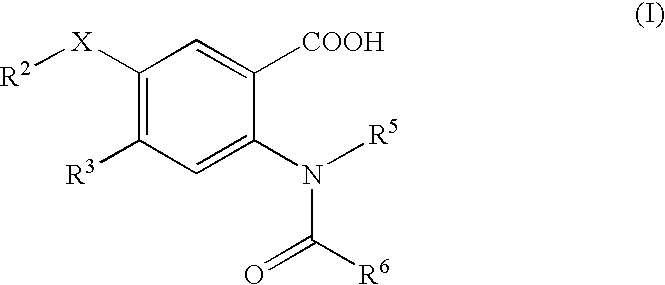
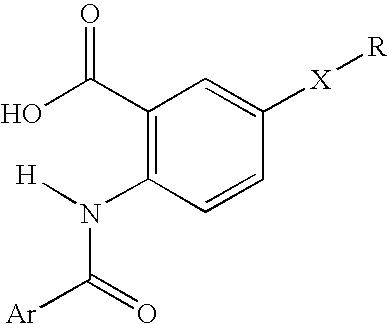
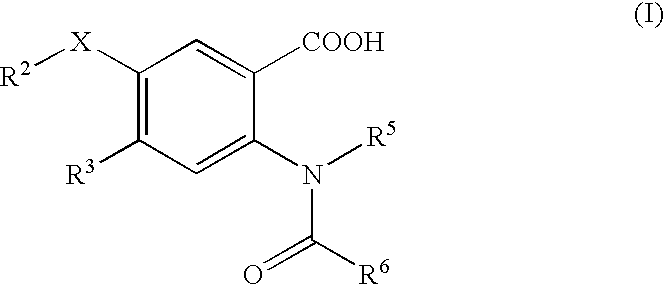
Examples
example 1a
Preparation of Intermediate 1a9
[0342]
Step 1:
[0343]To a mixture of 5-hydroxy-2-nitrobenzoic acid 1a1 (50 g, 0.273 mol) in MeOH (500 mL), is added SOCl2 (40 mL, 65.2 g, 0.55 mol) dropwise over about 30 minutes and the mixture is heated at reflux for 2 hours. Excess SOCl2 (20 mL, 32.6 g, 0.27 mol) is carefully added and heating at reflux is continued overnight. Further SOCl2 (20 mL, 32.6 g, 0.27 mol) is added and heating at reflux is continued for 1 hour. The reaction mixture is cooled to room temperature and concentrated under reduced pressure. The residue is diluted with EtOAc (600 mL), washed with saturated aqueous NaHCO3 and brine, dried over MgSO4, filtered and concentrated to dryness. The methyl ester 1a2 is recovered as a solid from CH2Cl2 and hexane.
Step 2:
[0344]A mixture of compound 1a2 (51.2 g, 0.26 mol), anhydrous K2CO3 (150 g, 1.09 mol) and PhCH2Br (39 mL, 56 g, 0.33 mol) in acetone (500 mL) is stirred overnight at room temperature. The mixture is filtered and the filtrate ...
example 1b
Preparation of Intermediate 1b3
[0353]
Step 1:
[0354]To a mixture of compound 1a4 (Example 1A) (2.0 g, 6.8 mmol) in anhydrous pyridine (35 mL) is added compound 1a7 (Example 1A) (1.65 mL, 10.2 mmol) and DMAP (82 mg, 0.67 mmol). The mixture is stirred at 50° C. for 1 hour and concentrated under reduced pressure. The residue is diluted with EtOAc (300 mL), washed with 2M HCl aqueous solution (5×200 mL), saturated aqueous NaHCO3 solution (6×200 mL) and brine (200 mL), dried over MgSO4, filtered and concentrated. Compound 1b1 is recovered from DCM / Hexanes.
Step 2:
[0355]To a mixture of compound 1b1 (2.0 g, 5.24 mmol) and anhydrous DMF (30 mL) cooled in an ice-water bath is added NaH (60%, 0.25 g, 10.5 mmol) and the mixture is stirred for 40 minutes. CH3I (0.9 mL, 14.5 mmol, 2.8 eq) is added and the mixture is allowed to stir at room temperature overnight. The mixture is diluted with EtOAc (600 mL), washed with saturated aqueous NH4Cl (3×300 mL), saturated aqueous NaHCO3 (300 mL) and brine (3...
example 2a
Preparation of Compound 1001, Table 1
[0358]
[0359]Phenol 1a9 (Example 1A) (20 mg, 0.06 mmol) is combined with 4-hydroxytetrahydropyran (0.08 mmol) and triphenylphosphine (20 mg, 0.08 mmol) in THF (1 mL). Diisopropylazodicarboxylate (0.02 mL, 0.10 mmol) is added and the mixture is allowed to stir overnight at ambient temperature. Aqueous NaOH (10N, 0.06 mL, 0.6 mmol), water (0.06 mL) and methanol (0.4 mL) are added and the mixture is warmed to 50° C. and allowed to stir for 2.5 hours. Purification by preparative HPLC affords compound 1001 (Table 1).
PUM
| Property | Measurement | Unit |
|---|---|---|
| temperature | aaaaa | aaaaa |
| pH | aaaaa | aaaaa |
| temperature | aaaaa | aaaaa |
Abstract
Description
Claims
Application Information
 Login to View More
 - R&D
- Intellectual Property
- Life Sciences
- Materials
- Tech Scout
- Unparalleled Data Quality
- Higher Quality Content
- 60% Fewer Hallucinations
Browse by: Latest US Patents, China's latest patents, Technical Efficacy Thesaurus, Application Domain, Technology Topic, Popular Technical Reports.
© 2025 PatSnap. All rights reserved.Legal|Privacy policy|Modern Slavery Act Transparency Statement|Sitemap|About US| Contact US: help@patsnap.com