Netrin-1 as a biomarker of injury and disease
a biomarker and injury technology, applied in the field of biomarkers for injury and/or disease, can solve problems such as affecting the use of such early treatments for aki
- Summary
- Abstract
- Description
- Claims
- Application Information
AI Technical Summary
Benefits of technology
Problems solved by technology
Method used
Image


Examples
example 1
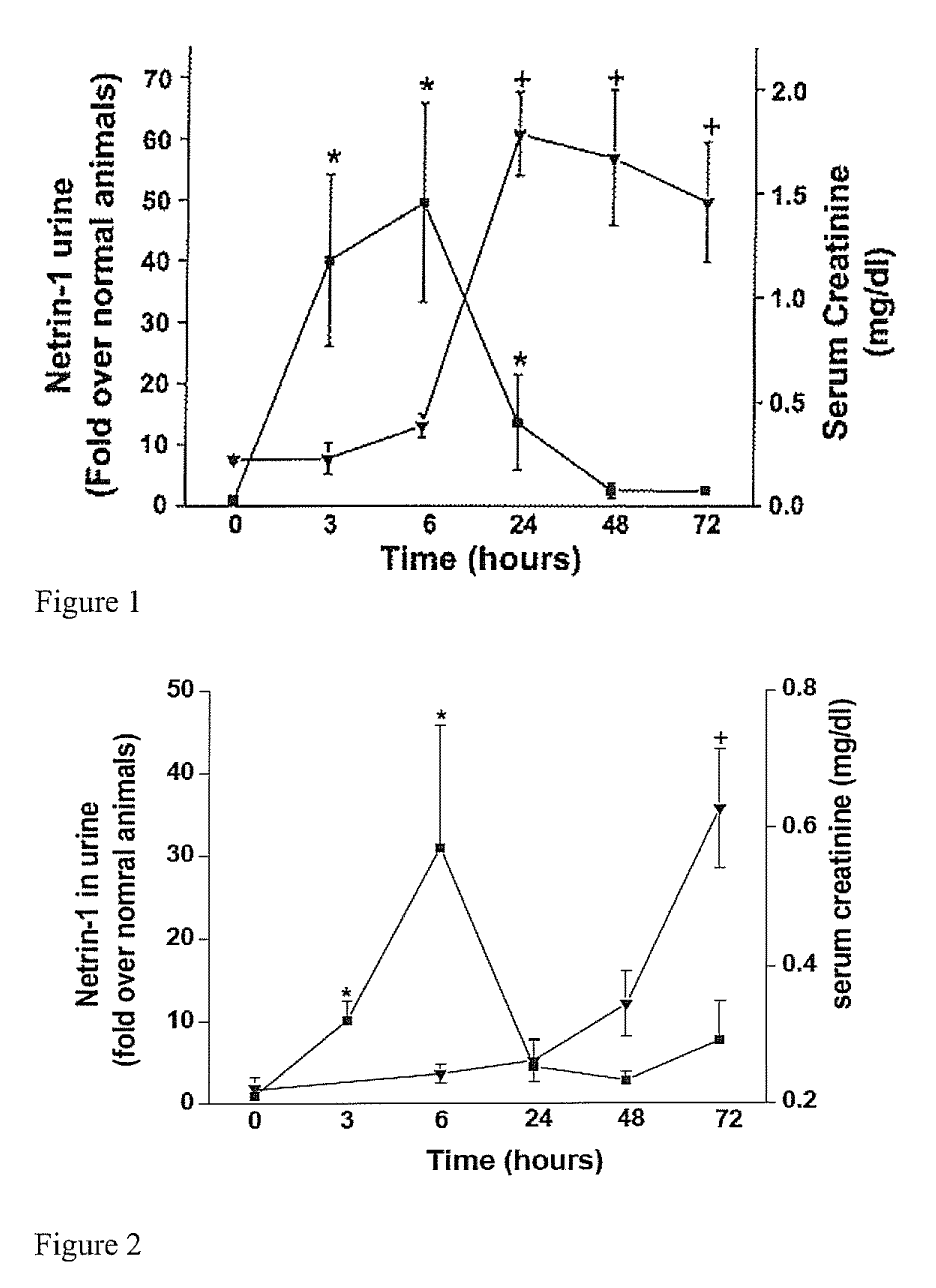
Netrin-1 is an Early Biomarker of Acute Kidney Injury
[0195]In this example, renal function of subjects is assessed by measurements of blood urea nitrogen, BUN, (VITROS DT60H Chemistry slides, Ortho-clinical Diagnostics) and serum creatinine (cat no: DZ072B, Diazyme Labs, USA).
[0196]Immunohistochemical localization of netrin-1 is performed as described in Ly, N. P. et al., PNAS 102: 14729-14734, 2005 with modification. Briefly, kidney is fixed in Paraformaldehyde / Lysine / Periodate (PLP) fixative for human kidney tissue or in 4% paraformaldehyde for mouse tissue over night. The fixed tissues are transferred to 30% sucrose, placed in a cryomold and frozen. Six-micrometer-thick sections are placed on glass slides. Sections are washed with PBS, permeabilized with 0.2% Triton X-100 in PBS and then washed again and blocked with 10% goat serum containing 1% BSA. The sections are incubated with the primary chicken anti-netrin-1 polyclonal antibody (Neuromics cat#CH23002) at a 1:100 dilution f...
example 2
Quantitation of Netrin-1 in Urine from Kidney Transplant Recipients after Surgery and in a Broad Spectrum of Types of Kidney Injury
[0220]Collection of Human Urine
[0221]Adult Subjects (age 22-91) are recruited when a nephrology consult is requested for rising serum creatinine and / or decreased urine output. AKI is defined by a 0.3 mg / dl or a 50% increase in serum creatinine (s-Cr), or urine output 6 hours in patients with baseline s-Cr<3 mg / dl. Urine samples are collected on the day of enrollment and 3 days later. Renal function and clinical condition are monitored for 2 weeks after enrollment.
[0222]Urine samples from transplant patients are collected 2 hours, and 3 and 7 days after the surgery. Renal function and clinical conditions are monitored for at least 14 days after kidney transplant. Control samples are collected 10 healthy prospective living kidney transplant donors with normal renal function (creatinine clearance >80 ml / min and normal urinalysis) prior to kidney donation. E...
example 3
[0234]This example shows that netrin-1 is highly induced and excreted in the urine after acute kidney injury (AKI) and that urinary netrin-1 levels predict AKI in humans undergoing cardiopulmonary bypass (CPB), allowing for the early diagnosis and prognosis of AKI after CPB, before the rise in serum creatinine.
[0235]Serial urine samples are analyzed by enzyme-linked immunosorbent assay for netrin-1 in 26 patients who developed AKI (defined as a 50% or greater increase in serum creatinine after CPB) and 34 control patients who did not develop AKI after CPB).
[0236]Using serum creatinine, AKI is detected on average only 48 hours after CPB. In contrast, urine netrin-1 increased at 2 hours after CPB, peaked at 6 hours (2462±370 pg / mg creatinine), and remained elevated up to 48 hours after CPB. The predictive power of netrin-1 as demonstrated by area under the receiver operating characteristics curve for diagnosis of AKI at 2, 6, and 12 hours after CPB is 0.74, 0.86 and 0.89, respectively...
PUM
| Property | Measurement | Unit |
|---|---|---|
| real time RT- | aaaaa | aaaaa |
| real time RT- | aaaaa | aaaaa |
| body weight | aaaaa | aaaaa |
Abstract
Description
Claims
Application Information
 Login to View More
 - R&D
- Intellectual Property
- Life Sciences
- Materials
- Tech Scout
- Unparalleled Data Quality
- Higher Quality Content
- 60% Fewer Hallucinations
Browse by: Latest US Patents, China's latest patents, Technical Efficacy Thesaurus, Application Domain, Technology Topic, Popular Technical Reports.
© 2025 PatSnap. All rights reserved.Legal|Privacy policy|Modern Slavery Act Transparency Statement|Sitemap|About US| Contact US: help@patsnap.com