Thiol detection method
a detection method and technology of thiol, applied in the field of compounds capable of detecting thiol, can solve problems such as background fluorescence generation and serious health problems
- Summary
- Abstract
- Description
- Claims
- Application Information
AI Technical Summary
Benefits of technology
Problems solved by technology
Method used
Image

Examples
example a
[0050]
[0051]A KOt-Bu (92.2 mg, 0.82 mmol, 3 eq) solution in THF (2 ml) was added dropwise to a rhodamine 110 (110.9 mg, 0.28 mmol) solution in DMF (2 ml) at 0° C. Thirty minutes later, 2,4-dinitrobenzenesulfonyl chloride (220.2 mg, 0.83 mmol, 3 eq) was added to the reaction solution. The mixed solution was left at room temperature for 2 hours, and 2,4-dinitrobenzenesulfonyl chloride (223 mg, 0.84 mmol, 3 eq) was then added to the reaction solution. Sixteen hours later, the reaction solution was diluted with ethyl acetate, followed by liquid separation using a saturated NaHCO3 aqueous solution. The organic layer was dried over Na2SO4, and the resultant was then subjected to vacuum concentration. The residue was purified by flash column chromatography, so as to obtain the above-described compound 2 (20.7 mg, 0.03 mmol, 10%).
[0052]1H-NMR (400 MHz, CDCl3 / CD3OD): δ 8.47-8.46 (d, 2H, J=2.2), 8.37-8.34 (dd, 2H, J=2.2, 11.0), 8.19-8.17 (d, 2H, J=8.8), 7.91-7.89 (d, 1H, J=7.1), 7.61-7.53 (m,...
example a1
Fluorescence Measurement
(Method)
[0055]The reaction was carried out using the 100 nM probe (compound 2) and 10 mM cysteine at 37° C. for 30 minutes in 50 mM Tris-HCl (pH 7.4). A fluorescence spectrum was obtained with a fluorescence spectrometer (FP-6500; JASCO). Fluorescence was obtained by excitation at 490 nm at a scanning range of 450 to 650 nm.
(Results)
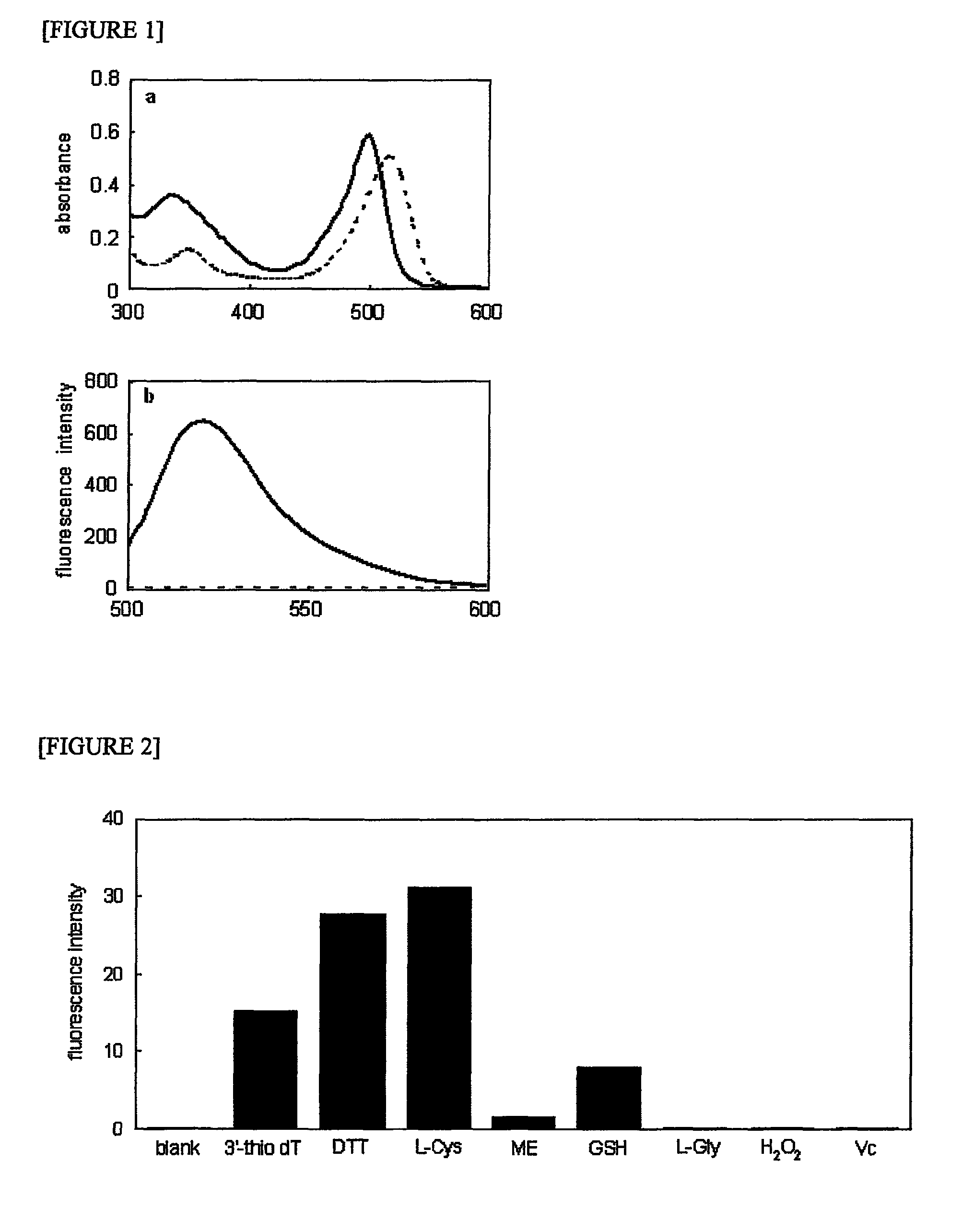
[0056]In order to examine fluorescence response, the probe (synthesized in Synthesis Example A1) was incubated in a Tris-HCl buffer (50 mM, pH 7.4), with or without cysteine. The obtained absorption spectrum and fluorescence spectrum are shown in FIG. 1. The solution without cysteine exhibited the maximum absorption at 516 nm derived from the DNB group. In a case in which cysteine was added to the probe solution, the maximum absorption peak was shifted to the short wavelength side (498 nm) as a result of the cleavage of the DNB group (FIG. 1a). Fluorescence characteristics were also examined. In the probe without cysteine, no sign...
example a2
Reactivity of Probe with Thiol
(Method)
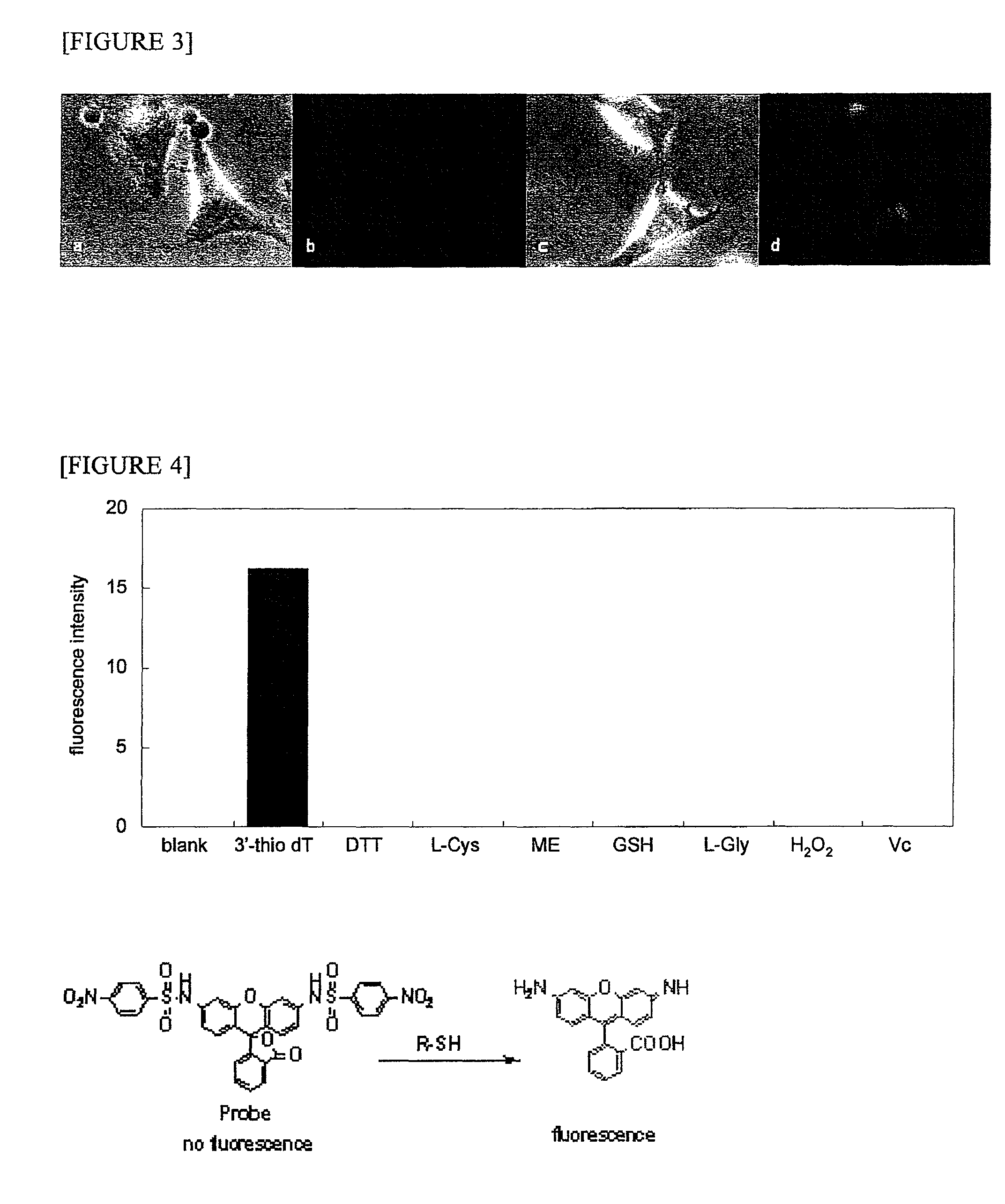
[0057]The reactivity of the probe (compound 2) with several types of thiols was examined by measuring an increase in the fluorescence intensity at 522 nm. The reaction was carried out using the 1 μM probe and 1 mM thiol at 37° C. for 30 minutes in 50 mM Tris-HCl (pH 7.4).
[0058]In addition, as a comparative example, a compound represented by the following formula (3) was used as a probe, and its reactivity was examined in the same above manner:
[0059]
(Results)
[0060]When the present probe is applied to the detection of biological thiol, selectivity is an important issue. The probe should specifically respond to thiol, and it should not generate signals with respect to other biological substances. In order to examine such selectivity, the probe was treated with several biological substances, and fluorescence signals were then measured. The selectivity of the probe to thiol was verified by monitoring the fluorescence at 522 nm using a biologically-re...
PUM
| Property | Measurement | Unit |
|---|---|---|
| pH | aaaaa | aaaaa |
| pKa | aaaaa | aaaaa |
| time | aaaaa | aaaaa |
Abstract
Description
Claims
Application Information
 Login to View More
 - R&D
- Intellectual Property
- Life Sciences
- Materials
- Tech Scout
- Unparalleled Data Quality
- Higher Quality Content
- 60% Fewer Hallucinations
Browse by: Latest US Patents, China's latest patents, Technical Efficacy Thesaurus, Application Domain, Technology Topic, Popular Technical Reports.
© 2025 PatSnap. All rights reserved.Legal|Privacy policy|Modern Slavery Act Transparency Statement|Sitemap|About US| Contact US: help@patsnap.com