Method and an arrangement for controlling pump displacement in a work vehicle
a technology for controlling the displacement of the pump and the work vehicle, which is applied in the direction of mechanical equipment, couplings, constructions, etc., can solve the problems of engine failure, engine failure, and difficulty in finding an engine that precisely manages the desired power output, so as to reduce the amount of hydraulic work, reduce the load of the engine, and reduce the effect of machine productivity
- Summary
- Abstract
- Description
- Claims
- Application Information
AI Technical Summary
Benefits of technology
Problems solved by technology
Method used
Image


Examples
first embodiment
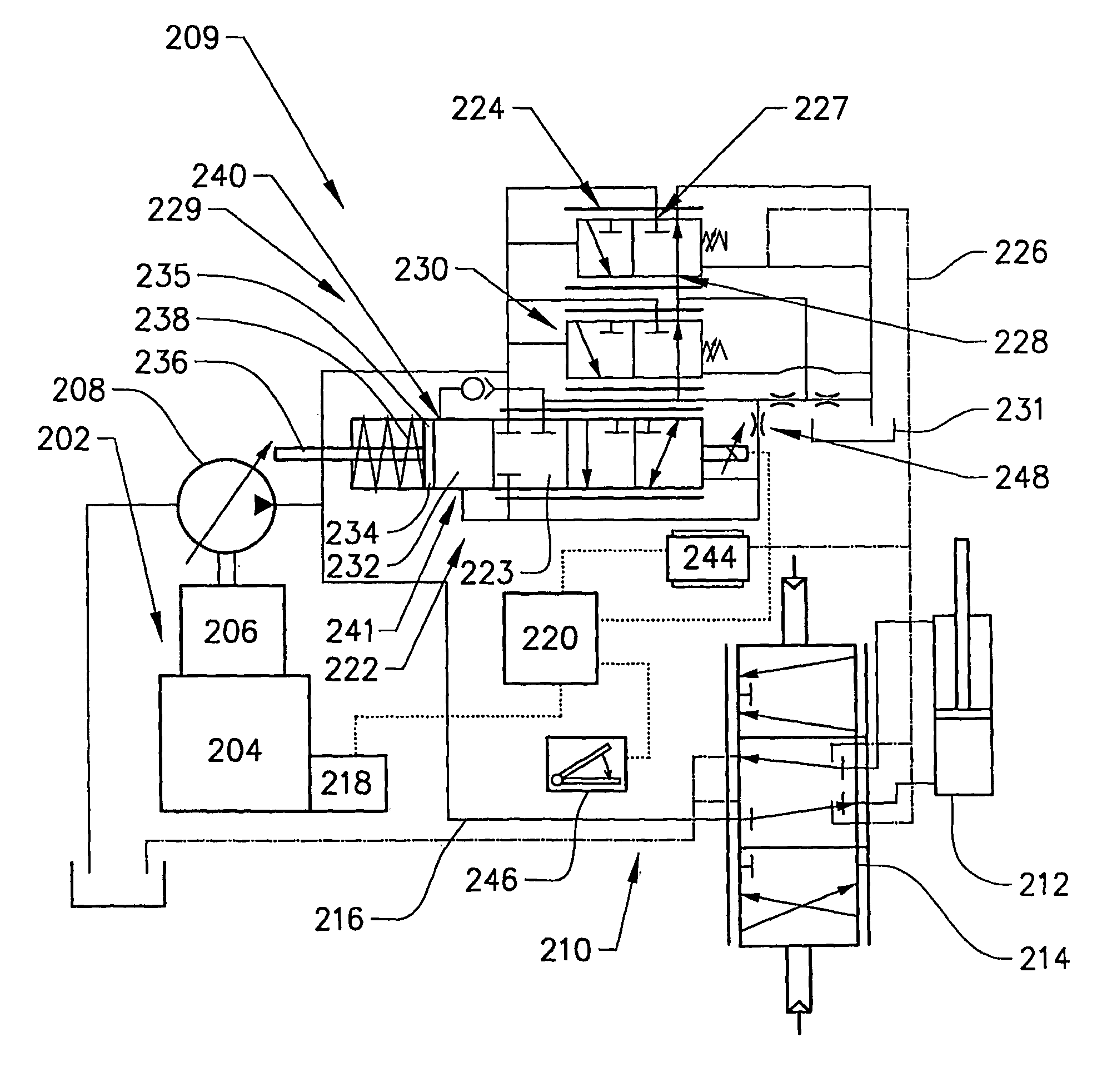
[0056]According to the invention, the power source operational condition detection means 218 is adapted for detecting a torque or output power of the power source. In this embodiment, the engine torque is sensed. The pressure in a clutch in the transmission may be used as a measure of the engine torque. Such clutch pressure signals are directly related to the torque being transmitted by the clutch to the wheels and by the wheels to the ground. When the torque falls to a predetermined minimum, the controller 220 will output a signal with a level as a function of accessible engine torque. As an alternative, the controller 220 will output a signal with a level as a function of both accessible engine torque and the detected position of an accelerator pedal 246.
second embodiment
[0057] the engine speed is sensed by the detection means 218. When the engine speed falls to a predetermined minimum, the controller 220 will output a signal with a level as a function of the detected engine speed. As an alternative, the controller 220 will output a signal with a level as a function of both the detected engine speed and the detected position of an accelerator pedal 246.
[0058]The engine speed sensor may be a magnetic pick-up device sensitive to the movement of a gear tooth in the engine, which is proportional to crankshaft speed.
[0059]According to a variant of the first and second embodiments, a limit value for a minimum engine speed is set. This limit value defines the critical region, in which the maximum available pump displacement is controlled. Further, within this established critical region, the detected torque or output power of the power source is used to control the level of the maximum available pump displacement.
[0060]According to a specific example, the ...
third embodiment
[0061] a turbocharger is operatively connected to the engine. The turbocharger pressure is sensed. When the turbocharger pressure falls to a predetermined minimum, the controller 220 will output a signal with a level as a function of the detected turbocharger speed. As an alternative, the controller will output a signal with a level as a function of both the detected turbocharger pressure and the detected position of an accelerator pedal 246.
[0062]The control arrangement 209 further comprises means 244 for detecting a hydraulic pressure associated to the actuator 212 and generating a corresponding signal. The pressure detection means 244 is adapted to sense the pressure in the load-sensing pressure conduit 226. According to an alternative, the pressure detection means 244 is adapted to sense the pressure in the conduit 216 delivering hydraulic fluid to the actuator 212. The controller 220 is adapted to receive the pressure signal and comprises means for comparing the detected hydrau...
PUM
 Login to View More
 Abstract
Description
Claims
Application Information
 Login to View More
 - R&D
- Intellectual Property
- Life Sciences
- Materials
- Tech Scout
- Unparalleled Data Quality
- Higher Quality Content
- 60% Fewer Hallucinations
Browse by: Latest US Patents, China's latest patents, Technical Efficacy Thesaurus, Application Domain, Technology Topic, Popular Technical Reports.
© 2025 PatSnap. All rights reserved.Legal|Privacy policy|Modern Slavery Act Transparency Statement|Sitemap|About US| Contact US: help@patsnap.com