Check patentability & draft patents in minutes with Patsnap Eureka AI!

Valve-type oil feeder

a valve-type, oil-feeding technology, applied in the direction of machines/engines, machines/engines, distribution equipment, etc., can solve the problems of high failure rate, high machining accuracy, and difficult repair work, so as to improve detection accuracy, improve working condition, and facilitate the delivery of lubricant oil or grease

Inactive Publication Date: 2012-06-26
BEIJING CMRC SCI & TECH DEV
View PDF19 Cites 3 Cited by
  • Summary
  • Abstract
  • Description
  • Claims
  • Application Information

AI Technical Summary

Benefits of technology

[0006]The object of the present invention is to provide a novel valve-type oil feeder for feeding lubricant oil or grease, which has simple structure, wide application range, low production cost, and can operate reliably.
[0010]With the present valve-type oil feeder, by controlling the operation of the valving spindle, such as its working time and working cycle, etc., lubricant oil or grease can be supplied conveniently as necessary; in addition, by controlling the working frequency of the valving spindle and the capacity of the oil discharge chamber, the delivery quantity of lubricant oil or grease can be adjusted easily.
[0011]In addition, as a preferred embodiment, a piston position sensor can be provided for the piston in the valve-type oil feeder in the present invention, so as to detect the piston position. Specifically, when the valving spindle is at the working position, the piston position sensor can judge whether the lubricant oil or grease is fed normally or not, or whether the valve-type oil feeder has failures or malfunctions or not by detecting the piston position, and send the information to a remote monitoring system, so that the personnel can obtain the lubricant feeding information on the site in a control room far away from the site, and does not need to go to the site to observe and check; the valve-type oil feeder not only can improve detection accuracy, improve working condition, reduce labor intensity, and enhance safety, but also has the advantages in simple structure, wide application range, and low manufacturing cost, and can achieve central control and unified management of lubricant oil or grease feeding work, and therefore has high application value.

Problems solved by technology

However, in actual applications, for no matter single line type oil feeder, duel line type oil feeder, or progressive type oil feeder, random control is not available, and in the design process it is required to calculate accurately the quantity of oil or grease used at each point of the system, and the quantity hardly can be adjusted in actual use, and the lubrication interval at each point of the system must be identical.
Single line type oil feeders also have a drawback of narrow application range, i.e. which are only applicable to fluids with low viscosity and good fluidity, but can't feed fluid or semi-liquid media with high viscosity or poor fluidity normally; duel line type oil feeders and progressive type oil feeders are complex in structure and require high machining accuracy, and have high failure rate in application; double line type oil feeders must use two main pipelines to feed lubricant oil in alternate and in parallel, and therefore the pipeline structure is complex; as for progressive type oil feeders, once any failure occurs in the application, it will be unable to determine accurately the location of the failure point, and therefore the repair work will be very difficult.

Method used

the structure of the environmentally friendly knitted fabric provided by the present invention; figure 2 Flow chart of the yarn wrapping machine for environmentally friendly knitted fabrics and storage devices; image 3 Is the parameter map of the yarn covering machine
View more

Image

Smart Image Click on the blue labels to locate them in the text.
Viewing Examples
Smart Image
  • Valve-type oil feeder
  • Valve-type oil feeder
  • Valve-type oil feeder

Examples

Experimental program
Comparison scheme
Effect test

embodiment 1

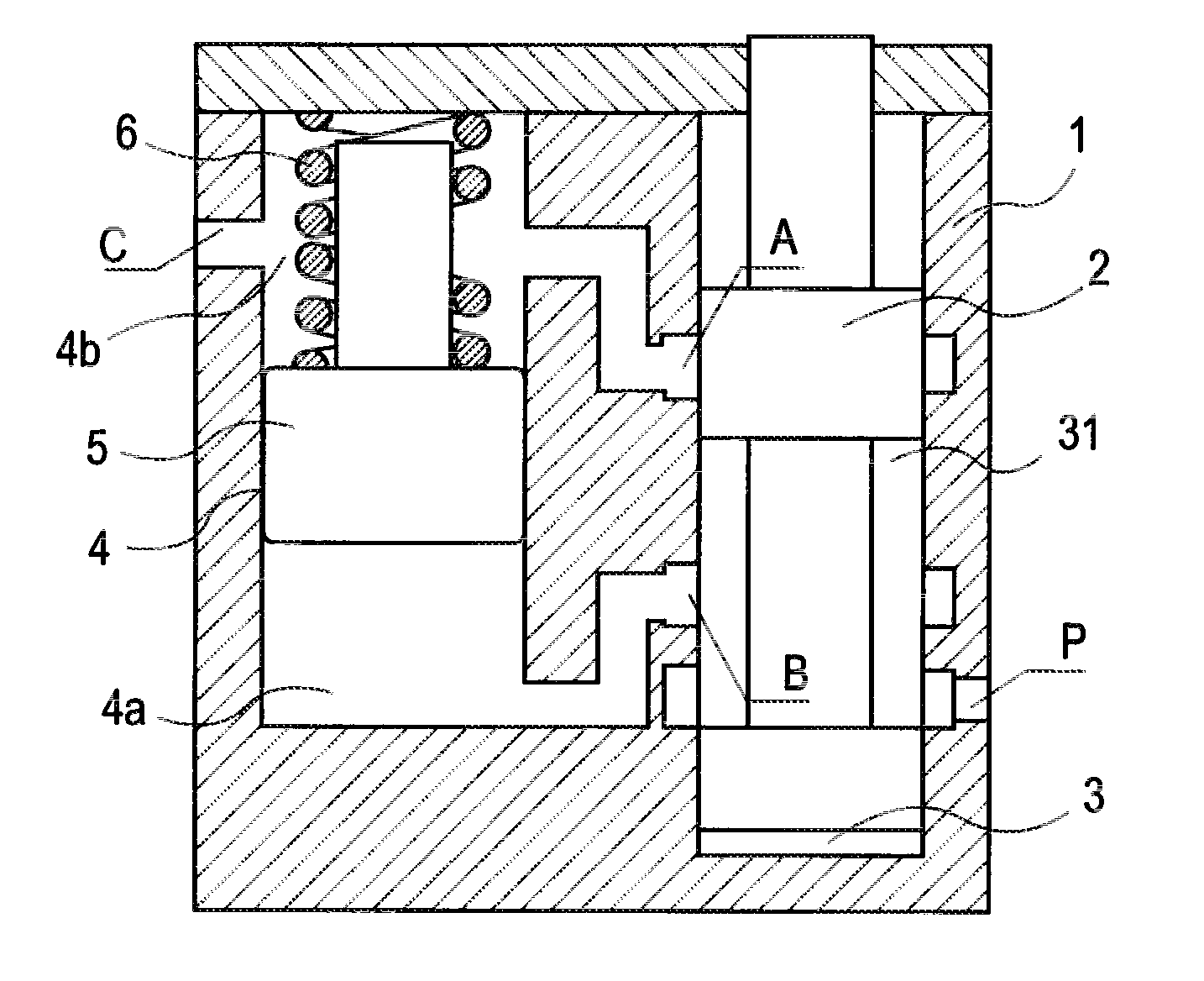
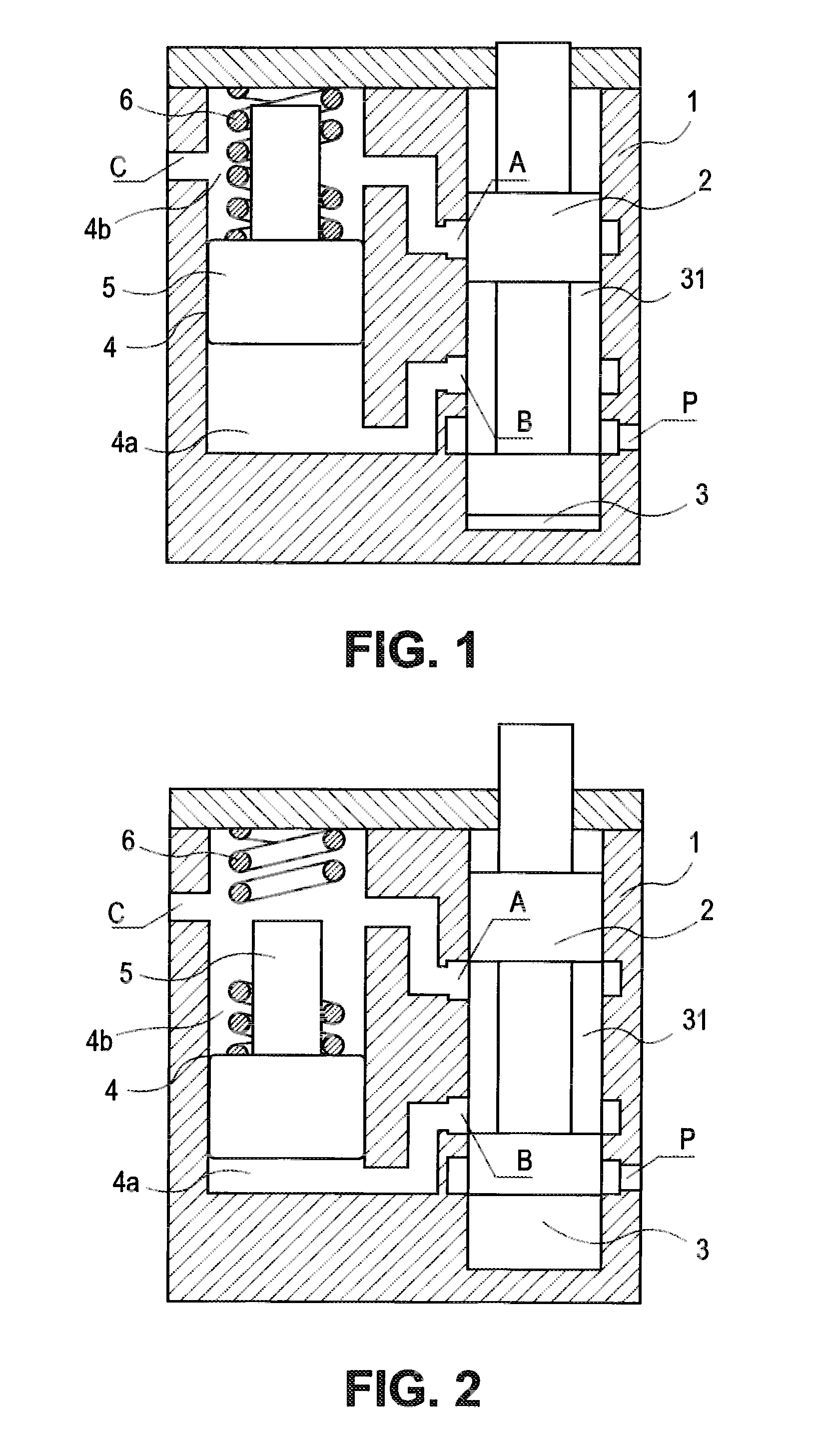
[0026]FIG. 1 is a structural schematic view of the valve-type oil feeder in working state in accordance with the first embodiment of the present invention. FIG. 2 is a structural schematic view of the valve-type oil feeder in original state in accordance with the first embodiment of the present invention.

[0027]As shown in FIG. 1 and FIG. 2, the valve-type oil feeder in accordance with the first embodiment of the present invention mainly comprises a housing 1, a valving spindle 2, and a piston 5.

[0028]The housing 1 has a valve chamber 3 designed to accommodate the valving spindle 2, and a piston chamber 4 designed to accommodate the piston 5. The valve chamber 3 has an oil inlet P, a first outlet A, and a second outlet B. In addition, the valve chamber 3 further has an oil storage chamber 31. The piston chamber 4 has an oil intake chamber 4a, an oil discharge chamber 4b, and an oil outlet C. The oil intake chamber 4a communicates with the second outlet B, and the oil discharge chambe...

embodiment 2

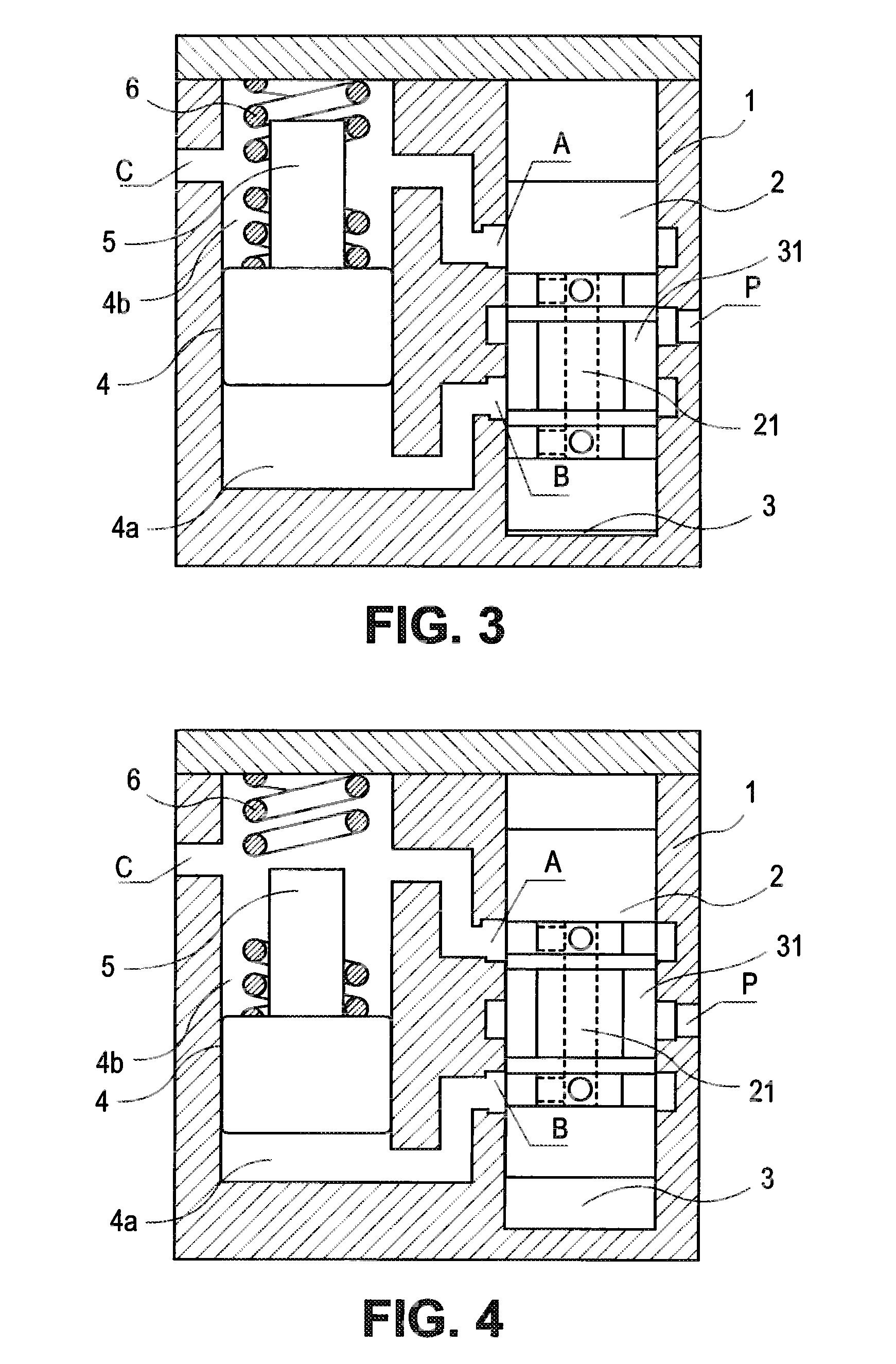
[0039]FIG. 3 is a structural schematic view of the valve-type oil feeder in working state in accordance with the second embodiment of the present invention. FIG. 4 is a structural schematic view of the valve-type oil feeder in original state in accordance with the second embodiment of the present invention.

[0040]As shown in FIG. 3 and FIG. 4, the difference between the valve-type oil feeder in the second embodiment and the valve-type oil feeder in the first embodiment of the present invention mainly lies only in the structure of the valve chamber 3 and the structure of the valving spindle 2 in the valve chamber 3. Therefore, hereunder the valve chamber 3 and the valving spindle 2 in the valve chamber 3 will be mainly described. Generally, the description about other aspects of the first embodiment is also applicable to the second embodiment essentially, and therefore will not be further detailed here. In addition, unless otherwise stated, the description about all aspects of the fir...

embodiment 3

[0043]FIG. 5 is a structural schematic view of the valve-type oil feeder in working state in accordance with the third embodiment of the present invention. FIG. 6 is a structural schematic view of the valve-type oil feeder in original state in accordance with the third embodiment of the present invention.

[0044]As shown in FIG. 5 and FIG. 6, the difference between the third embodiment and the first and second embodiments mainly lies in the structure of the valve chamber. In addition, it is noted that, in the third embodiment, the valving spindle 2 is arranged in the valve chamber 3 in a rotary manner.

[0045]Specifically, as shown in FIG. 5 and FIG. 6, the valving spindle 2 has a groove 32 on a side, and has a radial through hole 22 arranged therein. In addition, the groove 32 and the radial through hole 22 are arranged at a predetermined angle to each other on the circumference of the valving spindle 2, i.e., they are staggered by a predetermined angle to each other, for example, stag...

the structure of the environmentally friendly knitted fabric provided by the present invention; figure 2 Flow chart of the yarn wrapping machine for environmentally friendly knitted fabrics and storage devices; image 3 Is the parameter map of the yarn covering machine
Login to View More

PUM

No PUM Login to View More

Abstract

A valve-type oil feeder comprising a housing, a valving spindle, and a piston. The housing has a valve chamber and a piston chamber, the valve chamber has an oil inlet, a first outlet, and a second outlet; the piston chamber has an oil intake chamber, an oil discharge chamber, and an oil outlet; the oil intake chamber communicates with the second outlet, and the oil discharge chamber communicates with the first outlet and the oil outlet respectively; the valving spindle is arranged in the valve chamber and movable between an original position at which the oil inlet is cut off from the second outlet while the first outlet communicates with the second outlet, and a working position at which the oil inlet communicates with the second outlet while the first outlet is cut off from the second outlet The present invention is applicable to various fluid and semi-fluid media, and applicable to various pressure and viscosity ranges. By controlling the operation of the valving spindle, lubricant can be supplied conveniently as necessary, and the delivery quantity of lubricant can be adjusted easily; moreover, the valve-type oil feeder is characterized in simple structure, wide application range, low production cost, and reliable operation.

Description

CROSS REFERENCE TO RELATED APPLICATIONS:[0001]This patent application is a National Phase application under 35 U.S.C. §371 of International Application No. PCT / CN2007 / 070105, filed on 12 Jun. 2007, entitled A VALVE-TYPE OIL FEEDER, which claims priority to Chinese patent application number 200610017955.3, filed 15 Jun. 2006.FIELD OF THE INVENTION[0002]The present invention relates to an oil feeder, in particular to a valve-type oil feeder which is designed to feed lubricant oil or grease.BACKGROUND OF THE INVENTION[0003]In a lubrication system, it is very important for normal transport and feeding of lubricant oil or grease, especially for key parts of large-size equipments.[0004]In order to ensure accurate and normal feeding of lubricant oil or grease, centralized lubrication systems are usually used today. Presently, commonly used centralized lubrication methods include single line, dual line, and oil-gas types, etc., the main components of which are single line type oil feeder, d...

Claims

the structure of the environmentally friendly knitted fabric provided by the present invention; figure 2 Flow chart of the yarn wrapping machine for environmentally friendly knitted fabrics and storage devices; image 3 Is the parameter map of the yarn covering machine
Login to View More

Application Information

Patent Timeline
no application Login to View More
Patent Type & Authority Patents(United States)
IPC IPC(8): F04B37/00
CPCF16N25/02F16N25/00F16N7/00
Inventor WANG, DONGSHENG
Owner BEIJING CMRC SCI & TECH DEV
Features
  • R&D
  • Intellectual Property
  • Life Sciences
  • Materials
  • Tech Scout
Why Patsnap Eureka
  • Unparalleled Data Quality
  • Higher Quality Content
  • 60% Fewer Hallucinations
Social media
Patsnap Eureka Blog
Learn More