Check patentability & draft patents in minutes with Patsnap Eureka AI!

Self-assembly of block copolymers on topographically patterned polymeric substrates

a topographically patterned polymer substrate and self-assembly technology, applied in the direction of photomechanical equipment, instruments, manufacturing tools, etc., can solve the problems of poor lateral ordering of cylindrical microdomains, high cost of defects, and opening an avenue to smaller domain sizes and separation distances

Active Publication Date: 2012-08-21
UNIV OF MASSACHUSETTS +1
View PDF24 Cites 13 Cited by
  • Summary
  • Abstract
  • Description
  • Claims
  • Application Information

AI Technical Summary

Benefits of technology

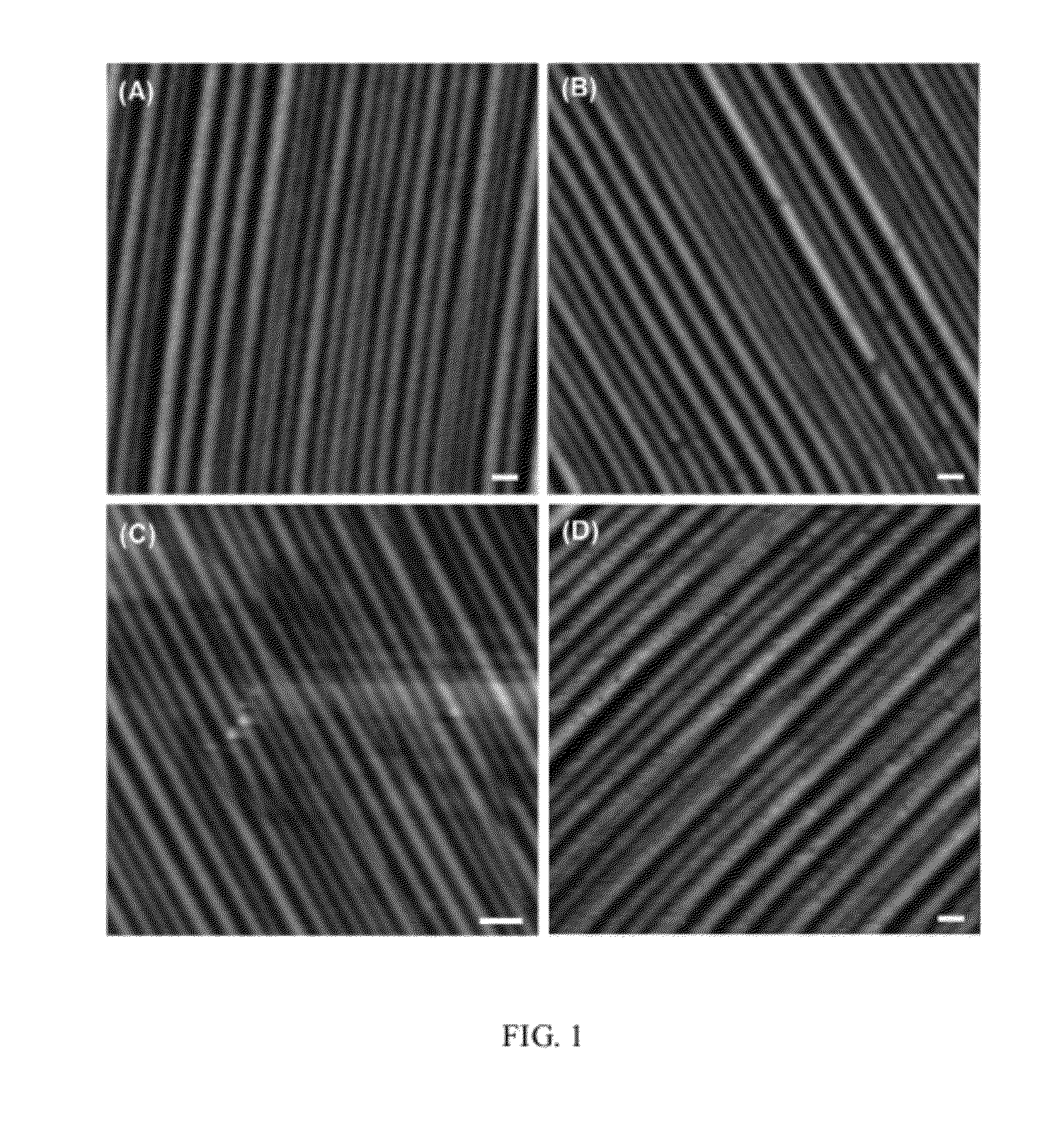
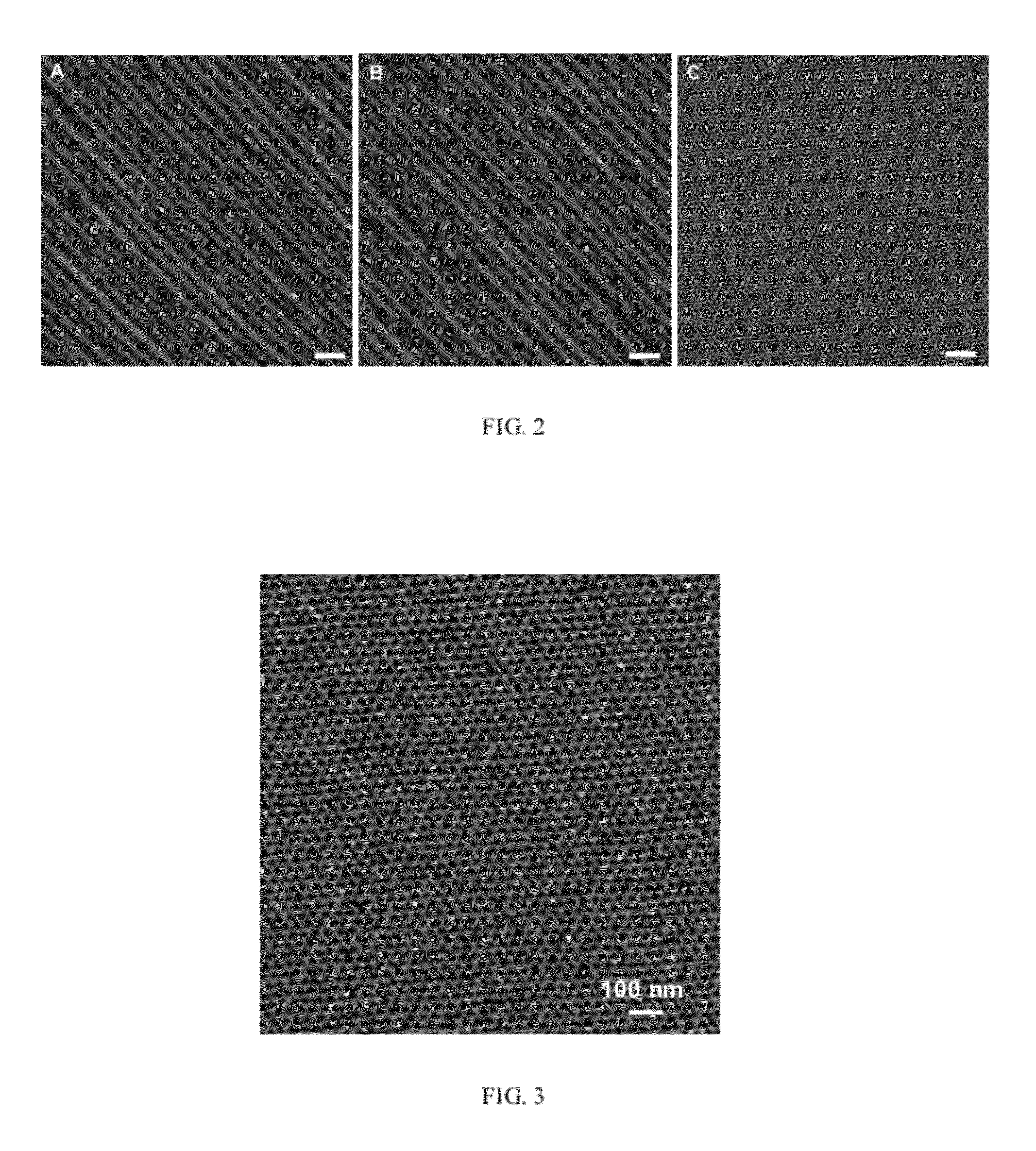
This approach allows for the fabrication of nanoporous templates or scaffolds with feature sizes as small as 5 nanometers over centimeter dimensions, achieving higher perfection in long-range order than the single crystal master, and enabling the use of roll-to-roll processing for high-density arrays on flexible polymeric replicas.

Problems solved by technology

However, the lateral ordering of the cylindrical microdomains was poor.
Processes to use alternate BCPs, like PS-b-P4VP or PS-b-PEO containing salt, have been developed that are simpler to employ and, more importantly, the interactions between the segments of the copolymer are very non-favorable, making defects energetically costly and, also, opening an avenue to smaller domain sizes and separation distances.
Although a beam of electrons may be focused to less than one nanometer in diameter, the resolution is limited by the interaction of the beam with the resist material and by the radius of gyration of the macromolecules, which is usually a few nanometers.
However, these approaches require expensive equipment and high-energy doses and are not suitable for non-conductive substrates, unless additional treatment is carried out.
Moreover, e-beam patterning is a time-consuming serial process not suitable for large areas.
Yet, NIL has the limitation that it requires a master that is used for the printing and, as of yet, it has not been possible to generate a perfect master with uniform, nanoscopic features sizes less than 20 nanometers over large lateral distances while maintaining the features in register.

Method used

the structure of the environmentally friendly knitted fabric provided by the present invention; figure 2 Flow chart of the yarn wrapping machine for environmentally friendly knitted fabrics and storage devices; image 3 Is the parameter map of the yarn covering machine
View more

Image

Smart Image Click on the blue labels to locate them in the text.
Viewing Examples
Smart Image
  • Self-assembly of block copolymers on topographically patterned polymeric substrates
  • Self-assembly of block copolymers on topographically patterned polymeric substrates
  • Self-assembly of block copolymers on topographically patterned polymeric substrates

Examples

Experimental program
Comparison scheme
Effect test

examples

Preparation of Polymeric Replicas

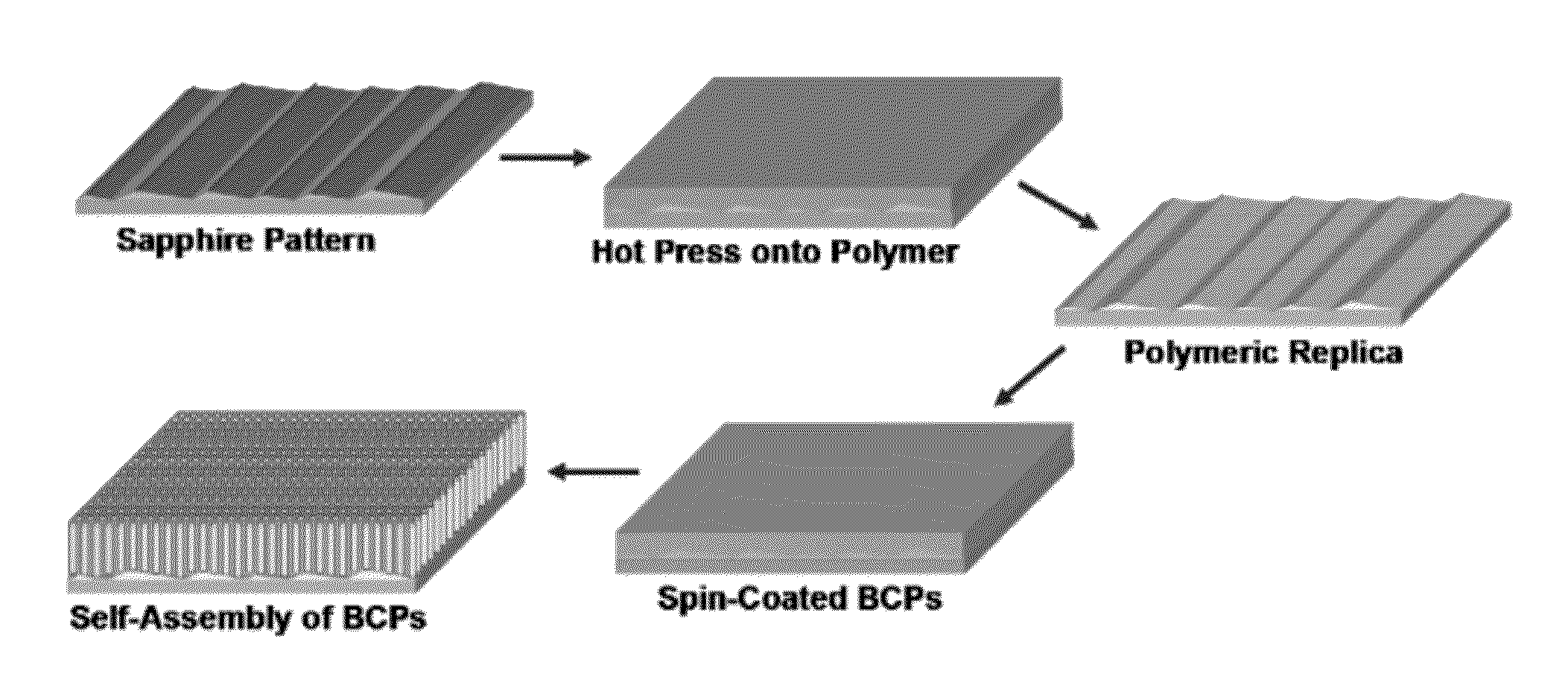
[0093]The following examples illustrate the formation of polymeric replicas of a topologically patterned crystalline surface using four different polymeric materials. Two of the replicas are formed by softening a pre-existing polymer layer while it is in contact with a crystalline master surface. A third replica is formed by creating a polymeric layer from a monomer mixture in contact with the crystalline master surface. And a fourth replica is formed by converting a precursor polymer in contact with the crystalline master surface to a product polymer in contact with the crystalline master surface.

[0094]Preparation of Miscut Sapphire Masters. Miscut C-Plane Sapphire (Miscut inclination angle of several degree towards the [1 100] direction) was annealed in air at 1373 K (1100° C.) for 10 hours. M-plane sapphire, which is not a miscut surface but is instead an unstable plane formed at temperatures over 1200° C., was formed by heating a sapphire wafer i...

the structure of the environmentally friendly knitted fabric provided by the present invention; figure 2 Flow chart of the yarn wrapping machine for environmentally friendly knitted fabrics and storage devices; image 3 Is the parameter map of the yarn covering machine
Login to View More

PUM

PropertyMeasurementUnit
areaaaaaaaaaaa
nearest-neighbor distanceaaaaaaaaaa
flexural modulusaaaaaaaaaa
Login to View More

Abstract

Highly-ordered block copolymer films are prepared by a method that includes forming a polymeric replica of a topographically patterned crystalline surface, forming a block copolymer film on the topographically patterned surface of the polymeric replica, and annealing the block copolymer film. The resulting structures can be used in a variety of different applications, including the fabrication of high density data storage media. The ability to use flexible polymers to form the polymeric replica facilitates industrial-scale processes utilizing the highly-ordered block copolymer films.

Description

CROSS REFERENCE TO RELATED APPLICATION[0001]This application claims the benefit of U.S. Provisional Patent Application Ser. Nos. 61 / 170,707 filed Apr. 20, 2009 and 61 / 098,253 filed Sep. 19, 2008, each of which is fully incorporated herein by reference.STATEMENT REGARDING FEDERALLY SPONSORED RESEARCH & DEVELOPMENT[0002]The U.S. Government has certain rights in this invention pursuant to Department of Energy, Office of Basic Energy Sciences Grant No. DE-FG02-96ER45612; Department of Energy, Office of Basic Energy Sciences Grant No. DE-AC02-05CH11231; and National Science Foundation MRSEC on Polymers Grant No. DMR-0213695.BACKGROUND OF THE INVENTION[0003]For nanotechnological applications, the use of thin films of materials is highly preferred. See, e.g., Segalman, R. A. Mater. Sci. Eng. 2005, R48, 191; Li, M.; Ober, C. K. Materials Today 2006, 9, 30; Hawker, C. J.; Russell, T. P. MRS Bulletin 2005, 30, 952; and Li, M.; Coenjarts, C. A.; Ober, C. K. Adv. Polym. Sci. 2005, 190, 183. It ...

Claims

the structure of the environmentally friendly knitted fabric provided by the present invention; figure 2 Flow chart of the yarn wrapping machine for environmentally friendly knitted fabrics and storage devices; image 3 Is the parameter map of the yarn covering machine
Login to View More

Application Information

Patent Timeline
no application Login to View More
Patent Type & Authority Patents(United States)
IPC IPC(8): B05D5/00B23B5/24B05D3/00
CPCB81C1/00031B82Y40/00G03F7/0002B82Y10/00B81C2201/0149Y10T428/24802Y10T428/249953
Inventor RUSSELL, THOMAS P.PARK, SOOJINLEE, DONG HYUNXU, TING
Owner UNIV OF MASSACHUSETTS
Features
  • R&D
  • Intellectual Property
  • Life Sciences
  • Materials
  • Tech Scout
Why Patsnap Eureka
  • Unparalleled Data Quality
  • Higher Quality Content
  • 60% Fewer Hallucinations
Social media
Patsnap Eureka Blog
Learn More