Communication system, signal processing method, signal processing device, and movable body
a communication system and signal processing technology, applied in the field of communication systems, can solve the problems of increasing calculation time and the number of calculations, and achieve the effect of shortening the calculation time for the fast fourier transformation
- Summary
- Abstract
- Description
- Claims
- Application Information
AI Technical Summary
Benefits of technology
Problems solved by technology
Method used
Image


Examples
first embodiment
3. First Embodiment
[0105]In the actual receiver 20, for example, the ADC 236 performs the sampling with 4.096 MHz, and the synchronization capturing section 240 performs the Fast Fourier Transform on the sampling value corresponding to several milliseconds obtained by the ADC 236 as an input data. However, in the following description, an example in which the Fast Fourier Transform is performed by using 16 pieces of input data is given for convenience of description.
[0106]FIG. 6 is an explanatory diagram illustrating a flow of the calculation of the Fast Fourier Transform in a case where the number of input data is 16. The input data x0 to x15 in the time domain is converted into the output data X0 to X15 in the frequency domain by the calculation shown in FIG. 6. In addition, the “W” in FIG. 6 is “exp(−j2π / 16)”.
[0107]On the other hand, as shown in FIGS. 7 to 10, it is possible to obtain the output data X0 to X15 by performing the Fast Fourier Transform divided into four.
[0108]FIGS....
second embodiment
4. Second Embodiment
[0138]As described above, the synchronization capturing section 240 according to the first embodiment includes one preprocessing execution section 310 and one memory 320. In contrast, a synchronization capturing section 240 according to a second embodiment includes two preprocessing execution sections 310 and two memories 320. With such a configuration, it is possible to shorten the processing time further.
[0139]4-1. Configuration of Synchronization Capturing Section
[0140]FIG. 14 is an explanatory diagram illustrating a configuration of the synchronization capturing section 241 according to the second embodiment. As shown in FIG. 14, the synchronization capturing section 241 according to the second embodiment includes: preprocessing execution sections 310A and 310B; memories 320A and 320B; an FFT 330; a memory 332; a readout address control section 334; an arithmetic control section 336; a PRN code generation section 340; an FFT 344; a memory 348; a multiplier 35...
third embodiment
5. Third Embodiment
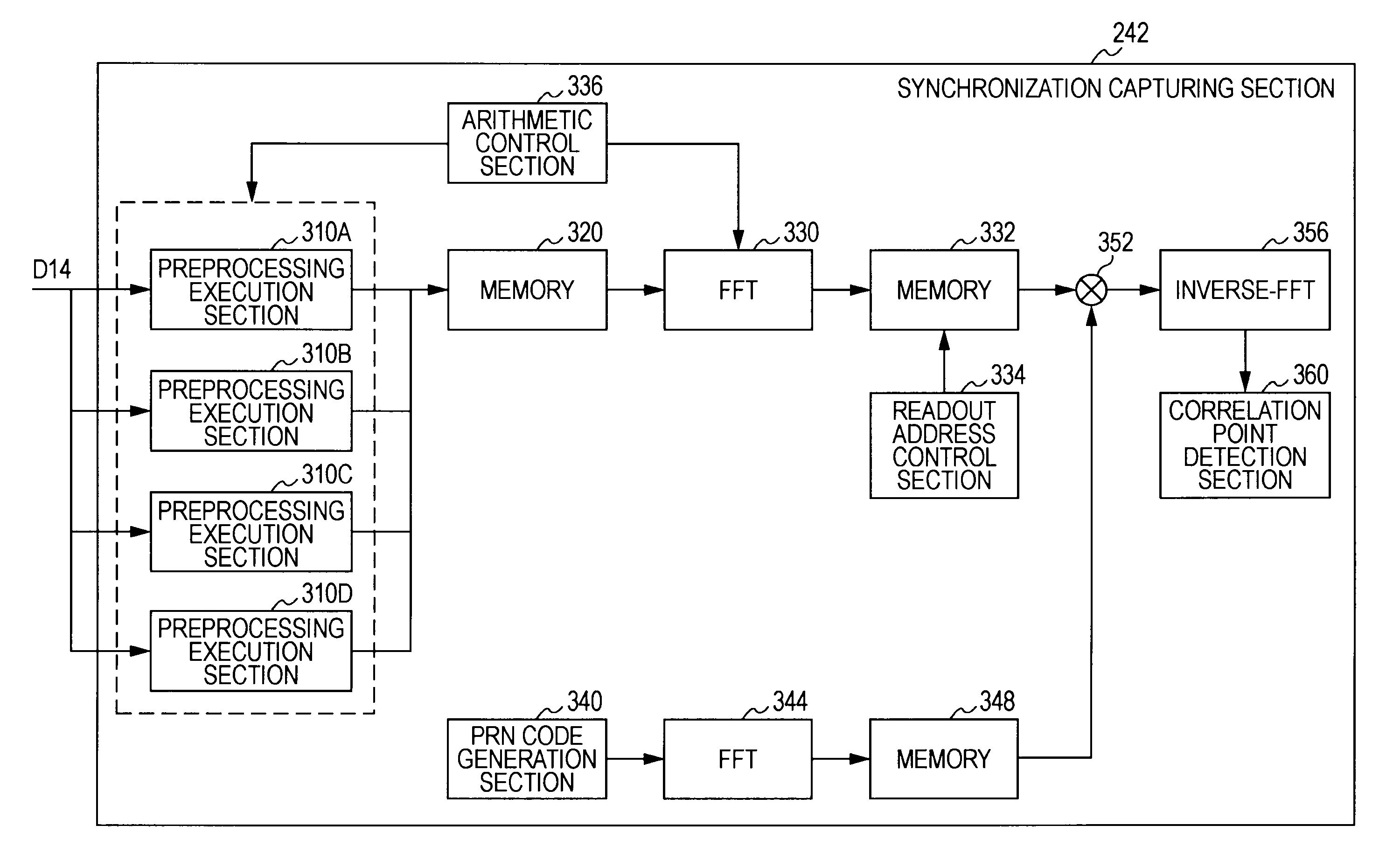
[0149]As described above, the synchronization capturing section 240 according to the first embodiment and the synchronization capturing section 241 according to the second embodiment includes the preprocessing execution section 310 and the memory 320 the number of which is the same. In contrast, in a synchronization capturing section 242 according to a third embodiment, the number of the memories 320 is made to be smaller than that in the preprocessing execution section 310. As a result, it is possible to reduce the circuit size.
[0150]5-1. Configuration of Synchronization Capturing Section
[0151]FIG. 16 is an explanatory diagram illustrating a configuration of the synchronization capturing section 242 according to the third embodiment. As shown in FIG. 16, the synchronization capturing section 242 according to the third embodiment includes: preprocessing execution sections 310A to 310D; a memory 320; an FFT 330; a memory 332; a readout address control section 334; ...
PUM
 Login to View More
 Abstract
Description
Claims
Application Information
 Login to View More
 - R&D
- Intellectual Property
- Life Sciences
- Materials
- Tech Scout
- Unparalleled Data Quality
- Higher Quality Content
- 60% Fewer Hallucinations
Browse by: Latest US Patents, China's latest patents, Technical Efficacy Thesaurus, Application Domain, Technology Topic, Popular Technical Reports.
© 2025 PatSnap. All rights reserved.Legal|Privacy policy|Modern Slavery Act Transparency Statement|Sitemap|About US| Contact US: help@patsnap.com