Check patentability & draft patents in minutes with Patsnap Eureka AI!

One-terminal reactive organopolysiloxane having a polyalkyleneoxide group at the omega-terminal and a method for the preparation thereof

a polyalkyleneoxide and organopolysiloxane technology, applied in the field of one-terminal reactive organopolysiloxane, can solve problems such as microphase separation and achieve good surface properties

Active Publication Date: 2013-03-26
SHIN ETSU CHEM CO LTD
View PDF16 Cites 4 Cited by
  • Summary
  • Abstract
  • Description
  • Claims
  • Application Information

AI Technical Summary

Benefits of technology

The resulting organopolysiloxane exhibits enhanced surface properties, enabling better microphase separation and durability, making it suitable for coatings and other applications requiring hydrophilic and hydrophobic segment interaction.

Problems solved by technology

However, these polyoxyalkylene compounds do not have a siloxane chain.
Therefore, in a case where the polysiloxane is used in paints, such a problem occurs that the hydrophilic group is covered with the siloxane segment, which prevents the microphase separation from occurring on a surface of a coating.

Method used

the structure of the environmentally friendly knitted fabric provided by the present invention; figure 2 Flow chart of the yarn wrapping machine for environmentally friendly knitted fabrics and storage devices; image 3 Is the parameter map of the yarn covering machine
View more

Image

Smart Image Click on the blue labels to locate them in the text.
Viewing Examples
Smart Image
  • One-terminal reactive organopolysiloxane having a polyalkyleneoxide group at the omega-terminal and a method for the preparation thereof
  • One-terminal reactive organopolysiloxane having a polyalkyleneoxide group at the omega-terminal and a method for the preparation thereof
  • One-terminal reactive organopolysiloxane having a polyalkyleneoxide group at the omega-terminal and a method for the preparation thereof

Examples

Experimental program
Comparison scheme
Effect test

example 1

(i) Synthesis of a polyalkyleneoxide-Modified silanol

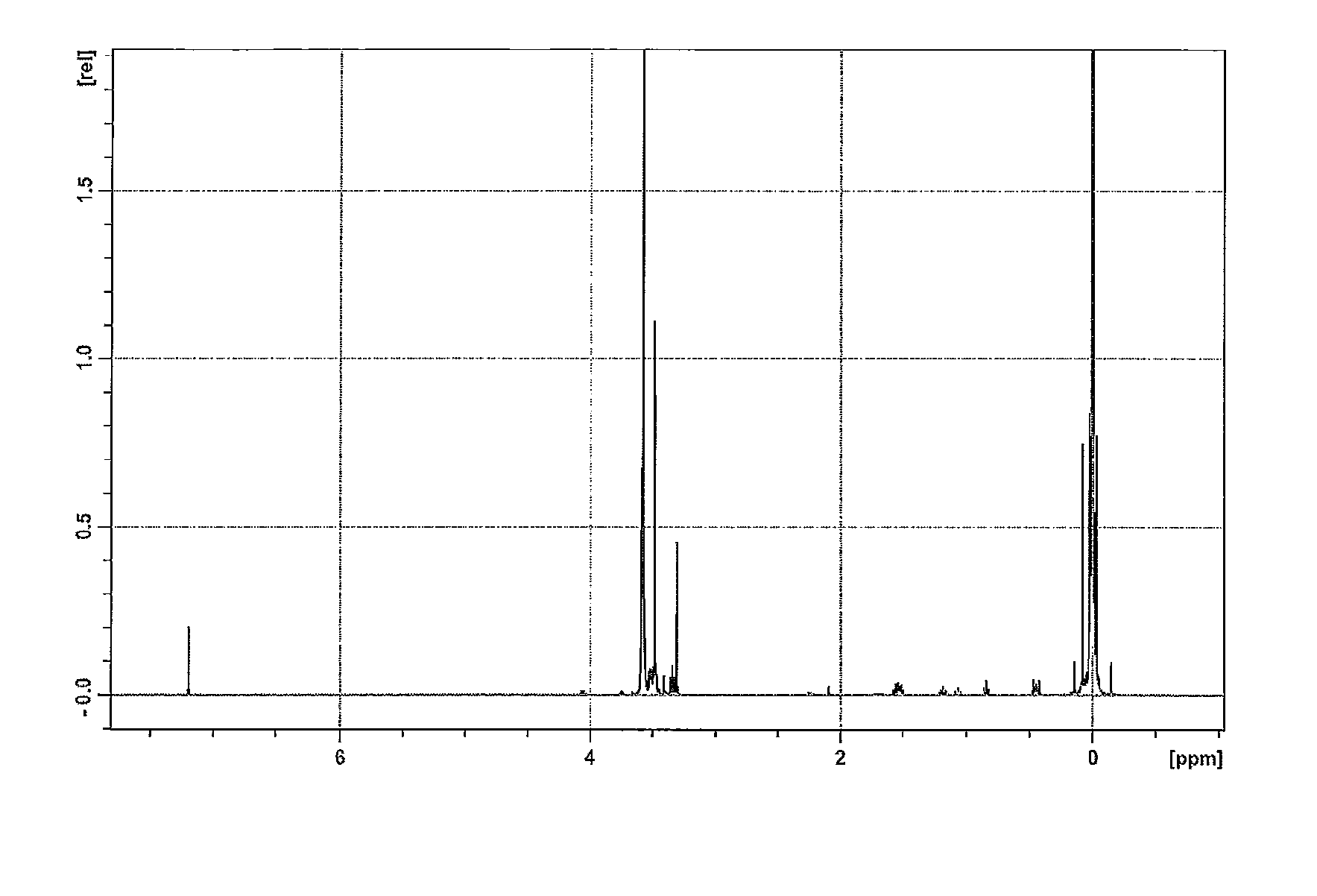
[0073]To a three-litter flask equipped with a stirrer, a thermometer, a reflux condenser, and a dropping funnel were added 400 g of ω-methoxy polyethyleneglycol monoallylether (Mw 550), 974 g of 1,1,3,3-tetramethyldisiloxane (molar ratio of Si—H group / Si-Vi group, 20), 500 g of a toluene and 0.48 g of a toluene solution of a tetramethyldivinyldisiloxane-coordinated zero-valent platinum catalyst containing 0.5% by weight of platinum metal (6 ppm of platinum metal), and heated at 70 degrees C. for 5 hours to react. The reaction mixture was subjected to stripping to remove volatiles to obtain 484 g of a light brown viscous liquid product. The absorption (2,125cm−1) by the Si—H bond of the product was confirmed by an infrared spectrophotometer. The average molecular weight was 690, as determined by the amount of the produced hydrogen gas.

[0074]To a five-hundred milliliter flask equipped with a thermometer, a tubular condenser and a st...

example 2

[0088]The silanol compound represented by the afore-mentioned formula (13) was prepared as in Example 1, and subjected to polymerization with hexacyclotrisiloxane. After the polymerization, 0.11 g of butylated hydroxytoluene (BHT), 24.0 g of pyridine and 82 g of toluene were added to the reaction mixture with stirring, and cooled in an ice bath. 45.3 Grams of methacryloyl propyl dimethyl chlorosilane (0.21 mol) was added dropwise. Then, the reaction mixture was heated at 70 degrees C. for 2 hours with stirring to cap the end. 20 Grams of methanol was added to deactivate the remaining chlorosilane. Then, the reaction mixture was subjected to stripping at 100 degrees C. / 10 mm Hg to remove the toluene and slight amounts of low volatiles, and filtrated with activated carbon to remove the polymerization catalyst to obtain a transparent, light brown oil product. The amount of the product was 581 g and the yield based on the silanol compound represented by the formula (13) was 98.0%. The p...

the structure of the environmentally friendly knitted fabric provided by the present invention; figure 2 Flow chart of the yarn wrapping machine for environmentally friendly knitted fabrics and storage devices; image 3 Is the parameter map of the yarn covering machine
Login to View More

PUM

PropertyMeasurementUnit
weightaaaaaaaaaa
weightaaaaaaaaaa
weightaaaaaaaaaa
Login to View More

Abstract

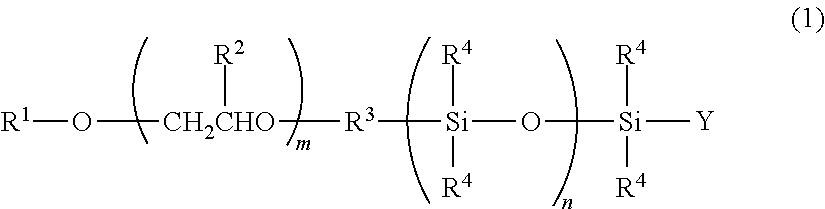
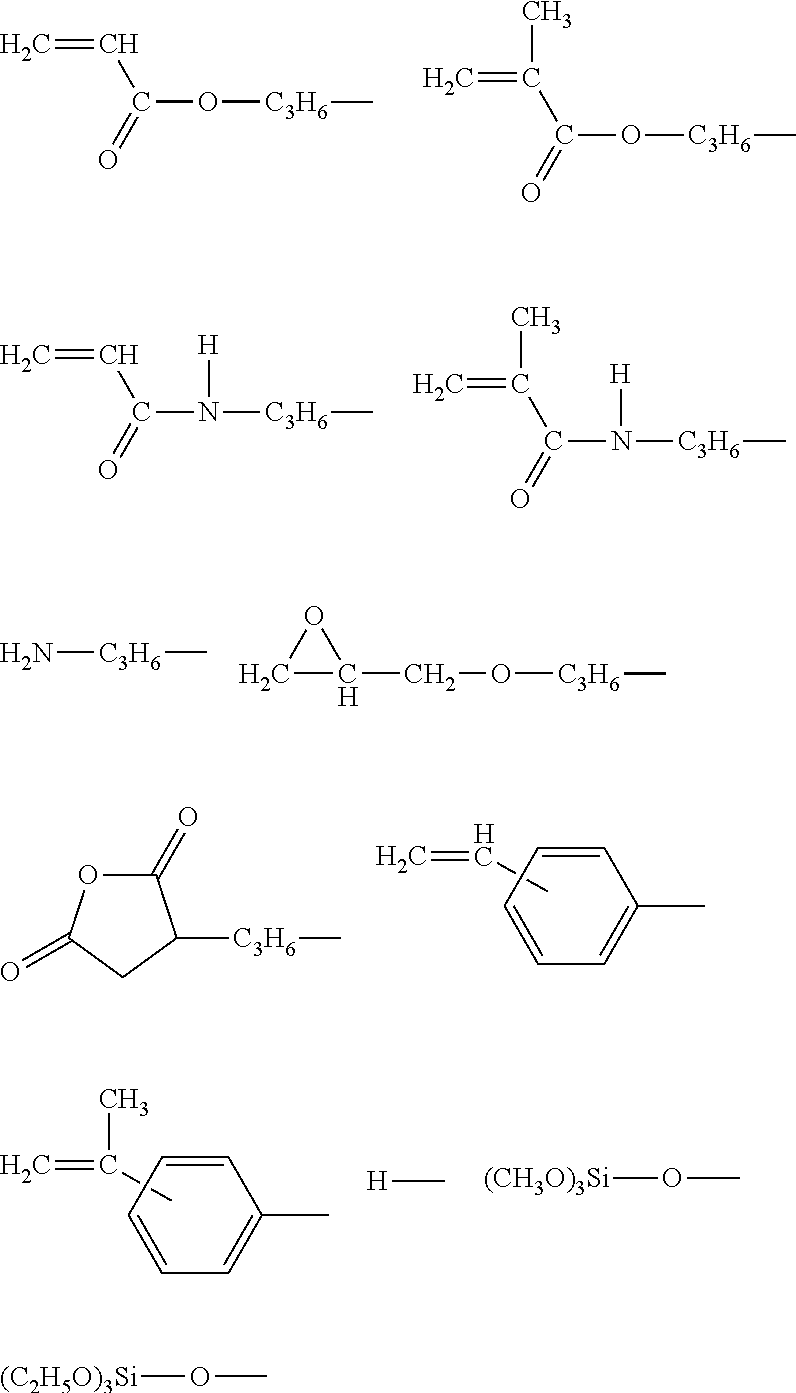
The present invention relates to a one-terminal reactive organopolysiloxane further having a hydrophilic polyalkyleneoxide group at the omega-terminal and a method for its production. Thus, the present invention provides a one-terminal reactive organopolysiloxane which is characterized by having a polyalkyleneoxide at the omega-terminal, and composed of blocks arranged in the following order:A-B—C—Ywherein A is a monovalent polyalkyleneoxide group having an alkoxy group at a terminal, B is a substituted or unsubstituted divalent alkylene group, C is a divalent polysiloxane group, Y is a monovalent group selected from the group consisting of an alkyl group having a reactive group, a hydrogen atom, a styryl group and a trialkoxysiloxy group, and provides a method for the preparation thereof.

Description

CROSS REFERENCE[0001]This application claims the benefits of Japanese Patent Application No. 2009-221036 filed on Sep. 25, 2009, the contents of which are herein incorporated by reference.FIELD OF THE INVENTION[0002]The present invention relates to a one-terminal reactive organopolysiloxane further having a hydrophilic polyalkyleneoxide group at the omega-terminal and a method for its production.BACKGROUND OF THE INVENTION[0003]It is known that an organopolysiloxane having a (meth)acryl group at one terminal is synthesized by ring-opening polymerization of hexamethylcyclotrisiloxane. For example, Japanese Patent Application Laid-Open No. Sho-59-78236 describes a method for the synthesis of an organopolysiloxane having a (meth)acryl group at one terminal by subjecting hexamethylcyclotrisiloxane to ring-opening polymerization, wherein lithium trimethylsilanolate is used as a polymerization initiator, and terminating the polymerization by 3-(2-methacryloxy ethoxy)propyl dimethyl chloro...

Claims

the structure of the environmentally friendly knitted fabric provided by the present invention; figure 2 Flow chart of the yarn wrapping machine for environmentally friendly knitted fabrics and storage devices; image 3 Is the parameter map of the yarn covering machine
Login to View More

Application Information

Patent Timeline
no application Login to View More
Patent Type & Authority Patents(United States)
IPC IPC(8): C07F7/00
CPCC08G77/16C08G77/38C08G77/46
Inventor HAGIWARA, MAMORU
Owner SHIN ETSU CHEM CO LTD
Features
  • R&D
  • Intellectual Property
  • Life Sciences
  • Materials
  • Tech Scout
Why Patsnap Eureka
  • Unparalleled Data Quality
  • Higher Quality Content
  • 60% Fewer Hallucinations
Social media
Patsnap Eureka Blog
Learn More