Apparatus for detecting nucleic acids using bead and nanopore
a technology of nucleic acids and nanopores, which is applied in the field of methods and apparatus for detecting nucleic acids using nanopores, can solve the problems of complicated production process and difficult manufacturing of nanostructures
- Summary
- Abstract
- Description
- Claims
- Application Information
AI Technical Summary
Problems solved by technology
Method used
Image


Examples
experiment 1
Determination of the Change of Current by the Nanopore Detection Unit without Bead
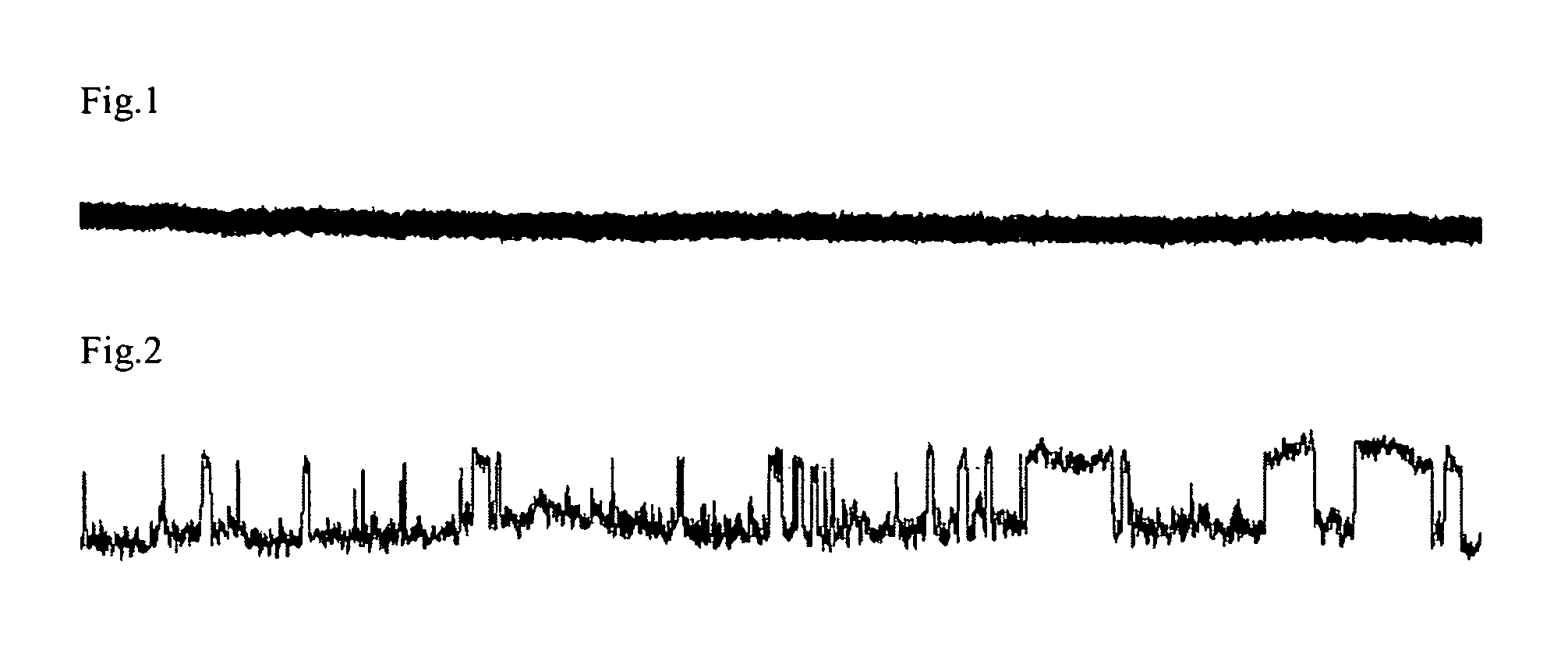
[0047]A current was measured through the nanopore detection unit containing the arrays of nanopores with a diameter of 100 nm using only the conductive fluid medium without bead. The conductive fluid medium was 1 M KCl and a voltage of 300 mV was applied to the nanopore detection unit. FIG. 1 shows a waveform diagram of current measured when only the conductivity fluid is passed through the nanopore detection unit without bead. As shown in FIG. 1, it could be seen that there was little current change when only the conductive fluid was used without bead.
experiment 2
[0048]Determination of the Change of Current by the Nanopore Detection Unit with Bead
[0049]A current was measured through the nanopore detection unit containing the arrays of nanopores with a diameter of 100 nm using the conductive fluid medium to which beads were added. The beads were streptavidin-Au conjugates with a diameter of 5 nm, the conductive fluid medium was 1 M KCl to which beads were added with a density of 5 ug / ml, and a voltage of 300 mV was applied to the nanopore detection unit. FIG. 2 presents a waveform diagram of current measured when the conductivity fluid containing the beads is passed through the nanopore detection unit. As presented in FIG. 2, it could be seen that there was a remarkable change in current when the conductive fluid with beads was used.
example
Detection of Bead-Bonded Nucleic Acid Fragments
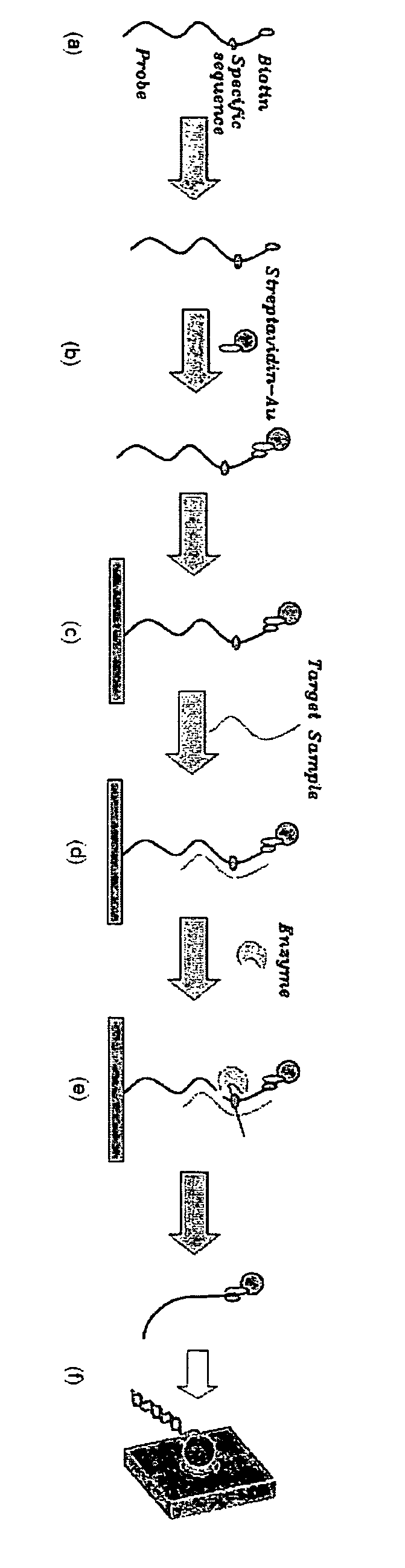
[0050]In Experiments 1 and 2, it was confirmed that the beads could be detected by the nanopore detection unit containing nanopores with a diameter of 100 nm. To detect the sample of 1 kps or less, more preferably nucleic acid fragments of PCR products of 70 to 300 bps through the nanopore detection unit containing nanopores with a diameter of 100 nm, using the method illustrated in FIG. 3 and the apparatus illustrated in FIG. 4, the following steps were carried out.
[0051]a. Step 1: Preparation of Nucleic Acid Probe with the Structure which Includes the Sequence Cleavable by a Specific Enzyme and Facilitates the Attachment of Bead
[0052]The target nucleic acid was first decided as E. coli BL21 16s RNA. Next, there was prepared, as the nucleic acid probe, 80 uM of 60 mer oligonucleotide including 25 mer oligonucleotide probe (AAAGTACTTTCAACGGGGAGGAAGG) which is hybridized with the nucleic acid fragment together with 1 to 3 bases mismatche...
PUM
| Property | Measurement | Unit |
|---|---|---|
| diameter | aaaaa | aaaaa |
| diameter | aaaaa | aaaaa |
| diameter | aaaaa | aaaaa |
Abstract
Description
Claims
Application Information
 Login to View More
 - R&D
- Intellectual Property
- Life Sciences
- Materials
- Tech Scout
- Unparalleled Data Quality
- Higher Quality Content
- 60% Fewer Hallucinations
Browse by: Latest US Patents, China's latest patents, Technical Efficacy Thesaurus, Application Domain, Technology Topic, Popular Technical Reports.
© 2025 PatSnap. All rights reserved.Legal|Privacy policy|Modern Slavery Act Transparency Statement|Sitemap|About US| Contact US: help@patsnap.com