Method for detecting an endogenous biomolecule
a biomolecule and endogenous technology, applied in the field of endogenous biomolecule detection, can solve the problems of not showing when, where, and how a substance in the body is associated with a given disease, and achieve the effect of significantly reducing the disappearance of ubisemiquinone and reducing the ubisemiquinone radical with tim
- Summary
- Abstract
- Description
- Claims
- Application Information
AI Technical Summary
Benefits of technology
Problems solved by technology
Method used
Image

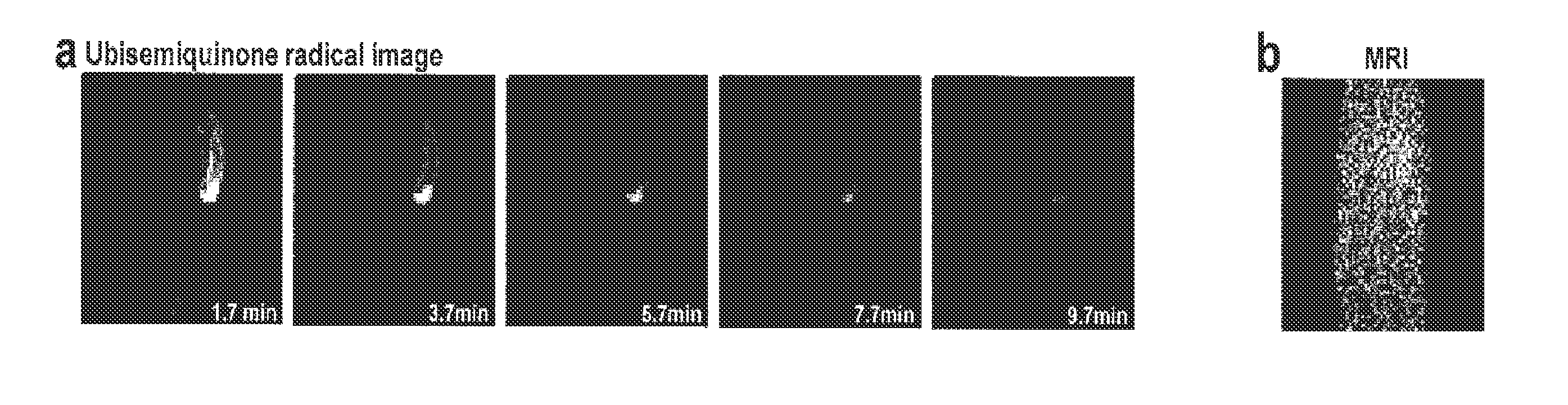
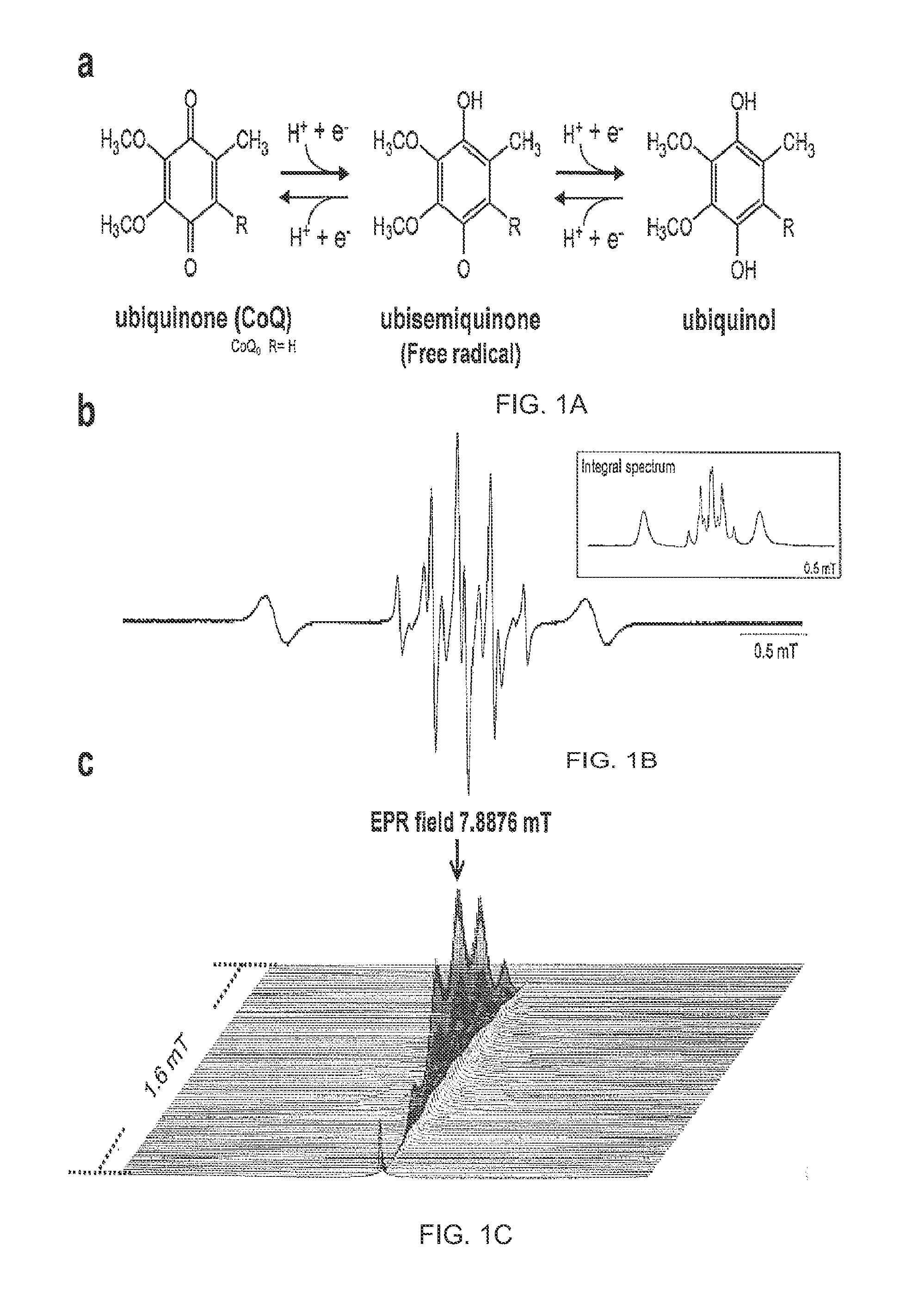

Examples
example 1
[0049]Phantom Experiment
[0050]A phantom consisting of 7 tubes were used in which each tube (4.7 mm id) contained 0, 0.5, 1, 2, 4, 6, or 8 mM aqueous ubiquinone solution (pH11.8) (See FIG. 3a). In the ubiquinone / NADH phantom experiment, both reagents are dissolved in the phosphate buffer (PBS)(pH7.4). An NADH solution (final concentration: 50 mM) was added into the ubiquinone solution (Final concentration: 10 mM, followed by OMRI imaging. The results are shown in FIG. 4.
[0051]The OMRI experiments were performed using a custom-made human whole-body magnet (79 cm diameter; 125cm length) (the Philips Research Laboratories in Hamburg) operating in a field-cycle mode so as to avoid excess power during the EPR cycle. The EPR B0 was at 8.1 mT, the NMR B0 was 15 mT. The resonator assembly for the mice experiments was tuned to 625 kHz and with a bandwidth of 80 kHz; it consists of the NMR transmit saddle coil (25 cm diameter, 23 cm length) and a solenoidal receiving coil (2.5 cm diameter, 60 ...
example 2
[0054]in vivo OMRI imaging
[0055]C57BL6 mice (female, 5 weeks of age) were purchased from Nippon SLC, Inc., (Hamamatsu, Japan) and were acclimated for one week before the experiment. The mice were housed 5 mice per cage in a temperature- and circadian-rhythm-controlled room with uninterrupted water and feeding; they were 6 to 8 weeks of age and had body weights, 20 to 30 g at the time of the experiment. All procedures and animal care were approved by the Committee on Ethics of Animal Experiments, Faculty of Pharmaceutical Sciences, Kyushu University, and were conducted according to the Guidelines for Animal Experiments of the Faculty of Pharmaceutical Sciences, Kyushu University.
[0056]Mice were anesthetized with (2 g / kg) urethane and were immobilized with the stomach side down to a holder using a dermatological adhesive tape. The body temperature of mice during the experiment was 37±1° C. The mice were transferred to the resonator to start an OMRI measurement. The OMRI imaging of the...
example 3
[0057]Molecular Imaging of Flavin Adenine Dinucleotide (FAD) by OMRI
[0058]Flavin adenine dinucleotide (FAD), an in vivo electron carrier, is a cofactor needed in an oxidation-reduction reaction in several metabolic reactions. FADH2 is an energy carrier; a reduced coenzyme is used as a substrate for mitochondrial oxidative phosphorylation. Such FAD was dissolved in PBS (pH7.4) to prepare aqueous FAD solutions thereof at various concentrations Then, after the addition of an aqueous NADH solution of a concentration equal to that of FAD, OMRI imaging was performed. The results are shown in FIG. 6.
PUM
| Property | Measurement | Unit |
|---|---|---|
| diameter | aaaaa | aaaaa |
| length | aaaaa | aaaaa |
| diameter | aaaaa | aaaaa |
Abstract
Description
Claims
Application Information
 Login to View More
 - R&D
- Intellectual Property
- Life Sciences
- Materials
- Tech Scout
- Unparalleled Data Quality
- Higher Quality Content
- 60% Fewer Hallucinations
Browse by: Latest US Patents, China's latest patents, Technical Efficacy Thesaurus, Application Domain, Technology Topic, Popular Technical Reports.
© 2025 PatSnap. All rights reserved.Legal|Privacy policy|Modern Slavery Act Transparency Statement|Sitemap|About US| Contact US: help@patsnap.com